The Wild Swans
My name is Elisa, and I remember a time when my world was filled with the scent of roses and the laughter of my eleven older brothers. We lived in a grand castle where the sun always seemed to shine, our days a blur of games in the royal gardens and stories told by our father, the King. My brothers were brave and kind, and I was their cherished only sister, their little shadow as we raced through the corridors and explored the vast lands surrounding our home. They taught me to ride, to read the stars, and to find courage even when I was small. But a cold wind began to blow through our happy home the day our father brought home a new queen, a woman with eyes as hard as glass and a heart full of shadows. She did not love us, and her jealousy grew like a poison vine around our lives, choking the warmth from the castle stones. I would see her watching us from the windows, her smile thin and cruel, and a shiver of dread would run down my spine. I didn't know it then, but our happy world was about to be shattered by a terrible magic, a story that would come to be known as the tale of The Wild Swans.
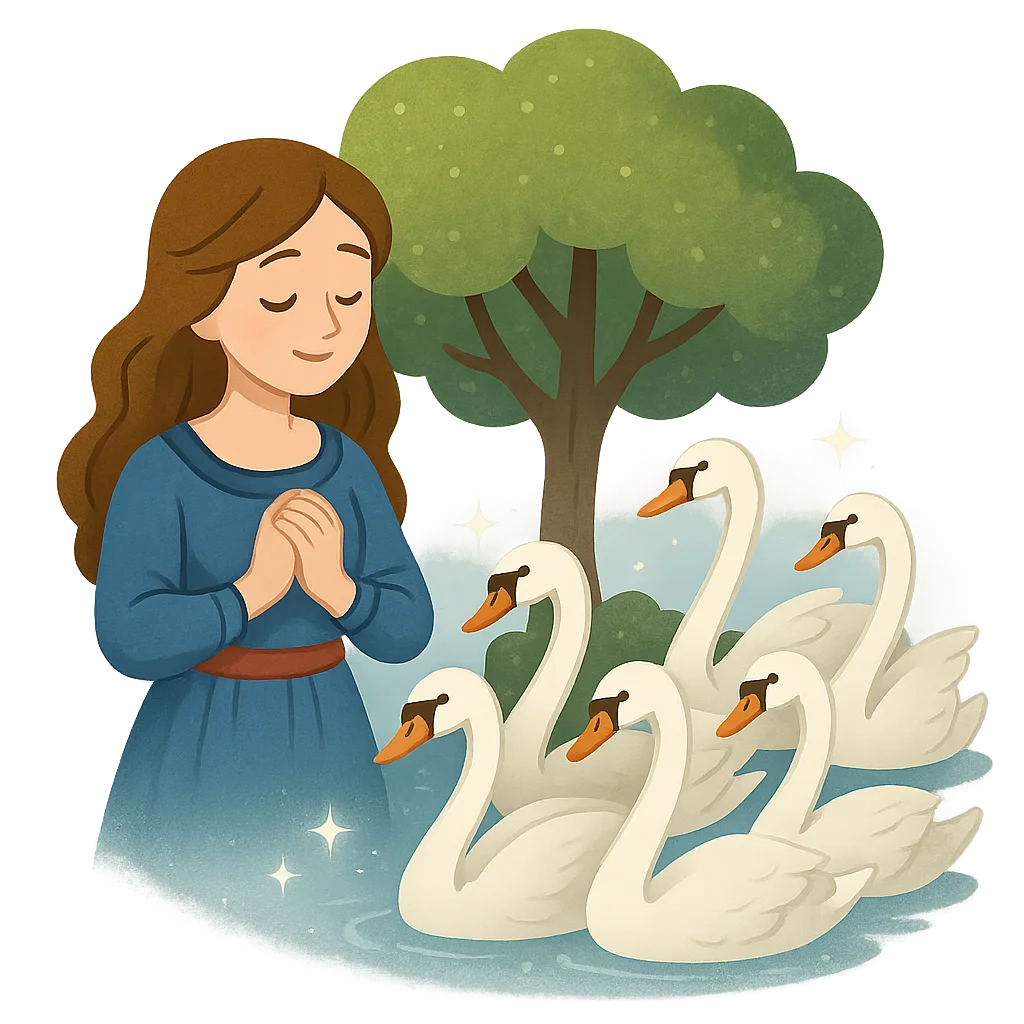
The new queen's hatred was a storm that finally broke. One morning, she marched into the courtyard where my brothers were preparing for their lessons. With a wicked chant and a wave of her hand, a foul-smelling green smoke enveloped them. When it cleared, my brothers were gone. In their place stood eleven magnificent white swans. With a great, heartbreaking cry of sorrow, they were forced to take flight, their powerful wings beating against the air as they flew away from the castle, their human voices lost forever. Not content with this devastating cruelty, she turned on me. She tried to make me ugly, smearing my face with foul potions, but my heart was too pure for her magic to truly take hold. Frustrated, she stained my face with dark walnut juice, tangled my hair with burrs, and dressed me in coarse rags. She presented me to my father, convincing him I was a worthless runaway who had disgraced the family name. Heartbroken and betrayed, he cast me out of my own home, banishing me to wander alone in the dark, wild forest. My heart ached with the loss of my brothers and the life I once knew, but as I huddled in the hollow of an old tree, a tiny spark of hope refused to die. I knew, somehow, I had to find them and break this terrible curse.
After years of searching and surviving on berries and roots, I finally found my brothers living by the sea. They could only become human for the short time between sunset and sunrise, and they told me of their sad life, flying as swans all day, endlessly migrating across the vast ocean. That night, exhausted and full of sorrow, I had a dream where a beautiful fairy, the Fata Morgana, appeared to me in a shimmer of light. She told me how to break the curse. The task seemed impossible: I had to find stinging nettles that grew in graveyards, crush them into flax with my bare feet, and then spin and weave that flax into eleven long-sleeved shirts. The most difficult part of the task was the vow I had to take: from the moment I began until the last shirt was finished, I could not speak a single word. If I uttered even a whisper, my brothers would instantly perish. I awoke with a renewed purpose. I found a graveyard overgrown with the fiery nettles and set to work. The pain was immense, covering my hands and feet in agonizing blisters, but the thought of saving my brothers gave me a strength I never knew I possessed. I worked in silence, my heart full of love and determination, weaving their freedom one painful thread at a time.
One day, while I was gathering nettles in the forest, a handsome young king who was out hunting found me. He was captivated by my silent grace and, despite my ragged appearance and blistered hands, he saw the goodness in my eyes. He took me back to his magnificent castle and, in time, made me his queen. I grew to love him dearly, but I could not speak to tell him my story or explain my strange, secret task. I continued my work in a hidden room, but the archbishop at the court grew suspicious. He saw my nightly visits to the graveyard to gather more nettles and was convinced I was practicing dark arts. "She is a witch!" he whispered to the king and the court. "She consorts with evil spirits!". The king tried to protect me, believing in my innocence, but the people were swayed by the archbishop's powerful words. Soon, the entire kingdom turned against me. I was condemned to be burned at the stake. Even as the guards led me from my prison cell to the public square, I clutched the nearly finished shirts, my fingers working frantically on the last sleeve of the eleventh one. My heart hammered with fear, not for myself, but for my brothers. I was so close, yet it seemed I was about to fail.
Just as the flames were about to be lit at the base of the pyre, a rush of wings filled the air. My eleven swan brothers swooped down from the sky, landing in a protective circle around me. It was now or never. I summoned all my remaining strength and quickly threw the nettle shirts over them. In a flash of brilliant light, ten of them stood before the astonished crowd as handsome princes once more. The youngest, however, was left with a single swan's wing instead of an arm, as I hadn't had time to finish the last sleeve of his shirt. My vow of silence was finally over. I could speak! I explained everything to the king and the crowd, who wept to hear of my suffering and my sacrifice. This story of sisterly love and perseverance was captured forever by the great Danish storyteller, Hans Christian Andersen, on November 2nd, 1838. For generations, it has inspired ballets, films, and art, teaching us that true courage isn't about shouting, but about quiet endurance. It reminds us that even when we feel voiceless, an act of selfless love has the power to break the most terrible of spells and bring our loved ones home.
Reading Comprehension Questions
Click to see answer