English
 For Schools
 For Homeschool

The Tortoise of Time
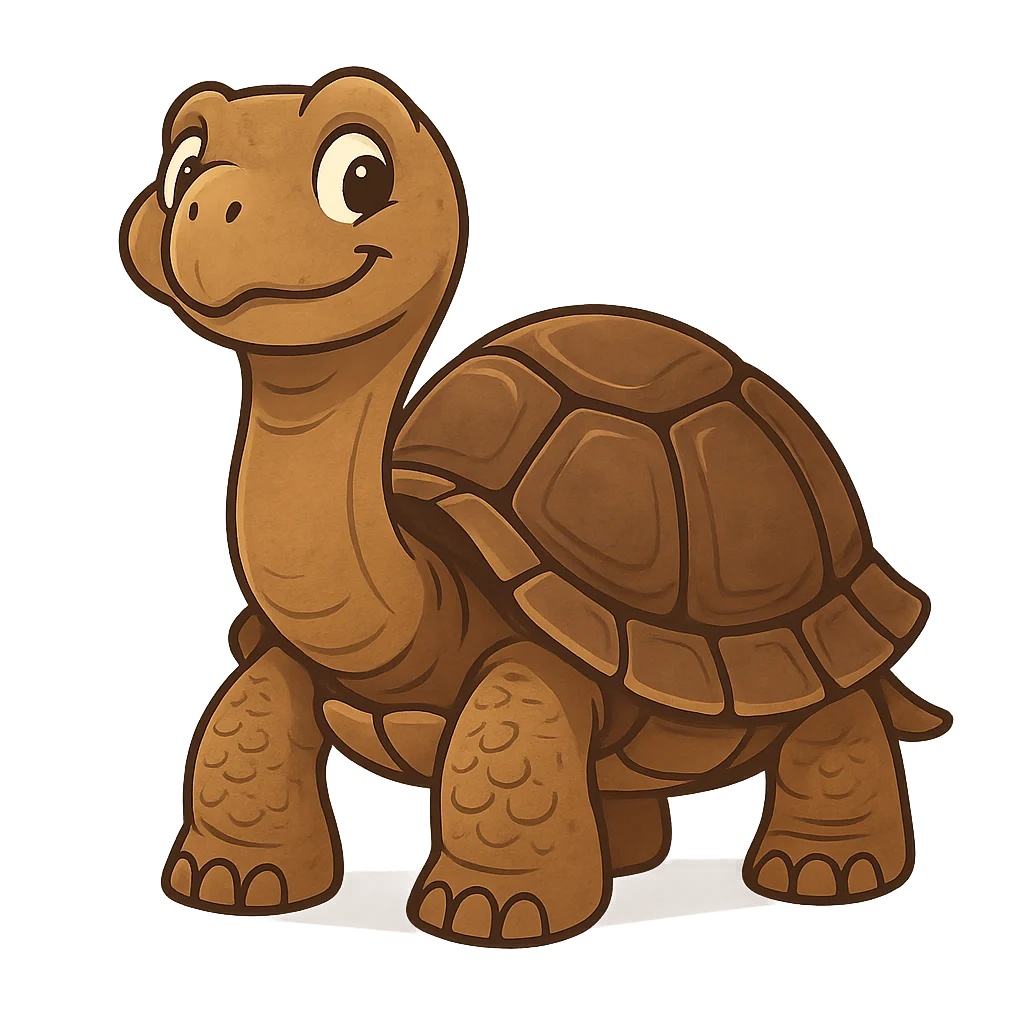
Hello. I am a Galápagos Tortoise, and my story is carved into the very rings of my shell. As one of the largest and oldest reptiles on Earth, I am a living piece of history. My journey began long ago, not with a roar, but with a quiet crackle. I pushed my way out of a leathery egg that my mother had carefully buried in the warm, dark volcanic soil of my island home. In those first few years, the world was a place of immense wonder and constant caution. I was small then, my shell no bigger than a stone, and I was vulnerable. My days were spent learning the landscape, finding the most tender grasses and the juiciest cactus pads to eat. I also learned to be invisible, hiding from the sharp eyes of the Galápagos hawk that soared in the blue skies above. My kind has roamed these islands for millions of years, thriving in this isolated world long before the first human ships ever appeared on the horizon. We are the ancient gardeners and keepers of this land, a lineage that has witnessed the slow and steady march of time.
My ancestors were remarkable travelers. Millions of years ago, they arrived on these islands, most likely floating on rafts of vegetation all the way from the South American mainland. They found a world unlike any other, a scattered collection of volcanic islands where life had evolved in unique and wonderful ways. Each island was its own separate kingdom, with its own distinct challenges and resources, and so we adapted. I carry these adaptations in my very bones. My enormous, heavy shell, my carapace, is my fortress. For some of my cousins, this shell is domed like a helmet, perfect for pushing through the dense, low-lying vegetation on their home islands. For others, like me, the front of the shell flares upward, like a saddle. This shape allows me to stretch my long neck high to reach the taller cactus that grows here. It is a perfect design for my world. But perhaps my most incredible adaptation is my slow metabolism. My body works so efficiently that I can survive for up to a year without a single bite of food or a drop of water. In a place where rain can be unpredictable and food scarce, this ability is the secret to my long life.
For centuries, my world was one of wind, rock, and sea. But then, new arrivals came. Starting in the 17th century, great wooden ships appeared, bringing pirates and whalers from distant lands. They saw my relatives not as ancient wonders, but as a convenient source of fresh food for their long and arduous voyages. They could keep us alive in the holds of their ships for months. It was a difficult time for my kind. Then, on September 15th, 1835, a different kind of visitor arrived. His name was Charles Darwin, a young naturalist aboard a ship called the HMS Beagle. He did not see us as food; he saw us as a puzzle. He walked carefully among us, his eyes filled with curiosity. He meticulously observed how my cousins on one island had domed shells, while those on another had saddle-shaped shells like mine. He wondered why we were so different, yet so clearly related. These observations, made right here on my island home, became a key piece of evidence for his world-changing idea of evolution by natural selection. Unfortunately, the changes brought by humans did not end there. Later, invasive species like rats and goats were introduced to our islands, competing with us for food and preying on our vulnerable eggs, making our survival even more challenging.
After centuries of decline, the 20th century brought a new kind of change: hope. People around the world began to realize that my species, a living link to a prehistoric past, was in danger of disappearing forever. A great effort began to protect us. In 1959, our home was officially protected with the creation of the Galápagos National Park to protect the unique ecosystems and biodiversity of the Galápagos Islands, including the Galápagos Tortoises. This was a promise to preserve the unique life that Darwin had studied. Since then, dedicated scientists and park rangers have worked tirelessly to give us a future. They became the guardians of our nests, protecting them from predators so that a new generation could hatch safely. They established special breeding centers, raising tiny hatchlings like I once was, giving them a head start in life until their shells were hard and they were strong enough to survive in the wild. These conservation efforts also focused on restoring the islands themselves, removing the invasive species that had caused so much harm. Their work is a powerful reminder that while humans can cause damage, they also possess an incredible capacity to heal and protect the natural world.
As I move slowly through my day, I carry more than just my shell on my back; I carry the story of my island. I have lived for a very long time, and I understand my role in this world. I am what scientists call an 'ecosystem engineer.' My existence actively shapes the world around me. As I graze, I clear paths through the vegetation, creating open spaces where new plants can sprout. When I eat fruits and cactus pads, I travel across the island, spreading the seeds far and wide, helping to plant the forests of the future. I am a symbol of resilience, a creature that has survived volcanic eruptions, changing climates, and the arrival of new species. My long life, which often lasts for more than 100 years, is a testament to the slow, steady, and enduring power of nature. My story is a living reminder of how precious and unique life is, and why the wild places of our world are so profoundly important to protect.
Activities
Take a Quiz
Test what you learned with a fun quiz!
Get creative with colors!
Print a coloring book page of this topic.