English
 For Schools
 For Homeschool

A Gorilla's Tale: My Life in the Forest
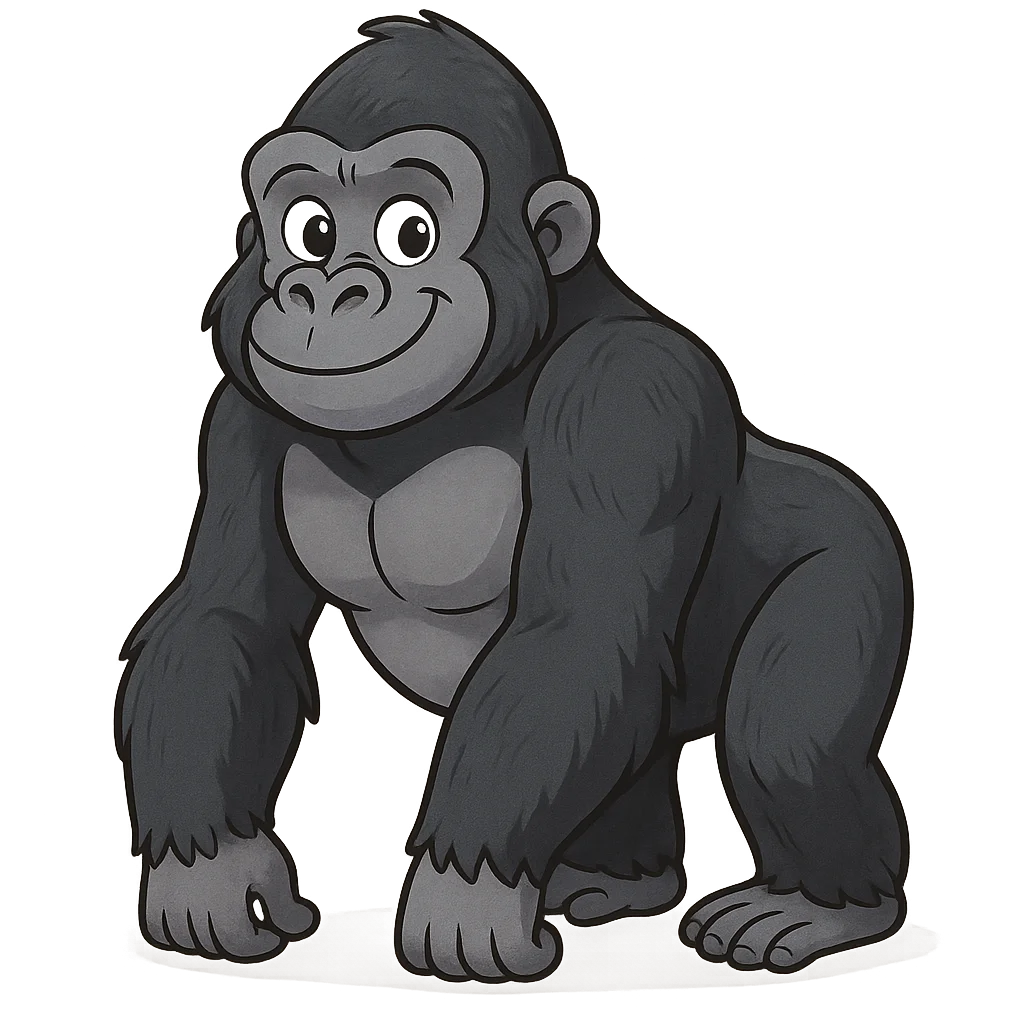
Hello. I am a Western Lowland Gorilla, one of the world's great apes, and I want to share the story of my life with you. My home is deep within the dense, humid rainforests of Central Africa, a world of towering trees, vibrant green leaves, and the constant hum of life. I live with my family, which we call a troop. We are a close-knit group, led by a magnificent silverback—our father and protector. You might wonder about his name. As a male gorilla grows older and stronger, the hair on his back turns a striking silver, a clear sign to everyone of his maturity and his role as our leader. He guides us, keeps us safe, and holds our family together with his calm wisdom. Each day for me begins in a cozy nest I build for myself high in the trees or on the forest floor. Using bent branches and soft leaves, I create a new bed every single evening. When the morning sun filters through the canopy, I wake and join my family to begin our most important activity: foraging for food. We spend hours searching for our favorite meals. I love the tender pith of certain stems, the crispness of fresh leaves, and most of all, the sweet burst of juicy fruits. We move peacefully through our forest home, munching and socializing as we go.
My youth was a time of exploration and learning, and my mother was my greatest teacher. She, along with my other relatives in the troop, taught me everything I needed to know to survive and thrive in the rainforest. I watched her carefully, learning how to identify the most nutritious plants and, just as importantly, which ones were harmful and should be avoided. She showed me how to strip leaves from a thorny branch without getting pricked and how to find the ripest, most delicious fruits. Beyond finding food, I learned the complex language of my family. We gorillas are quite expressive, and we communicate using more than 25 distinct sounds. I learned the meaning of a soft, rumbling sound, which often means we are content, and the sharp, loud hoot that can signal a warning. You have probably heard about our famous chest-beating. It’s a powerful display, but it doesn't always mean we are angry. We might beat our chests to show our excitement, to warn another troop that they are getting too close, or simply to send a message across the dense forest where it’s hard to see very far. Despite our impressive size and strength, we are generally shy and peaceful animals. Our days are spent quietly, focusing on our family and the rhythm of the forest.
For many years, my world was a peaceful one, but in the late 20th century, a shadow began to fall over our forest home. The world outside was changing, and those changes started to reach us. Humans began clearing large areas of the rainforest, cutting down the trees that provided our food and shelter to make space for farms and to harvest wood. Our world started to shrink, and finding enough space and food became more challenging. Along with the loss of our habitat, we faced the danger of poaching. Hunters would come into our forest, threatening the safety of my troop and many others. Then, a new and terrible threat emerged. During the 1990s and into the early 2000s, a devastating sickness called the Ebola virus spread through our communities. This disease was swift and severe, and it made many of my fellow gorillas incredibly sick. Our populations, which were already struggling, were dramatically reduced. It was a time of great uncertainty and loss for my kind, a challenge unlike any we had ever faced before.
Just when it seemed like the shadows were growing too long, something hopeful began to happen. People who cared about us and our future started to arrive in the forest. These people were scientists and conservationists, and they became our friends and protectors. They understood that to help us, they first had to understand us. They studied us from a respectful distance, learning about our social structures, our diets, and the way we used the forest. This knowledge was powerful because it helped them figure out the best ways to protect us. Their work led to one of the most important developments for our survival. Starting from the 1990s onward, governments and organizations began creating protected areas, such as national parks. Protected areas and national parks aim to serve as safe havens for us, but enforcement varies, and threats like poaching and disease can still affect us within these areas. While protected zones provide some level of safety, gorilla populations within these areas can still face threats from disease and illegal activities due to enforcement challenges. Many protected areas have regulations against logging and hunting, but enforcement can be weak, allowing illegal activities to persist within park boundaries. These protected zones gave my troop and many others a chance to live without the constant threat of loggers or poachers, allowing us to raise our young and thrive in peace.
My story, and the story of all gorillas, is deeply connected to the health of the rainforest itself. We have a very important job here. As we travel through the forest eating fruits, we swallow the seeds. Later, as we move to new areas, we leave these seeds behind in our dung, which acts as a natural fertilizer. From these seeds, new trees and plants can grow, ensuring the forest continues to flourish. In this way, we are often called the 'gardeners of the forest.' Our role is vital, but our future is uncertain. In 2007, my species, the Western Lowland Gorilla, was officially listed as Critically Endangered. This classification is a serious warning that we are at a very high risk of disappearing forever. The survival of my kind now depends on the continued efforts of our human friends. The kindness and actions of people who work to protect our homes give us hope that future generations of gorillas will be able to roam these beautiful forests for years to come.
Activities
Take a Quiz
Test what you learned with a fun quiz!
Get creative with colors!
Print a coloring book page of this topic.