English
 For Schools
 For Homeschool

The Tale of the Leafy Seadragon
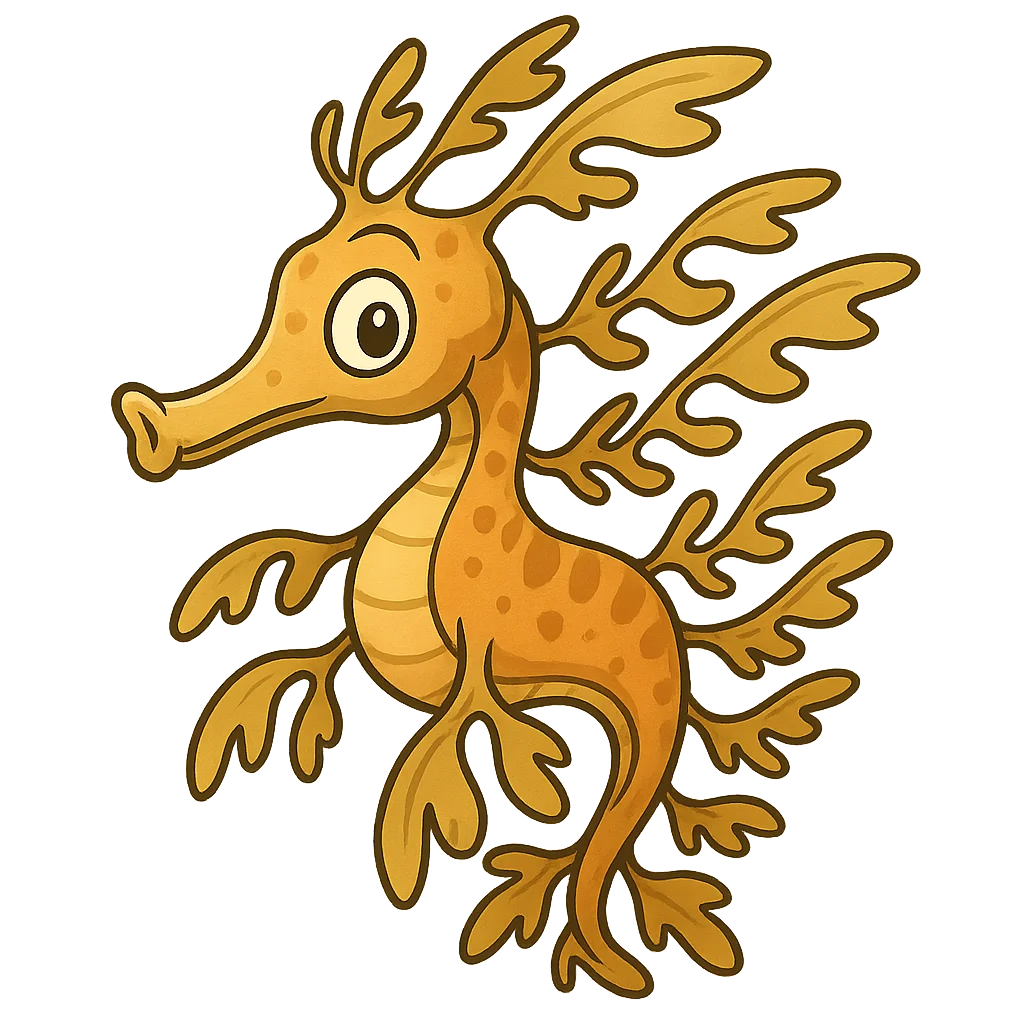
Hello! You might mistake me for a piece of drifting seaweed, and I wouldn't blame you. My name is Leafy Seadragon, and my home is in the cool, swaying kelp forests off the southern coast of Australia. My whole body is covered in delicate, leaf-shaped lobes that look exactly like the kelp I live in. This amazing camouflage isn't just for show; it keeps me safe from predators who swim right by without ever knowing I'm there. I'm not a plant, though—I'm a fish, related to seahorses and pipefish. My appearance is a perfect adaptation to my environment, a world of gentle currents and dense underwater foliage where blending in is the key to survival.
I don't swim like other fish. Instead of using my leafy parts, I glide through the water using two tiny, almost invisible fins—one on my neck and one on my back. They flutter so fast they're just a blur, making me look like I'm magically floating among the kelp fronds. Life for me is a slow, graceful dance with the ocean's rhythm. I spend my days hunting for my favorite food: tiny mysid shrimp. They often gather in small clouds, and when I spot one, I use my long, tube-like snout like a straw, sucking them up in a flash. My movements are deliberate and patient, as I rely on stealth rather than speed to catch my meals. It's a quiet life, but a full one, lived in harmony with the currents that guide me through my forest home.
In my family, it's the fathers who take care of the babies, a unique responsibility among fish. When it's time to start a family, a female will lay her bright pink eggs, sometimes up to 250 of them, onto a special soft patch on the male's tail. He then carries these precious eggs for about 4 to 9 weeks, becoming a living nursery. During this time, he protects them from danger and keeps them clean and healthy until they are ready to hatch. When we hatch, we are perfect, tiny copies of our parents, complete with our own leafy appendages. We are ready to drift off into the kelp forest on our own, immediately using our built-in camouflage to begin our independent lives.
For a long time, we were just a secret of the sea, known only to the creatures who shared our kelp forests. But in the year 1865, our existence was formally introduced to the human world. A scientist named Albert Günther officially described my species for the world to know, documenting our unique features in the records of science. He gave us the scientific name Phycodurus eques, which is a fancy way of saying 'seaweed-like horse.' It was the first time we were written about in science books, and it helped people understand that we were not mythical creatures, but a unique and special kind of fish deserving of study and admiration.
My home is very delicate, and things like pollution and the loss of seagrass meadows can make it hard for us to survive. As people learned more about us, they started to realize how special we are. This recognition led to a wonderful moment on April 11, 2000, when the Leafy Seadragon was declared South Australia's marine emblem. This designation meant we became protected. Now, it is illegal to take us from our ocean home, which helps ensure our populations can continue to dance in the kelp for years to come. This act of conservation was a promise to safeguard not just me, but the entire fragile ecosystem I call home.
My story continues today in the underwater forests of Australia. My presence is a good sign—it tells you that the seagrass and kelp ecosystems are healthy. By protecting me, people are also protecting my entire habitat, which is a nursery and home for countless other sea creatures. I am a small, slow-moving fish, but my role is big. I am a reminder of the ocean's intricate beauty and the importance of caring for every part of it, no matter how small or hidden. My journey is a testament to the quiet wonders that thrive beneath the waves.
Activities
Take a Quiz
Test what you learned with a fun quiz!
Get creative with colors!
Print a coloring book page of this topic.