English
 For Schools
 For Homeschool

A Patient Hunter's Tale
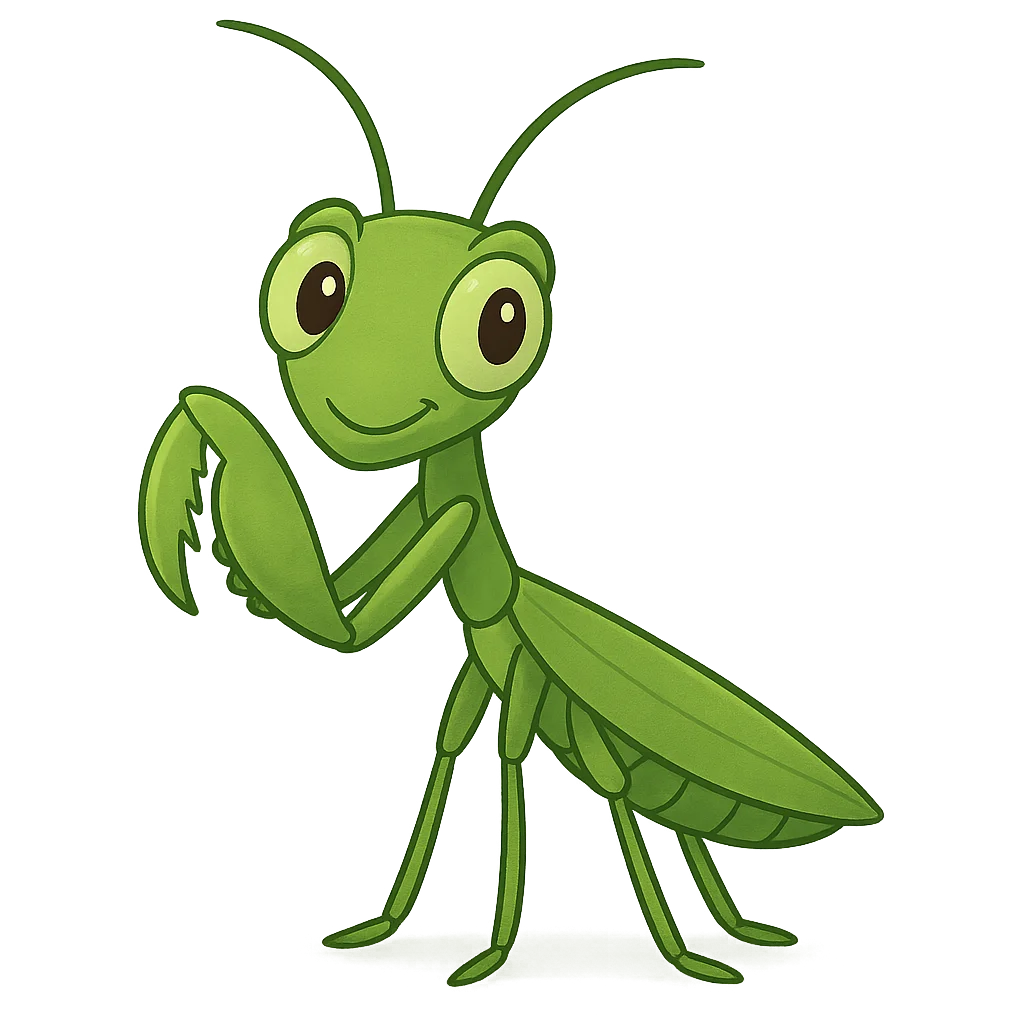
Hello there. You might know me as a Praying Mantis. I get my name from the way I hold my front legs together, as if I am in prayer. But don't be fooled by my calm posture; I am one of nature's most skilled hunters. My life began in the spring, when the world was waking up from its long winter sleep. I hatched from a foamy, protective egg case called an ootheca, along with nearly two hundred of my brothers and sisters. We emerged as tiny, wingless nymphs, miniature versions of our parents. The world was suddenly vast and dangerous. My very first challenge was to find a meal, a tiny insect to give me strength. At the same time, I had to be careful. My own siblings were just as hungry as I was, and in the world of mantises, sometimes the closest danger is your own family. Survival from that very first moment required patience, stillness, and a bit of luck.
To grow, I had to go through a process called molting. Several times, I shed my tight exoskeleton, like shrugging off a coat that had become too small. Each time, I emerged a little larger and stronger. My body is a masterpiece of design for a life of hunting. My green and brown coloring provides perfect camouflage, allowing me to blend in with the leaves and twigs of my garden home. Most praying mantises are ambush predators that wait for prey, but some species actively chase their food. Instead, I wait, perfectly still, for it to come to me. My two large front legs are lined with sharp spikes, and I can snatch prey like flies, moths, and crickets in a fraction of a second. To help me spot my next meal, I have five eyes—two large compound eyes and three smaller, simple eyes in between them. What truly sets me apart from most other insects is my remarkable neck. I can turn my triangular head a full 180 degrees, scanning my surroundings without ever moving my body. This gives me an incredible advantage, letting me see everything that moves around me.
After my final molt, I emerged as an adult, and with this change, I developed wings, as is typical for most praying mantis species. For the first time, I could fly, lifting myself from the leaves to explore the wider world, as is common among many adult praying mantises. My journey, and the journey of my species, has been a long one. My ancestors originally came from the warmer regions of Europe, Asia, and Africa. For centuries, we lived there, perfecting our hunting skills. It was in 1758 that a famous scientist named Carl Linnaeus gave my kind our official scientific name, Mantis religiosa. But our story took an unexpected turn. My species wasn't native to North America. The European mantis was likely introduced to Rochester, New York, in 1899 via nursery stock from Europe, but specific details about them hiding as egg cases on these plants are not confirmed. It was completely by accident, but it was the beginning of a new chapter for us. We found the new environment suitable, and from that small, accidental introduction, our population began to grow and spread.
My life is short, often lasting just a single season, but my purpose is significant. As a predator, I consume various insects in gardens and farms, including both pests and beneficial species. By hunting various insects, including both pests and beneficial species, I can influence the insect population in gardens and farms. This is my job, my contribution to the balance of the ecosystem. Before my time ends in the autumn, I will fulfill one last important duty: I will lay my own ootheca on a sturdy twig. Inside this protective case, the next generation will wait safely through the winter. When spring arrives, hundreds of new nymphs will emerge to continue the cycle. So when you are in a garden, look closely among the leaves. You might see one of my kind, a silent, patient guardian, waiting to play our small but important part in the world.
Activities
Take a Quiz
Test what you learned with a fun quiz!
Get creative with colors!
Print a coloring book page of this topic.