
 English
 For Schools
 For Homeschool

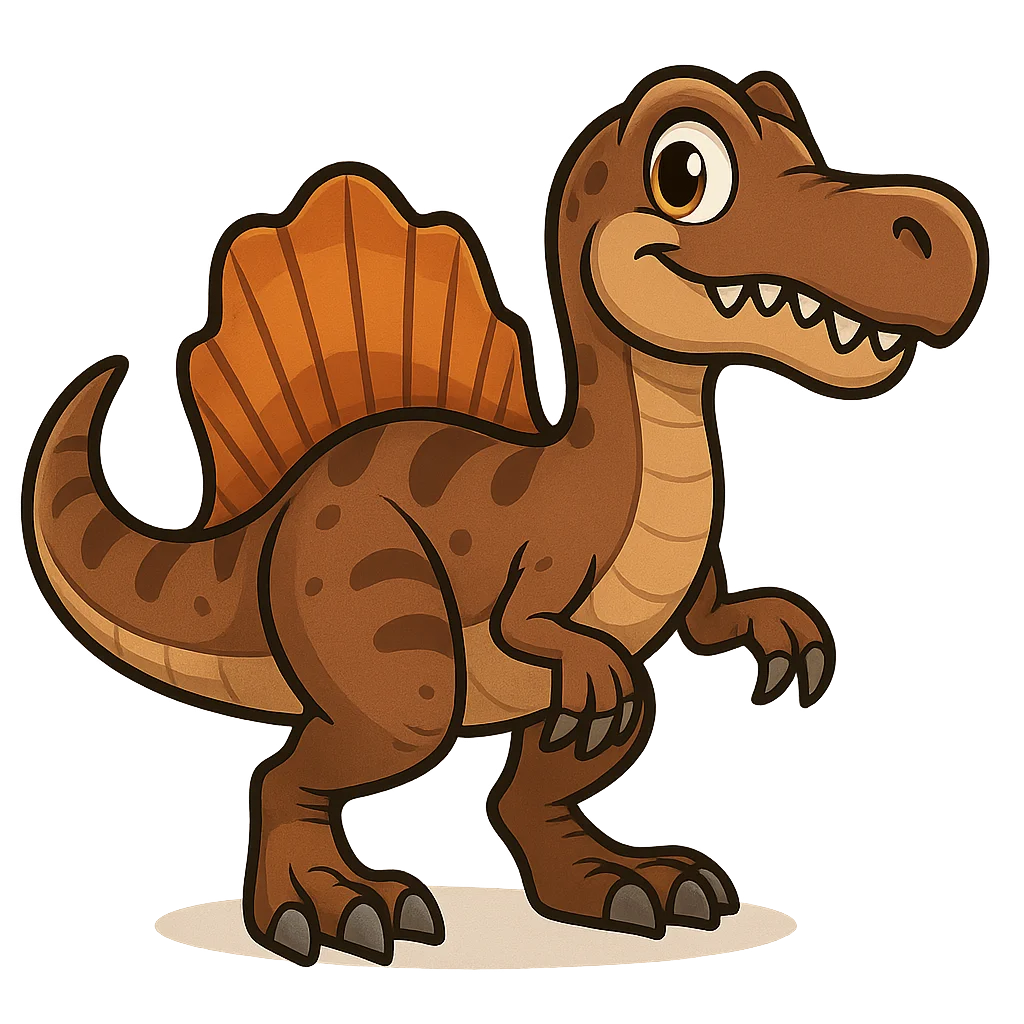
The River King's Tale: The Story of Spinosaurus
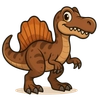
Hello, my name is Spinosaurus aegyptiacus, which means 'spined lizard from Egypt.' You can think of me as the River King. I lived approximately 99 to 93.5 million years ago, during the Cenomanian stage of the Late Cretaceous period. My home was not a dry, dusty plain like you might imagine for a dinosaur; it was a world of vast rivers and lush, swampy coastlines in what is now North Africa. I was enormous—longer than even a Tyrannosaurus rex. But the most striking thing about me wasn't just my size. It was the magnificent sail of skin held up by long spines on my back, and my long, narrow snout, which looked more like a crocodile's than any other meat-eating dinosaur's. You see, I was different. While other dinosaurs stalked the land, I found my power and my food in the water.
My body was perfectly designed for life in the river. My nostrils were positioned further back on my skull, potentially aiding in breathing while partially submerged. Unlike many other dinosaurs with hollow bones, mine were dense and solid, which helped me control my buoyancy as I moved through the water. My teeth were not like steak knives designed for tearing flesh; they were cone-shaped, perfect for gripping slippery prey. I preyed on the large sawfish Onchopristis, as evidenced by fossil findings. I would wade or swim silently, using special sensors in my snout to feel for vibrations in the water. Once I detected a fish, I would snap my powerful jaws shut with incredible speed. On land, a fearsome predator named Carcharodontosaurus roamed, but it rarely ventured into my watery kingdom. The rivers were my domain, and I was their undisputed ruler.
After my time on Earth ended, my bones rested for millions of years, turning to stone deep beneath the sand. It wasn't until 1912 that the first pieces of my skeleton were found by a fossil collector named Richard Markgraf in the Bahariya Oasis in Egypt. He sent them to a German paleontologist, Ernst Stromer, who carefully studied them and realized I was a unique and massive predator. In 1915, Stromer officially introduced me to the world. But my story took a tragic turn. The original, precious bones—the only ones known at the time—were kept in a museum in Munich, Germany. On the night of April 24th, 1944, during World War II, the museum was destroyed in a bombing raid, and my bones were lost forever. For decades, all that remained of me were Stromer's drawings and notes. I became a dinosaur mystery.
My story was not over, though. In the early 21st century, paleontologists began finding new fossils of my kind in the deserts of Morocco, in an area known as the Kem Kem beds. A team led by a scientist named Nizar Ibrahim made incredible discoveries that would change everything. In 2014, they announced they had found parts of a new skeleton that showed my legs were shorter than expected, which strongly suggested I spent more time in the water than on land. But the biggest surprise came in 2020. The team uncovered a nearly complete tail, and it was astounding. It wasn't thin and pointed like other theropods; it was broad and paddle-like, similar to the tail of a newt. This was the final piece of the puzzle. It was clear evidence that I was a powerful swimmer, propelling myself through the water to hunt. I wasn't just a dinosaur that waded—I was a dinosaur that swam.
I lived in the Late Cretaceous period, a time of giants on land and in the water. My kind disappeared from the world around 93.5 million years ago, long before the asteroid that wiped out most other dinosaurs. My story is a special one because it shows how science is a journey of discovery. For a long time, I was a mystery, a ghost known only from old drawings. But thanks to the tireless work of scientists who kept searching, I have been brought back to life in a way I never expected. I am remembered today as the first known semi-aquatic dinosaur, though some studies suggest it was adapted for shoreline hunting rather than being fully aquatic. My rediscovery reminds everyone to keep looking and keep questioning, because the Earth still holds ancient secrets, waiting to be revealed.
Activities
Take a Quiz
Test what you learned with a fun quiz!
Get creative with colors!
Print a coloring book page of this topic.