
 English
 For Schools
 For Homeschool

The Story of a Stegosaurus
Hello. My name is Stegosaurus, which means ‘roofed lizard,’ a name given to me because of the remarkable plates that stood tall on my back. My adventure began in a world very different from yours, during the Late Jurassic Period, about 150 million years ago. I lived in a vast, warm land that humans now call North America. My home was a lush paradise, a landscape painted in endless shades of green. Towering, ancient trees reached for the sky, while the ground was a thick carpet of ferns and cycads. This world was alive with giants, and I was one of them. I shared my home with other dinosaurs, from the long-necked Brachiosaurus that grazed on the treetops to the smaller, swifter dinosaurs that darted through the undergrowth.
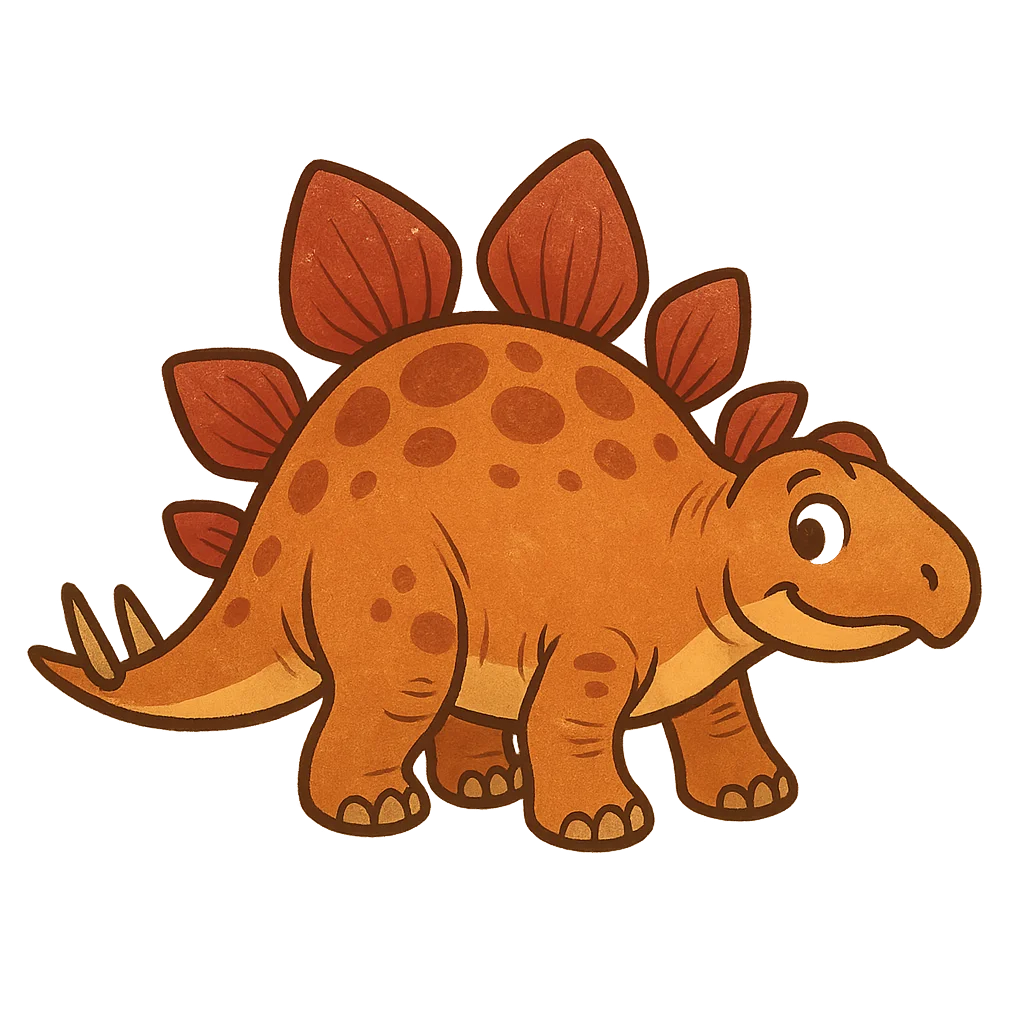
My body was immense, roughly the size of a modern-day bus, and it was built for a life of gentle grazing. But what truly set me apart were my most distinctive features. Running down my spine were two rows of large, bony plates that stood up like a line of shields. They were my most famous trait, a feature that has puzzled your scientists for many years. At the end of my powerful tail, I carried four long, sharp spikes. These were not for show; they were a formidable weapon that I would need in this ancient world of titans. My life was one of constant watchfulness and quiet strength, navigating a world that was both beautiful and dangerous.
My days were peaceful, spent moving slowly through the dense forests and open floodplains. As an herbivore, my entire diet consisted of plants. I had a beak-like structure at the front of my mouth and small, peglike teeth in my cheeks, which I used to feed on low-growing vegetation like ferns, mosses, and cycads. I spent most of my time eating to fuel my massive body. You may have heard that I had a brain weighing about 70 grams, approximately the size of a lime or a bent hotdog. While this is true, it was perfectly suited for my lifestyle. It managed all the necessary functions for my survival, from finding food to sensing danger, proving that size isn't everything when it comes to adaptation. My body was an incredible example of natural engineering, designed for my specific role in the Jurassic ecosystem.
My most fascinating features—my plates and spikes—served critical purposes. The scientific debate about my plates continues to this day. Were they a form of armor to protect my back from predators? Perhaps. Or were they a vibrant display to attract a mate or intimidate rivals? It is also possible they acted like solar panels, helping me absorb the sun’s heat to warm my body or release it to cool down. While the purpose of my plates remains a mystery, the function of my tail spikes is much clearer. In the 1980s, scientists gave my spiked tail a fitting nickname: the ‘thagomizer.’ This was my primary weapon for defense. When a predator like the fierce Allosaurus threatened me, I could swing my muscular tail with incredible force, using the sharp spikes to inflict serious wounds and protect myself from harm.
My species, the Stegosaurus, thrived for millions of years, a testament to our successful adaptation to the Jurassic environment. We inhabited regions of western North America during the Late Jurassic Period, moving in small groups and filling an important niche as large herbivores. But the Earth is in a constant state of transformation, and no world lasts forever. Toward the end of the Jurassic Period, around 145 million years ago, our world began to change profoundly. This wasn't a sudden catastrophe, but a slow, gradual shift that unfolded over thousands of years. The climate, which had once been generally warm with high sea levels, started to become different, and this had a direct impact on the plants that I depended on for survival.
The lush ferns and cycads that were my main food source began to decline, replaced by new types of plants that I was not equipped to eat. As the world transformed, it became increasingly difficult for my kind to find the food and habitats we needed to flourish. Our numbers slowly dwindled as our environment changed around us. It is important to understand that my story came to a natural close long before the cataclysmic asteroid that caused the mass extinction of many other dinosaurs at the end of the Cretaceous Period. My time on Earth faded away, a quiet ending to a long and successful chapter in the planet’s history.
I lived during the Late Jurassic Period. For millions of years, my bones lay silent, buried deep within the earth, my story waiting to be rediscovered. That moment finally came in 1877, when a paleontologist named Arthur Lakes unearthed my fossilized remains near Morrison, Colorado. He was the one who gave me my name, Stegosaurus, and introduced my existence to the human world. Since that day, scientists have carefully studied my bones, piecing together the puzzle of my life and the ancient world I inhabited. My skeleton reveals secrets about how I moved, what I ate, and how I defended myself. My story is a vital piece of Earth’s great history.
My legacy continues to capture the imagination of people everywhere. In 1982, I was honored as the official state fossil of Colorado, a place where many of my fossils have been found. My unique silhouette, with its arched back, bony plates, and spiked tail, is one of the most recognizable of all dinosaurs, beloved by children and adults around the globe. I hope my story inspires a deep curiosity about our planet's incredible past and the amazing creatures that have called it home. My existence is a reminder that Earth’s story is long and ever-changing, and there is always more to discover.
Activities
Take a Quiz
Test what you learned with a fun quiz!
Get creative with colors!
Print a coloring book page of this topic.