
 English
 For Schools
 For Homeschool

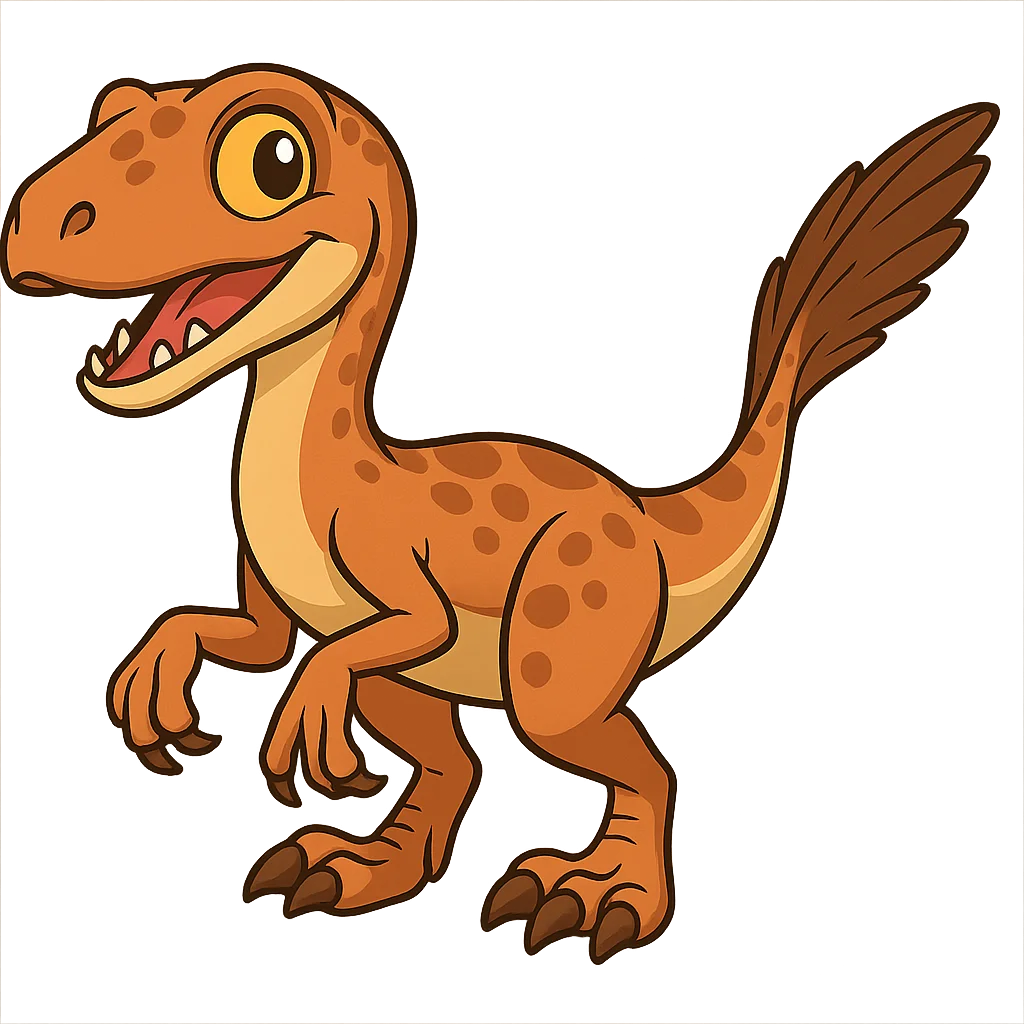
A Feathered Hunter from the Cretaceous
Hello. You may think you know me from movies, but I am here to tell you my real story. I am a Velociraptor mongoliensis, a feathered hunter that roamed the Earth around 75 million years ago, during the Late Cretaceous Period. Before we go any further, let’s clear something up. I was not a giant, scaly monster. In fact, I was about the size of a large turkey, and my body was covered in a coat of feathers. While these feathers may have helped regulate body temperature, specific evidence for their role in keeping warm during cool desert nights is not confirmed. Instead, they helped keep me warm in the cool desert nights and were likely used for display, perhaps to attract a mate or signal to others in my group. My world was very different from the lush jungles you might imagine. I lived in what is now the Gobi Desert, a challenging environment defined by its dry, arid landscapes and vast sand dunes. Life here was about survival, and I was perfectly adapted for it.
My entire body was a finely tuned instrument for hunting. I had a long, upturned snout, and my jaws were lined with 26 to 28 sharp, serrated teeth on each side, which were perfect for gripping struggling prey. But my most famous feature was the weapon I carried on each foot. On my second toe, I had a large, sickle-shaped claw. I was careful to keep this claw raised off the ground as I walked, which kept its edge razor-sharp and ready for action. Its primary purpose wasn't for slashing, as many believe, but for pinning down prey, holding it firmly in place while I used my powerful jaws. My diet consisted of small animals and even other dinosaurs. One of my frequent adversaries was a tough, plant-eating dinosaur called Protoceratops. Velociraptor and Protoceratops did interact, as evidenced by a fossil showing them in combat, but the frequency of such encounters is unknown. We know this for a fact because of an incredible discovery made in 1971. Paleontologists unearthed a fossil now known as the 'Fighting Dinosaurs,' which shows one of my kind locked in a life-or-death struggle with a Protoceratops. This fossil provides direct proof of predatory behavior between Velociraptor and Protoceratops, capturing a moment in time and showing just how intense life could be in my world.
For millions of years after I lived, my story was lost, buried beneath the shifting sands of the desert. My bones, along with those of the creatures of my time, slowly turned to stone in a process called fossilization. My tale remained a secret until the 20th century. On August 11th, 1923, an expedition from the American Museum of Natural History was exploring the Gobi Desert. A team led by the famous explorer Roy Chapman Andrews made a historic find: the first-ever fossil of my species. It was a crushed skull, but it was enough to reveal my existence to the modern world. The following year, in 1924, the president of the museum, Henry Fairfield Osborn, gave my kind an official name. He called us Velociraptor mongoliensis, a name that perfectly captures my essence. It translates to 'swift seizer from Mongolia,' a fitting tribute to a fast predator from the very lands where my bones were found.
I lived during the Late Cretaceous period, approximately 75 to 71 million years ago, and went extinct before the mass extinction event around 66 million years ago. Though I no longer walk the Earth, my story is far from over. My fossilized bones serve as clues from a forgotten world, helping scientists piece together the puzzle of prehistoric life. Perhaps most importantly, my feathers provide a direct link to the birds you see flying in your skies today, showing that my dinosaur family tree lives on in a different form. Every new fossil that is unearthed tells a little more of my story—the story of a swift, feathered hunter from a lost world.
Activities
Take a Quiz
Test what you learned with a fun quiz!
Get creative with colors!
Print a coloring book page of this topic.