

 English

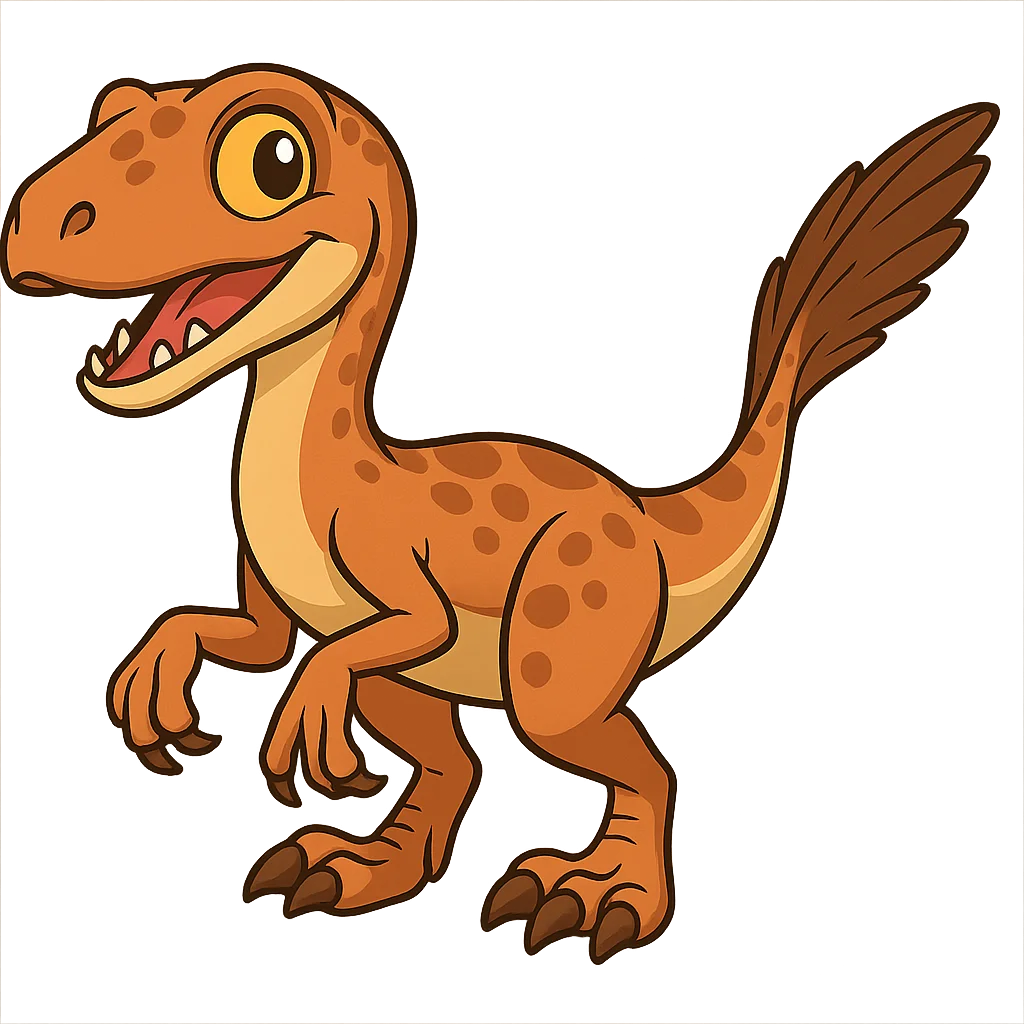
The Story of the Swift Seizer
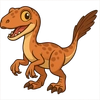
Hello! My name is Velociraptor, which means 'swift seizer.' I lived about 75 million years ago during a time you call the Late Cretaceous Period. You might have seen dinosaurs that look like me in movies, but let me tell you my real story. I wasn't a giant, scaly monster. I was only about the size of a big turkey, and my body was covered in feathers, much like a bird. My home was a dry, sandy place that is now known as the Gobi Desert in Mongolia. Life in the desert required me to be fast, so I had powerful legs and a sharp mind. My most special feature was a long, curved claw on each of my feet. I kept it raised off the ground as I walked, which helped keep it perfectly sharp for when I needed it.
Being a hunter in the desert was an exciting life. My excellent eyesight and keen sense of smell were very helpful for finding my next meal. Since I wasn't big enough to take on huge dinosaurs, I focused on hunting smaller animals, like lizards and little mammals that scurried across the sand. My special sickle-shaped claw wasn't for slashing, as some people think. It was the perfect tool for pinning my wriggling prey to the ground while I used my mouth full of sharp teeth. Some scientists who study my fossils believe we might have hunted in small family groups, using teamwork to catch our food. We had to be smart and quick to survive among all the other dinosaurs that roamed the desert landscape.
My most famous moment is a story that was locked away in stone until paleontologists discovered it in 1971. They found a fossil of one of my relatives in the middle of a battle with another dinosaur, a tough plant-eater called Protoceratops. The fossil showed my relative had leaped onto the Protoceratops, kicking with its sharp claw. At the same time, the Protoceratops had bitten down hard on my relative's arm. It must have been a very fierce fight! But then, something incredible happened. A massive sand dune likely collapsed on top of them, or a sudden, powerful sandstorm buried them both instantly. They were frozen right in the middle of their fight, creating one of the most amazing fossils ever found. Today, it is called the 'Fighting Dinosaurs' fossil.
For millions of years, my story was completely hidden beneath the desert sand. My kind was unknown to your world until an expedition on August 11th, 1923, found the very first fossil of my species—a crushed skull and my special claw. The next year, in 1924, the leader of that expedition, a man named Henry Fairfield Osborn, officially gave me my name: Velociraptor mongoliensis. For a long time, people weren't sure if I really had feathers. But in 2007, that changed when scientists found little bumps on a Velociraptor's arm bone. These bumps were just like the quill knobs where modern birds anchor their feathers. That was all the proof they needed! I was officially known as a feathered dinosaur.
I lived during the Late Cretaceous Period, a world very different from the one you know. Although my kind is no longer here, our fossils tell an amazing story about life long ago. Discoveries like the 'Fighting Dinosaurs' give you a real-life snapshot of our struggles for survival and our power. I am a reminder that today's birds are the living relatives of dinosaurs just like me. Every time you see a bird flying in the sky, you can think of me and the incredible, ancient world I came from. My story is written in stone, and it shows just how connected life on Earth has always been.
Activities
Take a Quiz
Test what you learned with a fun quiz!
Get creative with colors!
Print a coloring book page of this topic.







 Free for Educators