English
 For Schools
 For Homeschool

The Tooth-Walker's Tale
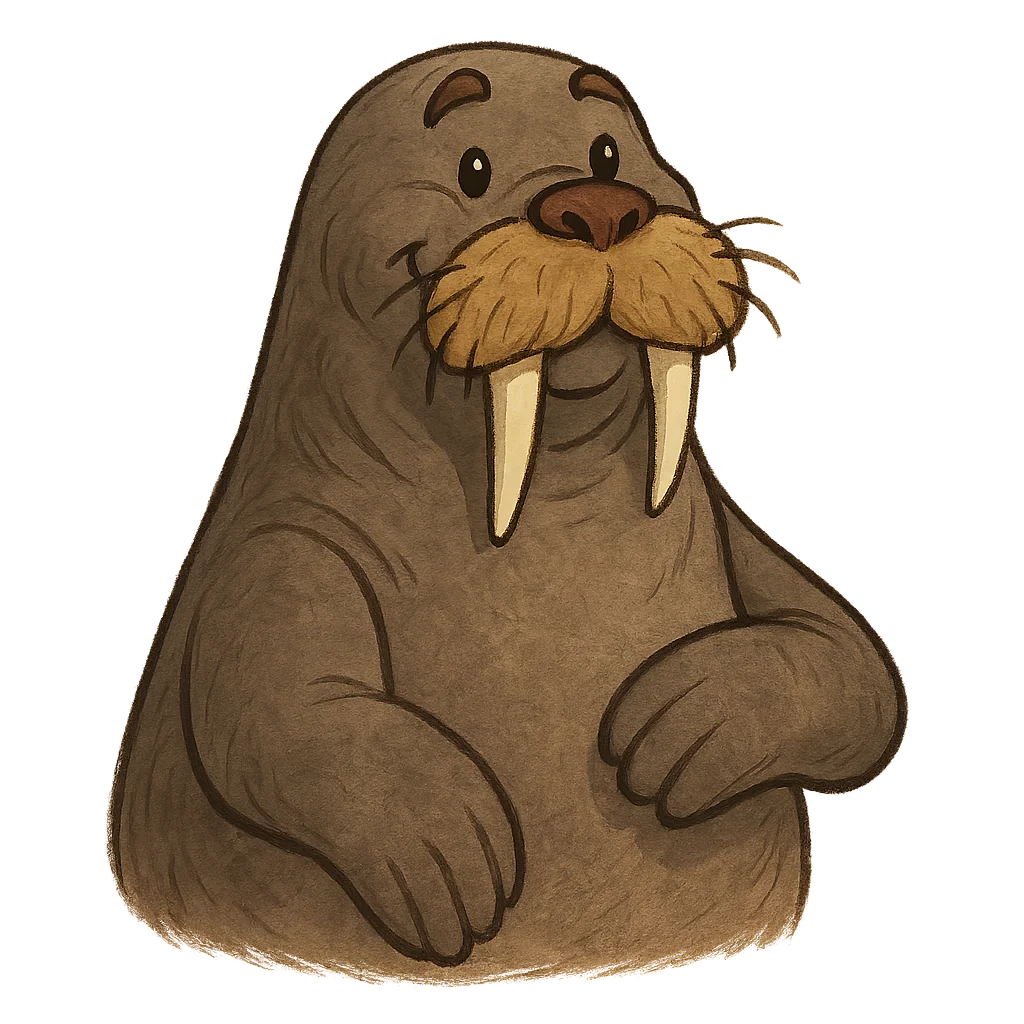
Hello there. I am a walrus, a giant of the chilly Arctic. My story begins in the vast, icy waters where I spend my days. You might be surprised to learn that the genus name Odobenus translates to 'tooth-walker,' while rosmarus is of Scandinavian origin. Scientists gave my species this name back in 1758, and it’s a fitting name, because I literally use my long, ivory tusks to grip the ice and haul my enormous body out of the frigid sea. Imagine pulling yourself along with your teeth—that’s my daily reality. My home is a world of floating sea ice and cold, nutrient-rich waters. It’s a harsh environment, but I am perfectly built for it. My skin is wrinkly and has a cinnamon-brown color, and beneath it lies a thick layer of fat, or blubber, that insulates me from the biting cold. While my eyes aren’t the sharpest, I have something far more useful for navigating the dark depths of the ocean: a magnificent set of sensitive whiskers. Each whisker is a finely tuned sensor, allowing me to feel my way along the seafloor and find my next meal even in complete darkness. They are my guide in the underwater world.
Life for a walrus is a very social affair. I live in a massive herd, often with thousands of my kind. The air is thick with the smells of the sea and our bodies, and the sound is a constant chorus of grunts, bellows, and whistles. We are not a quiet bunch. We gather together on land or large ice floes in groups we call 'haul-outs.' Huddling close provides warmth and safety in numbers, creating a living fortress of blubber and tusks. Family is at the center of my world. As a mother, I raise my calf with great care. My little one stays by my side for at least two years, nursing and learning the essential skills of survival. I teach my calf how to navigate the waters, find food, and be wary of danger. My tusks are not just for walking; they are crucial tools for life in the herd. They signal my status and help establish my place in our social structure. They are also my primary weapon for defense. If a hungry polar bear approaches, my sharp tusks become a formidable barrier, protecting both me and my calf from the Arctic’s greatest predator.
When hunger calls, I leave the haul-out and dive into the deep. I am what scientists call a 'benthic' feeder, which is a fancy way of saying I find my food on the bottom of the ocean. My dives take me to the dark, muddy seafloor, a place that might seem empty to you, but for me, it is a banquet. I don't use my eyes down there. Instead, I rely on my incredible whiskers. I swim along the bottom, brushing my whiskers against the sediment, feeling for the telltale shapes of my favorite foods: clams, snails, and worms buried just beneath the surface. Once I locate a clam, I do something quite clever. I don’t waste energy trying to crack its hard shell with my teeth. Instead, I press my lips to the shell, create a powerful vacuum with my mouth, and with a strong slurp, I suck the soft body right out. It’s a highly efficient way to eat, and it allows me to consume as many as 3,000 to 6,000 clams in a single feeding session, giving me the energy I need to thrive in the cold.
Lately, however, my world has been changing, and not for the better. The greatest challenge my species faces is the loss of our home. The sea ice, which is so essential to my life, is melting due to climate change. This ice isn't just a place for me to rest; it’s a platform from which I can easily access the shallow feeding grounds below. With less ice available, I have to swim much farther to find food, using up precious energy. We are also forced to gather on crowded beaches for our haul-outs, which can be dangerous, especially for the youngest and smallest members of our herds. But there is hope in my story. Humans have also taken steps to protect us. In 1972, the Marine Mammal Protection Act was passed. This law stopped widespread hunting in many areas and allowed our populations, which had been in decline, to start growing again. It was a crucial moment that showed when people decide to help, they can make a real difference for animals like me.
Legacy & Remembering: An Ocean Gardener
My role in the Arctic ecosystem is more significant than you might imagine. When I forage for food on the seafloor, my powerful suction and the movement of my muzzle stir up the mud and sand. Scientists call this process 'benthic bioturbation.' By digging and churning the bottom, I release nutrients that were trapped in the sediment back into the water. These nutrients become food for tiny organisms, which in turn feed fish and other sea creatures, supporting the entire food web. In this way, I act as a gardener for the ocean floor, cultivating life without even realizing it. My story is still being written, as my kind continues to adapt to our changing world. A walrus like me can live for about 40 years, and every day is a testament to our resilience. Our future, however, is not in our tusks alone; it is tied to the health of the Arctic. Our survival depends on the protection of our magnificent, icy world.
Activities
Take a Quiz
Test what you learned with a fun quiz!
Get creative with colors!
Print a coloring book page of this topic.