English
 For Schools
 For Homeschool

The Tooth-Walker's Tale
Hello there. I am a walrus, and my story begins in the chilly Arctic, where I was born in the spring on a huge, floating piece of sea ice. The first thing I remember was the sound of my family—a whole herd of walruses grunting and bellowing all around me. It was a loud but comforting sound, and I felt safe snuggled close to my mother. My world was a landscape of bright white ice and deep blue water. Even though I was just a small calf, I was part of a long history. A very long time ago, a human scientist named Carl Linnaeus gave my species its scientific name, Odobenus rosmarus. That happened way back in the year 1758, and it means 'tooth-walking sea-horse,' which you’ll soon see is a perfect name for us. My early days were spent learning the rhythms of the Arctic, listening to the calls of my herd, and relying on my mother for warmth and milk.
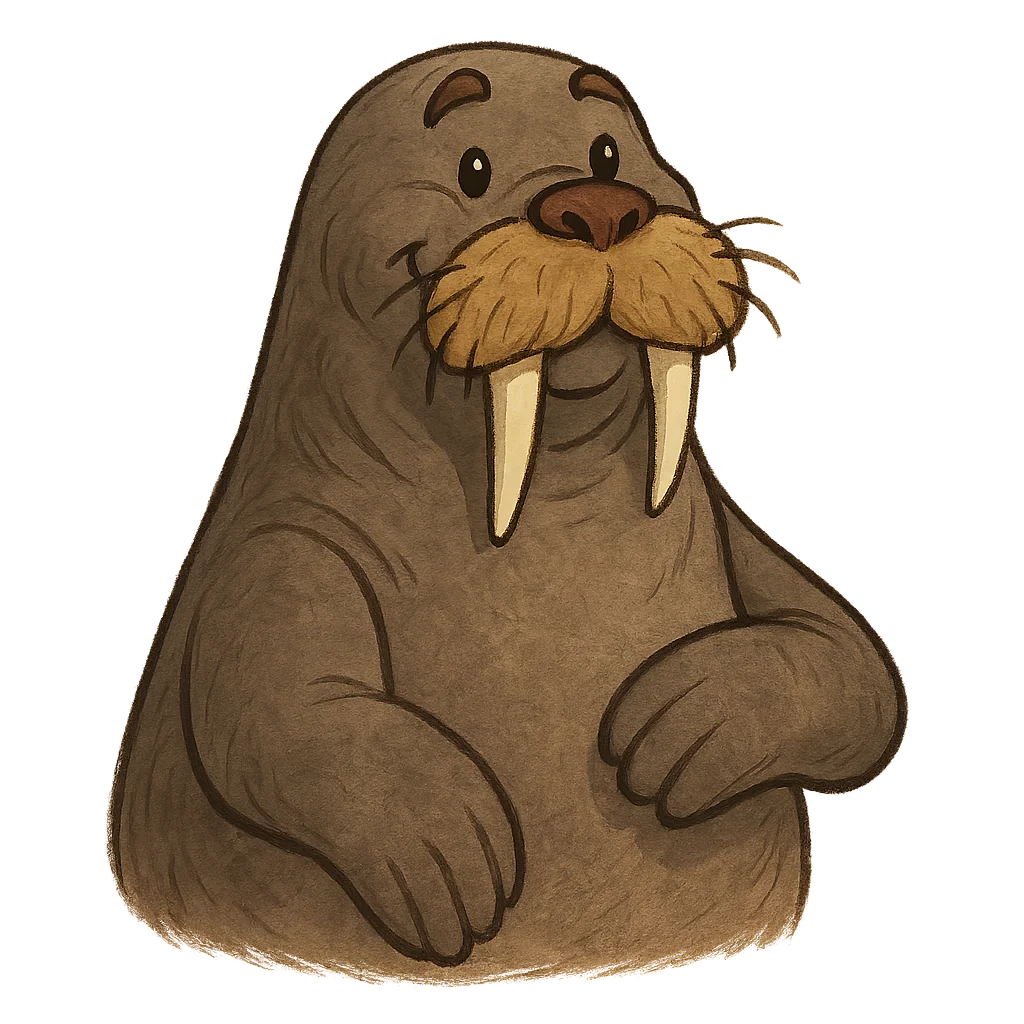
I stayed close by my mother’s side for the first few years of my life. She taught me everything I needed to know to survive in our icy world. One of the most important lessons was how to find food. We don't see very well underwater, but we have an amazing tool right on our faces. My snout is covered in hundreds of super-sensitive whiskers called vibrissae. When I dive to the dark ocean floor, I use these whiskers to feel for the shapes of tasty clams buried in the sand and mud. They work perfectly. Of course, the other thing you probably notice about me are my long, white tusks. Both male and female walruses have them, and they grow throughout our entire lives. My tusks are very useful. I use them to defend myself, but their best trick is helping me get out of the water. I hook them onto the edge of the ice and pull my heavy body up. This special move is how we earned our nickname, 'tooth-walkers.'
My home is a world of incredible contrasts. The Arctic water is freezing, but I am perfectly built for it. Under my wrinkly brown skin, I have a thick layer of fat called blubber that works like a warm winter coat, keeping me insulated from the cold. I am also an expert diver. When I go searching for food, I can do something amazing: I can slow my own heartbeat down. This allows me to save oxygen and stay underwater for a long time, sometimes up to ten minutes, without needing to come up for air. Life here isn’t lonely, because we are very social animals. I live in a huge herd with hundreds, sometimes thousands, of other walruses. We are always communicating with loud grunts, deep bellows, and even whistles. Sticking together in a big group helps keep us safe from predators and allows us to rest together on the ice, creating a giant, warm pile of walruses.
Lately, my Arctic home has been facing a very big challenge. The climate is getting warmer, and the sea ice we depend on is melting. For us, sea ice is not just a place to rest; it is a platform we use to reach the best feeding areas. With less ice, we have to swim much farther to find food, which uses a lot of our energy. Instead of resting on our favorite ice floes, many of us now have to gather on crowded beaches, which can be dangerous. But there has been good news in our history, too. For a long time, humans hunted us, but people also realized we needed help. In 1972, a law called the Marine Mammal Protection Act was passed in the United States. The Marine Mammal Protection Act provided significant protections to walruses, contributing to their conservation, though multiple factors influence population trends. This law gave us important protections and helped our numbers grow again, showing that people can make a positive difference for animals like me.
My job in the Arctic is bigger than just finding food and raising my young. When I forage on the seafloor, digging for clams with my snout, I stir up the mud and sand. This process releases nutrients back into the water, which helps many other smaller creatures survive and thrive. Because of this, scientists call me a keystone species. Walruses significantly influence their ecosystem, especially benthic communities, through their feeding habits. That means my entire ecosystem depends on the work I do every day. My story is still happening, and so is the story of the Arctic. I hope that by learning about my life as a 'tooth-walker,' you can see why it is so important to protect this beautiful, icy world. When you help protect the Arctic, you help make sure my family has a home for many, many years to come.
Activities
Take a Quiz
Test what you learned with a fun quiz!
Get creative with colors!
Print a coloring book page of this topic.