
 English

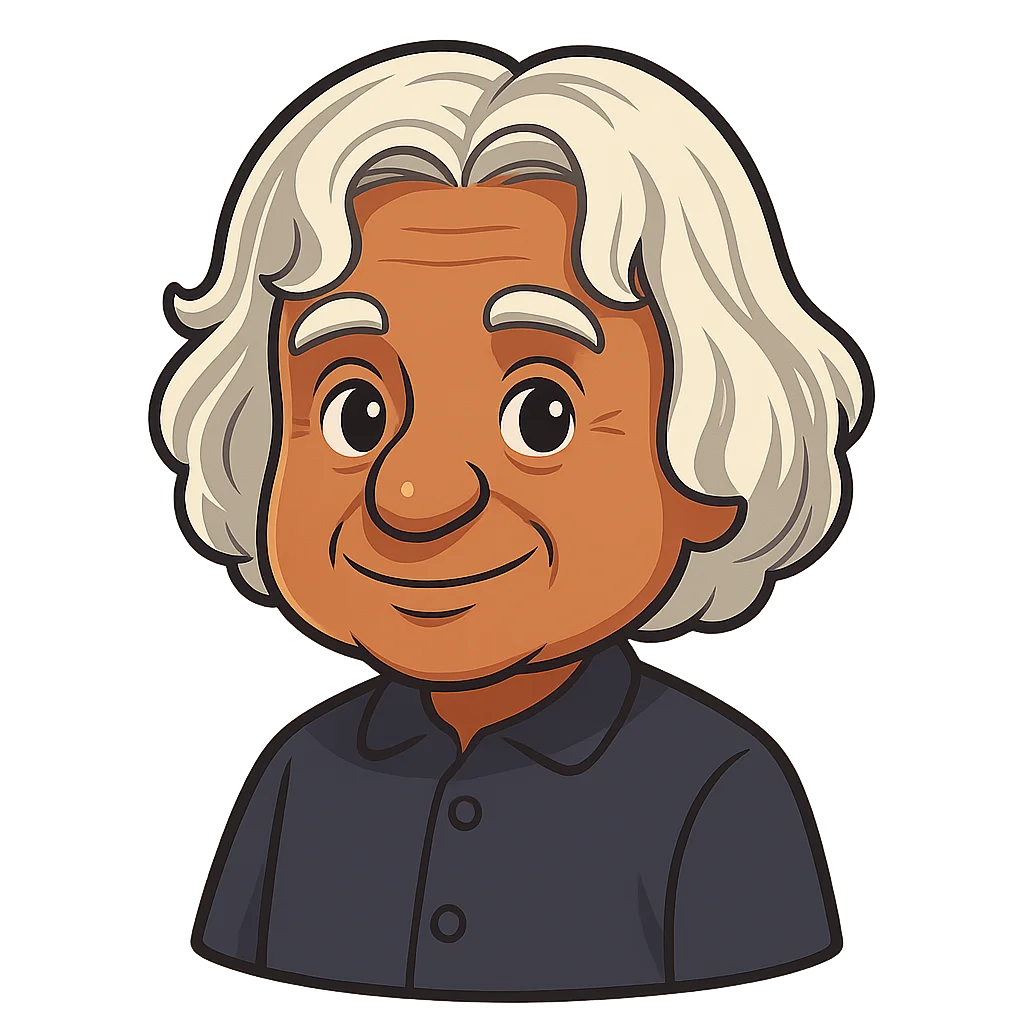
A. P. J. Abdul Kalam
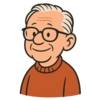
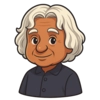
Hello, my name is Avul Pakir Jainulabdeen Abdul Kalam, but you can call me A. P. J. Abdul Kalam. My story begins on a small island called Rameswaram in India, where I was born on October 15th, 1931. Life was simple but full of love. My father, Jainulabdeen, was a boat owner and a wise man who taught me about faith and kindness, and my mother, Ashiamma, was a gentle soul who always made sure everyone was cared for. We didn't have much money, so to help my family, I would wake up before the sun to deliver newspapers. As I rode my bicycle through the dusty streets, I would often look up at the sky and see birds flying freely. I was mesmerized. How did they soar so high? How did their wings catch the wind? Watching them, a tiny seed of a dream was planted in my heart: one day, I too wanted to fly.
That dream of flying pushed me to study hard in school. I loved learning about how the world worked, especially in subjects like physics and mathematics. I knew that to understand flight, I needed to understand science. After finishing school, I went to college to study physics and then moved on to study aerospace engineering, which is the science of building things that fly. It was not easy. I worked tirelessly, often staying up late to read my books. My biggest dream was to become a fighter pilot in the Indian Air Force. I worked so hard and was so close, but in the end, I was not chosen. I was heartbroken. For a moment, it felt like my dream had crashed. But I remembered my father’s words about accepting our destiny and moving forward. So, I picked myself up and found a new path. In 1960, I joined India’s Defence Research and Development Organisation, or DRDO, as a scientist. A few years later, in 1969, I moved to the Indian Space Research Organisation, ISRO. My dream of flying might have changed, but I was now helping my country reach for the stars by designing rockets and satellites.
At ISRO, I was given a huge responsibility: to lead the team building India's very first satellite launch vehicle. We called it SLV-III. It was a giant rocket designed to carry a satellite into space. We worked for many years, facing countless challenges and failures. But we never gave up. Finally, on July 18th, 1980, our hard work paid off. I stood with my team and watched as our rocket, SLV-III, roared to life and blasted off into the sky, successfully placing a satellite into orbit. My heart swelled with pride. We had done it. Because of my work with rockets and missile technology, people started calling me 'The Missile Man of India.' Then, in 2002, something completely unexpected happened. I was asked to become the 11th President of India. I was a scientist, not a politician, but I accepted the honor because I saw it as another way to serve my country. I didn't want to be a president who just sat in a big palace; I wanted to be the 'People's President,' especially for the young people. I visited schools all over the country to talk to students just like you.
After my time as president ended in 2007, I happily returned to my first love: teaching. Being in a classroom, sharing knowledge, and seeing the bright, curious eyes of students was the greatest joy of my life. I wanted to inspire every child to dream big and to use science and technology to make the world a better place. My message was simple: 'Dream, dream, dream. Dreams transform into thoughts and thoughts result in action.' My life's journey came to a peaceful end on July 27th, 2015. I was doing what I loved most, giving a lecture to students at a university, when I collapsed and my heart simply stopped. Looking back, I see that my life was a journey fueled by curiosity and dreams. I may have started as a small boy fascinated by birds, but I learned that with hard work and a belief in yourself, you can fly beyond the clouds. So, I ask you to find your own dream, ignite your mind with knowledge, and never, ever give up.
Activities
Take a Quiz
Test what you learned with a fun quiz!
Get creative with colors!
Print a coloring book page of this topic.


 Free for Educators