English
 Continue with Google
 Continue with Apple

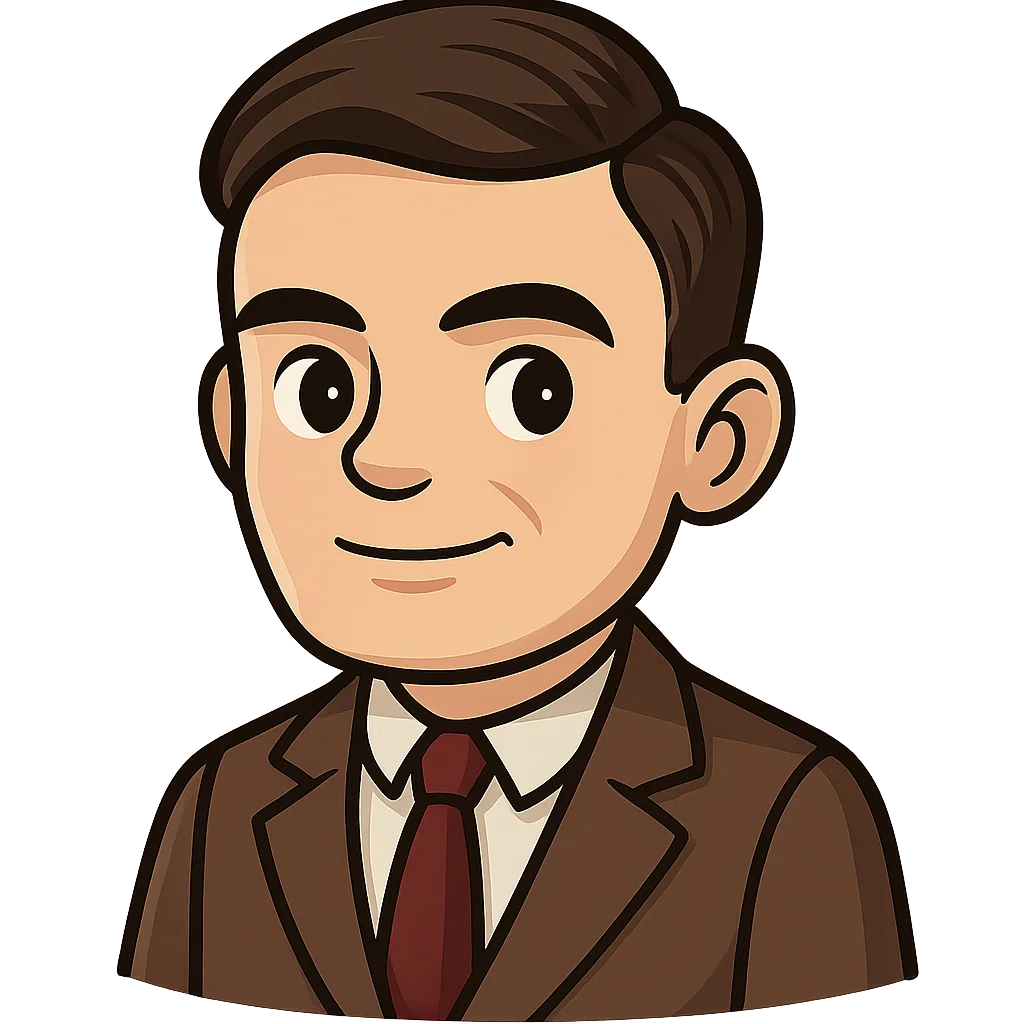
Alan Turing: The Man Who Cracked the Code
Hello, my name is Alan Turing, and I am often called the father of modern computing. My story is one of numbers, puzzles, and secret codes, but it began in a world that was just starting to grasp the power of machines. I was born in London, England, on June 23rd, 1912, into a world without smartphones or laptops. From my earliest days, I was captivated by the world of science and mathematics. While other children were playing with toys, I was conducting chemistry experiments in my home and was fascinated by how things worked. I even taught myself to read in just three weeks so I could dive into a book called “Natural Wonders Every Child Should Know.” My mind didn't work like everyone else's. At school, my teachers were often frustrated because I preferred solving complex mathematical problems to studying the classics like Latin and Greek. They didn't understand that I saw the world as a giant puzzle, waiting to be solved.
Everything changed when I met my dear friend, Christopher Morcom. He was just as passionate about science and mathematics as I was. We would spend hours discussing everything from quantum mechanics to astronomy, dreaming of one day studying together at the University of Cambridge. Christopher understood my way of thinking, and for the first time, I felt I had found a true intellectual companion. But tragedy struck in February of 1930 when Christopher suddenly fell ill and passed away. His loss was devastating, but it also ignited a profound question within me: what is a human mind? Is it just a machine? Could a machine be built that could think like a person? This question would guide the rest of my life's work, pushing me to explore the very boundaries of logic and consciousness and to understand the mechanics of thought itself.
My dream of attending the University of Cambridge came true, and it was there, at King's College, that my ideas truly began to flourish. In 1936, I published a paper that introduced a concept that would change the world. I called it a “universal computing machine.” Imagine a single machine that could solve any problem you gave it, from calculating a mathematical equation to playing a game of chess, as long as you provided it with the correct instructions, or what we now call a program. This theoretical device, later known as a Turing Machine, was the blueprint for every computer that exists today. My work was groundbreaking, but soon the world would need my skills for a very different, and much more urgent, purpose. In 1939, as World War II began to cast its shadow over Europe, I was summoned to a secret location known as Bletchley Park. My country needed me for a mission of the utmost importance: to break the German codes. The greatest challenge was a machine called Enigma. It was used by the German military to send encrypted messages, and its code was considered unbreakable. The machine had millions upon millions of possible settings that changed every single day. The task seemed impossible, and the lives of thousands depended on our success.
At Bletchley Park, I was not alone. I worked with a team of brilliant minds, including the gifted mathematician Joan Clarke. We worked tirelessly, day and night, under immense pressure. It was clear that we couldn't break the Enigma code by hand; we needed a machine to fight a machine. Drawing on my ideas about universal computation, I helped design an electromechanical device we called the “Bombe.” It wasn't a thinking machine, but a logical one. It rattled through thousands of possible Enigma settings at incredible speed, searching for contradictions that would reveal the correct key for the day. Each time the Bombe clicked to a halt, it meant we had found a clue, a small opening into the enemy's most secret communications. It was a race against time every single day, but slowly and surely, we began to unlock the secrets that were vital to the war effort.
Our success at Bletchley Park had a profound impact. Historians now believe that breaking the Enigma code shortened the war by at least two years, saving countless lives. Yet, for decades, my work and the work of my colleagues remained a closely guarded secret, bound by the Official Secrets Act. After the war ended in 1945, I turned my attention back to my dream of creating a true thinking machine. I worked on designing some of the world's first programmable computers, like the Automatic Computing Engine, or ACE. I also proposed a test, which became known as the “Turing Test,” to determine if a machine could exhibit intelligence indistinguishable from a human's. I was asking questions about artificial intelligence long before it became a popular field of study. However, the world in the 1950s was not always a kind or accepting place. Because of who I was, I faced persecution under the intolerant laws of the time, which brought my career to a devastating halt. On June 7th, 1954, my life came to a tragic and early end.
Though my own story ended in sadness, my ideas lived on. The universal machine I dreamed of is no longer just a theory; its principles are at the heart of the computer you are using right now, the phone in your pocket, and the digital world that connects us all. My work was once a secret, but it eventually came to light, revealing the hidden story of how codebreakers helped win a war. I hope my story reminds you that sometimes the people who seem different are the ones who imagine things no one else can. Don't be afraid to ask big questions and to follow your own unique path. Your curiosity and your ideas have the power to change the world, even if it takes the world a little while to catch up.
Reading Comprehension Questions
Click to see answer