

 English

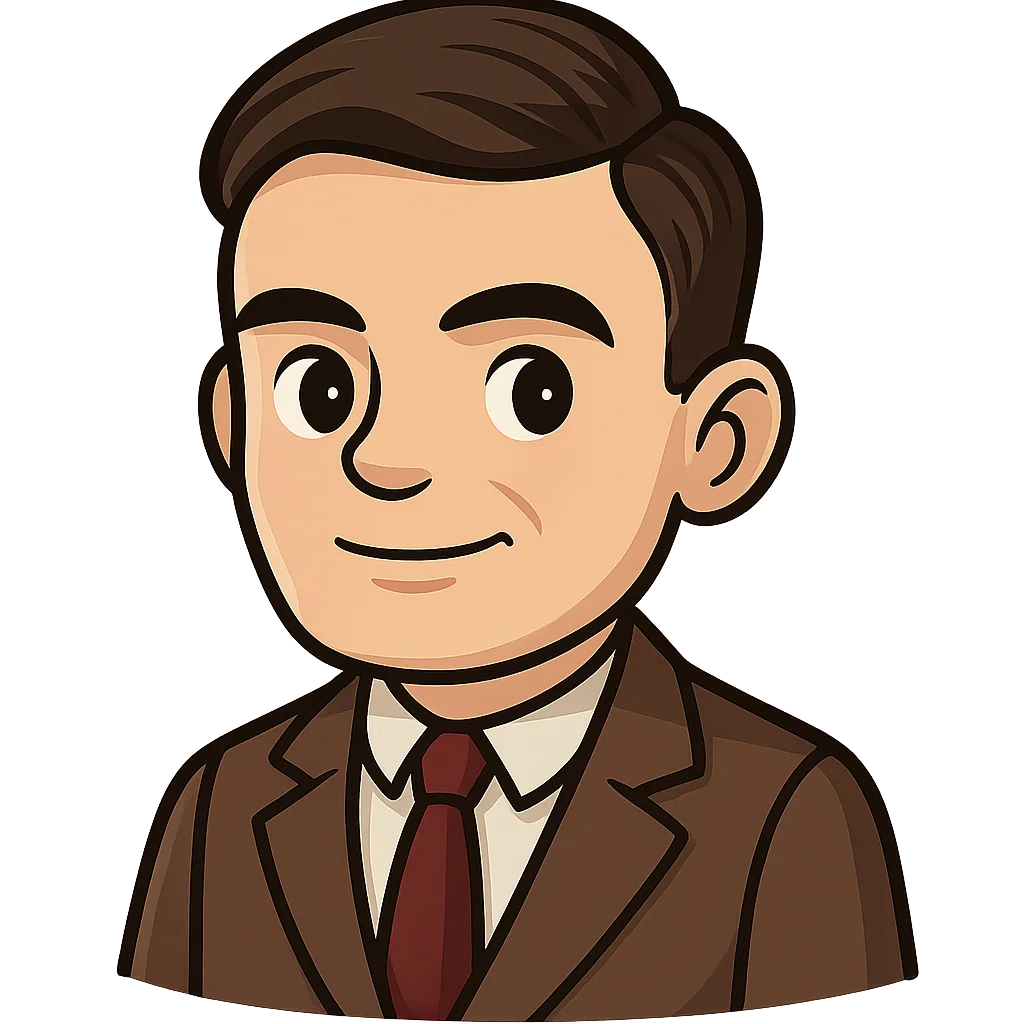
Alan Turing: The Boy Who Cracked the Code
Hello there! My name is Alan Turing. Long before I was known for my work with computers and codes, I was just a boy who saw the world as one giant, fascinating puzzle. I was born in London, England, on June 23rd, 1912. Even when I was very little, I wasn't as interested in games as I was in numbers and science. I loved figuring out how things worked! I once taught myself to read in just three weeks. At school, I met a wonderful friend named Christopher Morcom. He was as curious as I was, and we loved talking about science and ideas. He made me believe that I could achieve great things, and his friendship inspired me to learn as much as I could about the world and the human mind.
As I grew older, my love for puzzles turned into a love for mathematics. I went to the famous University of Cambridge, where I spent my days thinking about very big questions. One question really stuck with me: could a machine be made to think? I imagined a special kind of machine, one that could solve almost any problem you gave it, as long as you gave it the right instructions. I called it a 'universal machine.' It wasn't a real machine made of metal and gears just yet; it was an idea. It was the blueprint for what you now call a computer! I believed that if you could break down any task into simple steps, a machine could do it. This idea would become very important later in my life.
Then, a very serious event happened: World War II began in 1939. The world was in trouble, and I knew I had to help. I was asked to join a top-secret team at a place called Bletchley Park. Our job was to solve the enemy's most difficult puzzle. The German military used a special machine called Enigma to send secret messages. Enigma looked like a typewriter, but it scrambled messages into a code that seemed impossible to break. Every single day, the code changed, so we were in a constant race against time. My team and I worked day and night. Using my idea of a 'universal machine,' I helped design a giant, clanking, whirring machine to help us. We called it the 'Bombe.' It was like an enormous mechanical brain that could check thousands of possibilities much faster than a person could. It was hard work, but we were a team of puzzle-solvers, including brilliant people like Joan Clarke and Gordon Welchman. Finally, we did it. We cracked the Enigma code! Our work was a secret for many years, but it helped the war end sooner and saved so many lives.
After the war, I wanted to turn my dream of a 'thinking machine' into a real one. I designed one of the world's very first computers, called the Automatic Computing Engine, or ACE for short. It was huge and filled an entire room! I also came up with a fun game to test if a computer was truly 'thinking.' It's called the 'Turing Test.' Imagine you're texting with two others, but one is a person and one is a computer. If you can't tell which is which, then the computer has passed the test! It was my way of asking a question that people still think about today: what does it really mean to be intelligent?
My life had many challenges. My ideas were sometimes so new that people didn't understand them, and I was not always treated kindly for being different. I passed away on June 7th, 1954, long before the world could see what my ideas would become. But I like to think my story didn't end there. The seed of an idea I had—the 'universal machine'—grew into the computers, smartphones, and laptops you use every day. Every time you play a game, search for information, or talk to a friend online, you are using a piece of my dream. So, always stay curious. Keep asking questions and solving puzzles, big or small. You never know which idea might just change the world.
Activities
Take a Quiz
Test what you learned with a fun quiz!
Get creative with colors!
Print a coloring book page of this topic.







 Free for Educators