English
 Continue with Google
 Continue with Apple

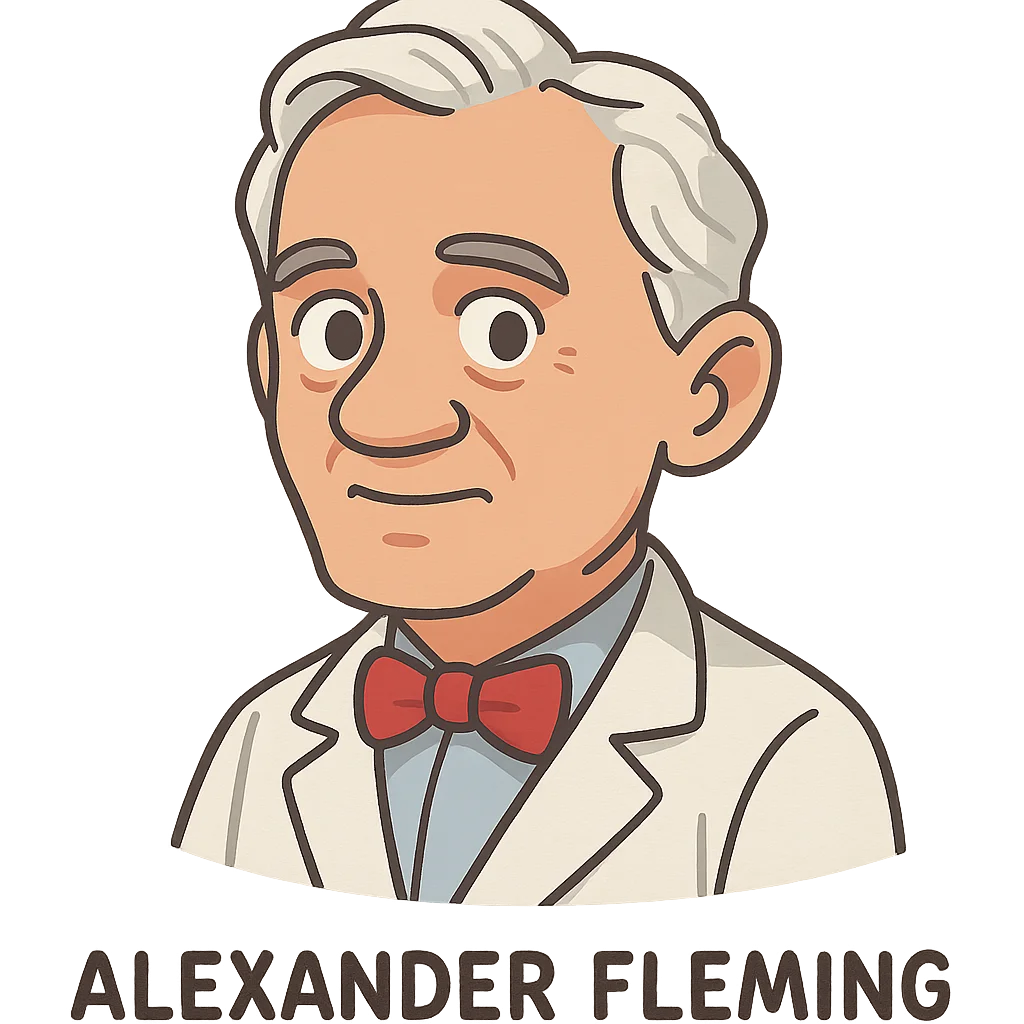
Alexander Fleming: The Accidental Scientist
Hello! My name is Alexander Fleming. I am going to tell you the story of how my messy desk led to one of the most important discoveries in medicine. I was born on a farm in Scotland on August 6th, 1881. Growing up in the countryside, I loved exploring the outdoors and learning all about nature. When I was a teenager, my family moved to London. It was a very different world from the farm! After thinking about what I wanted to do, I decided in 1901 to study medicine at St. Mary's Hospital Medical School, which was a very exciting step for me.
A few years after I became a doctor, a very big war started, known as World War I. From 1914 to 1918, I served as a doctor in the army, helping to care for injured soldiers. It was a very sad time. I saw that many soldiers would get sick from simple cuts and wounds because their injuries would get infected with bad germs called bacteria. The medicines we had back then could not stop the infections from spreading. Seeing this happen over and over again made me determined to find a better way to fight these dangerous germs and save people's lives.
After the war, I returned to my laboratory at St. Mary's Hospital to continue my research. I have to admit, I was not the tidiest scientist! My desk was often cluttered with experiments. In September of 1928, I came back to my lab after being away on a holiday. Before I left, I had forgotten to clean up some of my petri dishes, which are little plates used for growing germs. I noticed something very strange on one of them. A fuzzy green mould was growing on the dish, but the really interesting part was what was happening around it. In a circle all around the mould, the bacteria I had been growing had completely disappeared! It was as if the mould had a secret weapon that was destroying the germs.
I was so curious about what I had found. I carefully took a sample of the mould to study it. I learned that it was from the Penicillium family of moulds. I began doing many experiments and discovered that the 'juice' from the mould was a powerful killer of many types of harmful bacteria. Because the mould was a type of Penicillium, I decided to call my discovery 'penicillin.' I was very excited and wrote about my findings in a science paper in 1929. However, it was very difficult to make enough of the mould juice to use as a real medicine, so for many years, my discovery was not widely used.
About ten years after I published my paper, two other brilliant scientists, Howard Florey and Ernst Boris Chain, read about my work. During the 1940s, they figured out a way to grow the mould and make large amounts of penicillin. It became a true miracle drug, especially during the next big conflict, World War II, where it saved the lives of thousands of soldiers who would have otherwise died from infections. I was so proud that my accidental discovery could finally help so many people. In 1945, the three of us—Howard Florey, Ernst Boris Chain, and I—were awarded the Nobel Prize for our work.
I continued my work as a scientist for many more years after that. I lived to be 73 years old, passing away in 1955. People remember me for noticing that little bit of mould on a dirty dish and being curious enough to find out why it was there. My discovery of penicillin started the age of antibiotics, which are special medicines that fight bacteria and have saved millions and millions of lives all over the world. It just goes to show that sometimes, a little bit of mess and a lot of curiosity can change the world for the better.
Reading Comprehension Questions
Click to see answer