
 English
 For Schools
 For Homeschool

The Story of Anne Frank
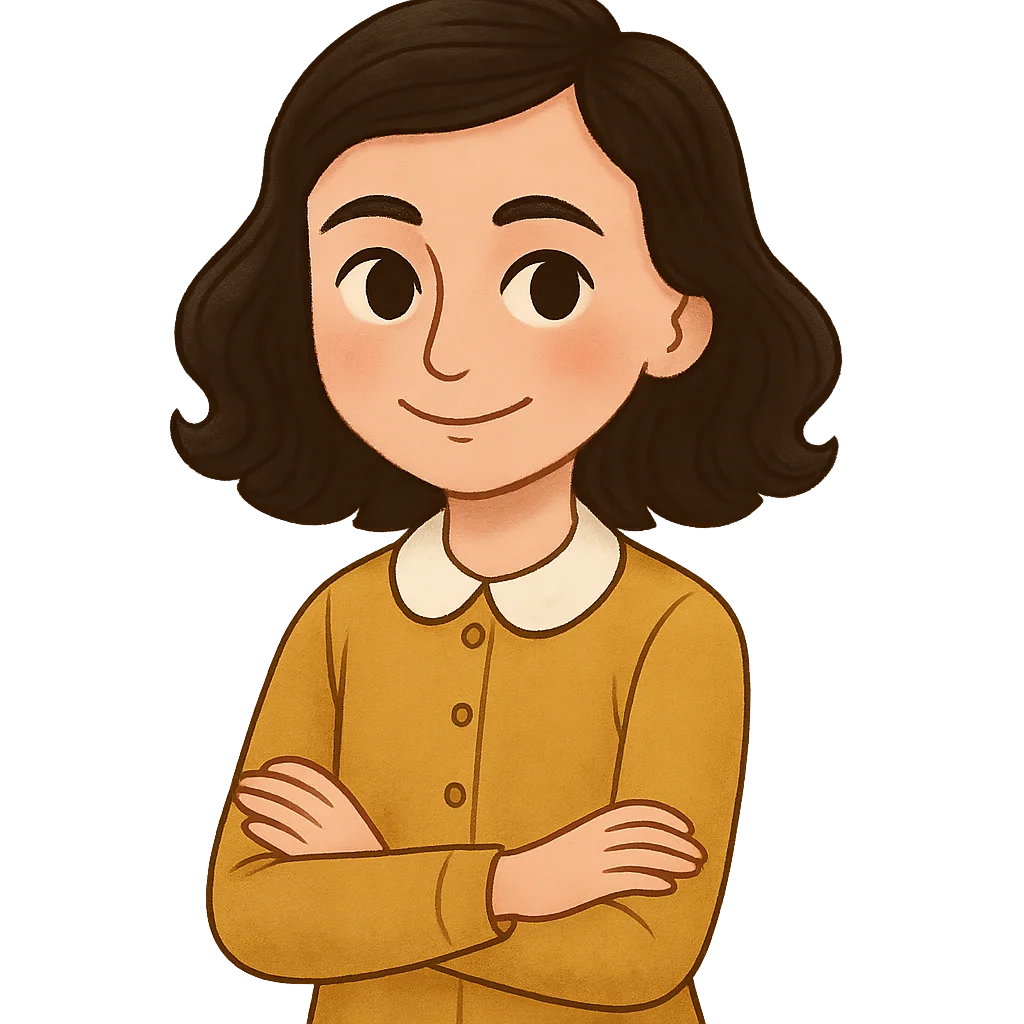
Hello. My name is Annelies Marie Frank, but everyone who knew me called me Anne. I want to tell you my story. I was born in a city called Frankfurt, in Germany, on June 12th, 1929, into a world that felt full of sunshine and laughter. My early years were happy ones, filled with the love of my family. There was my wise and gentle father, Otto, my loving mother, Edith, and my quiet, clever older sister, Margot. We were a Jewish family, and for a while, that was simply a part of who we were. But the world outside our home was changing. In the early 1930s, a man named Adolf Hitler and his Nazi party came to power in Germany. They blamed Jewish people for the country’s problems and began passing laws that took away our rights and our safety. My parents saw the growing danger, and in 1934, when I was only five years old, they made the difficult decision to leave our home and our country behind. We moved to Amsterdam in the Netherlands, a city of canals and bridges, hoping for a new and safer life. And for a time, it was wonderful. I learned to speak Dutch, made new friends at my Montessori school, and felt like a normal girl again. I was bubbly and talkative, sometimes a little mischievous, and I loved to read, write, and dream of one day becoming a famous writer or a movie star. I felt free, and I believed the worst was behind us.
That feeling of freedom did not last. In May of 1940, the Nazi army invaded the Netherlands, and the darkness we had fled from in Germany found us once again. Slowly, our world began to shrink. Laws were passed that forbade Jewish people from owning businesses, going to public parks, or even riding bicycles. Margot and I had to leave our school and attend a separate one just for Jewish children. We had to wear a yellow Star of David on our clothes so that everyone would know who we were. Fear became a constant shadow in our lives. For my 13th birthday, on June 12th, 1942, I received a gift that would become my most treasured possession: a red-and-white-plaid notebook. I decided to use it as a diary, and I named her Kitty. To Kitty, I could confide all my secret thoughts, my frustrations, and my dreams. I never imagined how important she would become. Just a few weeks later, on July 5th, 1942, a terrifying letter arrived. It was a call-up notice for Margot, ordering her to report to a so-called 'work camp' in Germany. My parents knew this was a lie; it was a transport to a concentration camp, a place of unimaginable horror. There was no more time to wait. That very night, my father told us that we would be going into hiding the next day.
On July 6th, 1942, my family and I walked through the pouring rain to our hiding place, which I called the 'Secret Annex.' It was a hidden set of rooms in the back of my father’s office building, concealed behind a movable bookcase. We were soon joined by another family, the van Pels—Hermann, Auguste, and their teenage son, Peter—and later by a dentist named Fritz Pfeffer. Eight of us lived together in that small, cramped space for over two years. Our lives were governed by rules and fear. During the day, when workers were in the building below, we had to be completely silent. We couldn't walk in shoes, speak above a whisper, or even flush the toilet. At night, we listened to the radio for news of the war, praying for it to end, while the sounds of sirens and bombs filled the air outside. We had brave helpers, like Miep Gies, who risked their own lives to bring us food and books. But living so closely together was incredibly difficult. We had arguments and disagreements, and I often felt lonely and misunderstood. Through it all, my diary, Kitty, was my one true confidante. I wrote to her every day, pouring out my heart about my fears for the future, my annoyance with the other residents, my changing relationship with my mother, and my hopes for a better world. I wrote about my own growth, my thoughts on human nature, and my budding friendship, and eventually affection, for Peter van Pels. In the pages of my diary, I was not a prisoner; I was still Anne, a girl with dreams.
For 761 days, we lived in the shadows, hoping for liberation. But on the morning of August 4th, 1944, our worst fear came true. We were discovered. Police stormed the annex, and we were all arrested. Our hiding place was no longer a secret. From there, my family and the others were sent on a terrible journey to concentration camps. We were separated, and the horrors we faced were greater than anything I could have imagined. My sister Margot and I were eventually moved to the Bergen-Belsen camp in Germany. The conditions there were horrific, and disease was everywhere. In the cold of early 1945, just weeks before the war in Europe ended, both Margot and I fell ill with typhus, and our lives came to an end. But my story did not end there. Of the eight people from the Secret Annex, only one survived: my dear father, Otto. When he returned to Amsterdam after the war, our helper Miep Gies gave him my diary, which she had found scattered on the floor after our arrest. Reading my words, my father learned about the daughter he knew and the young woman I was becoming. He decided to fulfill my greatest dream—to be a writer whose work lived on after her death. He had my diary published. Even though my life was cut short, my voice was not silenced. My words have traveled across the world, telling my story to millions. I hope they serve as a reminder that even in the darkest of times, it is possible to find hope, to believe in the good of people, and to stand up against intolerance and hatred so that such a thing may never happen again.
Activities
Get creative with colors!
Print a coloring book page of this topic.