English
 Continue with Google
 Continue with Apple

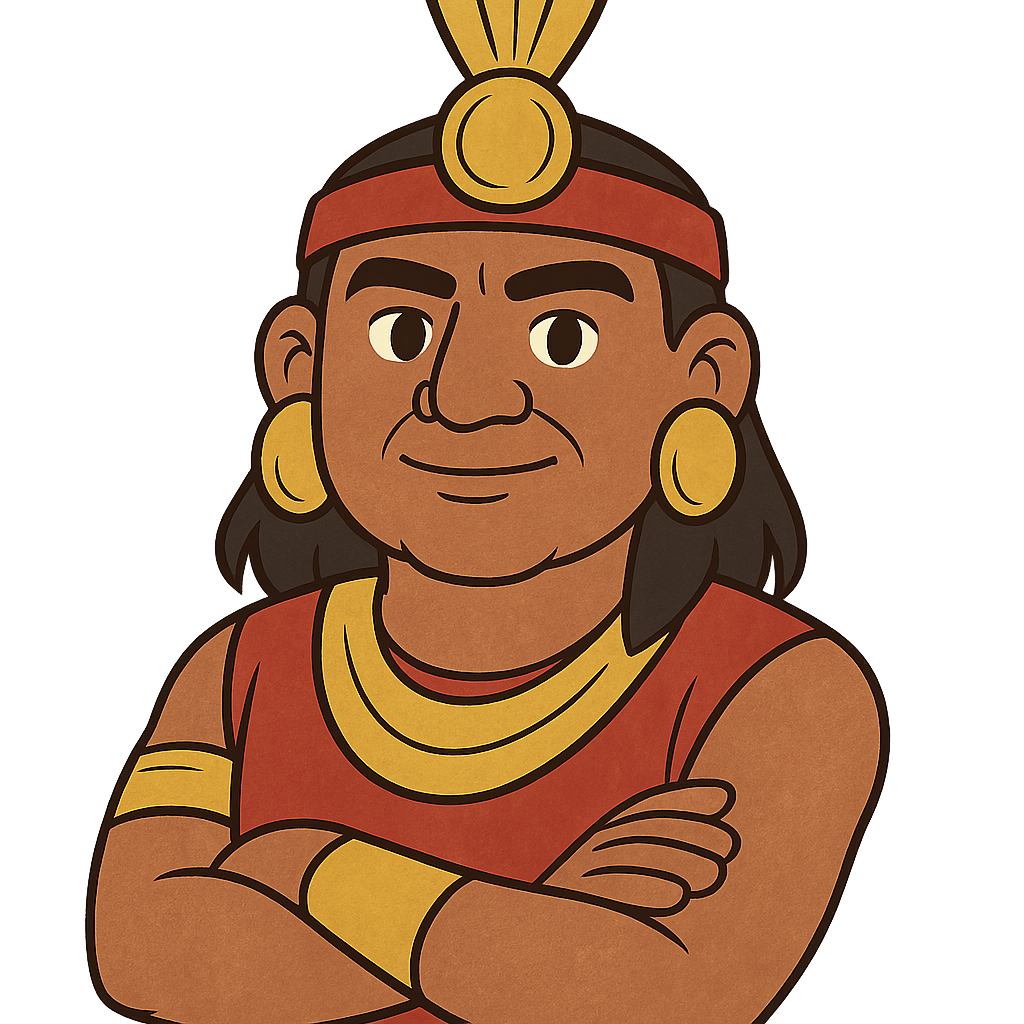
Atahualpa: The Last Inca
My name is Atahualpa, and I was the last Sapa Inca to rule over a free and mighty empire. My story is one of greatness, tragedy, and the unyielding spirit of my people. I was born a prince, the son of the great Sapa Inca, Huayna Capac, who ruled over the vast and powerful Inca Empire. Our home was not a country as you might know it, but a magnificent realm called Tawantinsuyu, which means 'The Four Regions Together.' It stretched thousands of miles along the towering Andes Mountains, a land of breathtaking peaks and fertile valleys. Growing up in the northern city of Quito, I learned what it meant to be a leader. I was trained in the arts of warfare, strategy, and governance, for it was my duty to be strong and wise for my people. I watched in awe as our empire thrived. We built incredible cities of stone, like the magnificent Cuzco and the sky-high fortress of Machu Picchu, all without the use of wheels or mortar. An incredible system of roads, spanning over 25,000 miles, connected every corner of our realm. Our swift-footed messengers, the chasquis, could carry messages from one end of the empire to the other in a matter of days. We had no written language, but we kept detailed records using a clever system of knotted strings called quipus. Our society was orderly and organized, and I was proud to be part of it, destined to help protect it.
Our world changed in an instant around the year 1527. A strange and terrible illness, one we had never seen before, swept through our lands like a silent fire. It took my father, the great Huayna Capac, and also his chosen heir, my older brother Ninan Cuyochi. Suddenly, our empire, which had seemed so strong and eternal, was left without a clear leader. My father, in his final days, made a decision he thought would bring peace: he divided the empire. He gave the northern territories to me, to rule from Quito, while my half-brother, Huáscar, was to rule the southern heartland from our capital city of Cuzco. But a kingdom divided cannot stand strong. Soon, suspicion and jealousy grew between us. Huáscar saw me as a threat to his authority, and I believed I was the more capable warrior and leader, having spent my years with my father's armies. The tension between us finally broke, and a devastating civil war erupted. Brother fought against brother, and the empire bled. For five long years, from 1527 to 1532, my armies battled Huáscar's forces across the mountains and valleys of our homeland. My generals were brilliant, and my soldiers were brave. In 1532, we finally achieved victory. Huáscar was captured, and I became the one true Sapa Inca, ruler of a unified Tawantinsuyu. I thought the hardest battle had been won, but I had no idea a far greater storm was gathering on the horizon.
Just as I was celebrating my victory and preparing to march to Cuzco to be formally crowned, I received strange news. Messengers reported the arrival of a small group of bearded men who had come from the sea. They rode upon enormous, powerful animals we had never seen before and carried sticks that made the sound of thunder and spat fire. Their leader was a man named Francisco Pizarro. I was curious, but not afraid. How could a mere 180 men be a threat to me, the Sapa Inca, with an army of eighty thousand loyal warriors at my command? I believed they were mortals, not gods, and I was confident I could deal with them easily. I agreed to meet them in the mountain city of Cajamarca. On November 16th, 1532, I arrived in the city's main square, carried on a magnificent golden litter and surrounded by thousands of my attendants and warriors, who were largely unarmed to show our peaceful intentions. The square seemed eerily empty. Pizarro and his men were hiding. Suddenly, the thunder of their cannons echoed off the stone buildings, and their soldiers charged out on their massive beasts, which I later learned were called horses. They wore shining metal armor that our weapons could not pierce. Chaos and terror erupted. My people were confused and frightened by the noise, the smoke, and the terrifying sight of men on horseback. It was not a battle; it was an ambush, a trap. In the confusion, I was pulled from my litter and taken prisoner. My world, and the world of the Inca, had been shattered in a single afternoon.
I was now a captive, a king in chains. Though imprisoned, I was still the Sapa Inca, and I observed my captors closely. I saw their insatiable hunger for gold and silver, the precious metals my people used for art and ceremony. Believing I could buy my freedom, I made Pizarro an incredible offer. I promised to fill the large room I was held in once with gold and twice over with silver. Pizarro agreed. For months, my loyal subjects traveled across the empire, stripping temples and palaces of their treasures to deliver the ransom. They brought llamas laden with gold artifacts and silver statues, a treasure beyond anything the Spanish had ever imagined. The room was filled, just as I had promised. But the Spanish were not honorable men. They broke their word. Instead of freeing me, they melted down our sacred works of art into plain bars of metal. Then, they put me on trial, accusing me of ridiculous crimes like treason against them, the invaders of my own land. On July 26th, 1533, they executed me. My death marked the end of an era. I was the last independent Sapa Inca, the final ruler of a magnificent empire before it fell under foreign control. Though my reign was cut short and my life ended in betrayal, the story of my people did not end with me. The spirit of the Inca, our culture, our language, and our resilience, lives on in the mountains of Peru and in the hearts of our descendants to this day.
Reading Comprehension Questions
Click to see answer