

 English

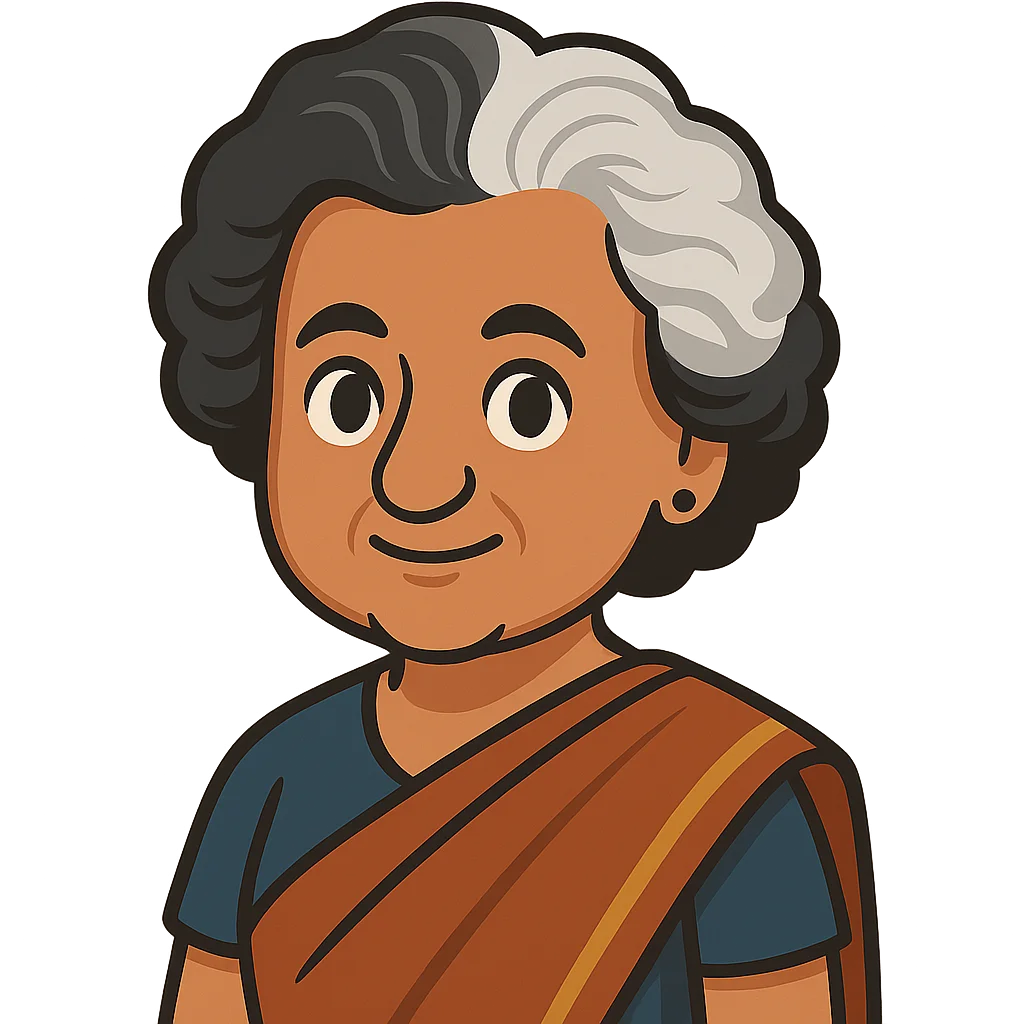
Indira Gandhi: A Daughter of India
Hello, my name is Indira Gandhi, and I had the great honor of serving my country as its first female Prime Minister. But my story doesn't begin in a grand office. It begins in a house that was the very heart of a revolution. I was born on November 19th, 1917, in Allahabad, India. My family affectionately called me 'Indu,' which means 'moon.' My childhood was unlike any other. Our home was always filled with serious discussions and important visitors because my family was at the center of India's struggle for independence from British rule. My father, Jawaharlal Nehru, and our dear family friend, Mahatma Gandhi, were leading figures in this movement. They taught me that our country's freedom was the most important cause we could fight for.
I learned this lesson deeply, even as a little girl. At the time, we were encouraged to use only Indian-made goods to strengthen our economy, a movement called 'Swadeshi.' I had a beautiful doll that was made in England, and I loved it very much. But I knew that keeping it went against everything we were fighting for. With a heavy heart, I built a small bonfire and placed my doll in the flames. It was my own small sacrifice for India. My desire to help didn't stop there. I gathered the children in my neighborhood to form a group we called the 'Vanar Sena,' or 'Monkey Brigade.' We acted as little spies, carrying secret messages for the freedom fighters, sewing flags, and running errands. We might have been small, but our hearts were filled with a big purpose: to see our country free.
My education was a journey that took me far from home but brought me closer to understanding the world. I studied in schools in India, Switzerland, and at Oxford University in England. These experiences opened my eyes to different cultures and ideas, but they also made me miss my homeland deeply. During this time, my mother, Kamala, became very ill. I left my studies to be by her side in Europe, caring for her until she passed away. It was a time of immense sadness, but it also taught me a profound lesson in strength and responsibility. It was also in Europe that I reconnected with a young man named Feroze Gandhi. We fell in love and decided to get married, which we did on March 26th, 1942, after returning to India. Our marriage was a partnership of love and shared ideals.
After we married, Feroze and I were both arrested for participating in the independence movement. After our release, we started our family, and I became a mother to two wonderful sons. My life changed forever on August 15th, 1947, when India finally achieved its independence, and my father became its first Prime Minister. I moved to the capital, New Delhi, to be with him. I became his official hostess, welcoming world leaders and managing the household, but my role was much more than that. I was his confidante, his advisor, and his student. I traveled the country with him, listening to the concerns of farmers, workers, and families. I saw firsthand the immense challenges our new nation faced. This period was my true political education, preparing me for a path I had not yet imagined for myself.
After my father's death in 1964, I was appointed to a government post, but I never expected what came next. On January 24th, 1966, I was chosen to be the Prime Minister of India. The weight of leading a nation of over 500 million people was immense, but I was determined to make India strong and self-sufficient. I knew our country's greatest challenge was feeding our people. I championed a program called the 'Green Revolution,' which introduced modern farming techniques and high-yield seeds. It was a tremendous success, and for the first time, India could grow enough food to feed its entire population. I also wanted to ensure our economy worked for everyone, not just the wealthy. In 1969, I made the bold decision to nationalize the country's major banks, which meant the government took control of them to provide loans and services to small farmers and business owners who had been ignored before.
One of the defining moments of my leadership came in 1971. A terrible conflict had broken out in neighboring East Pakistan. Millions of refugees were fleeing into India, and we chose to support their fight for freedom. Our armed forces acted swiftly and decisively, leading to a victory that resulted in the birth of a new, independent nation: Bangladesh. This victory was not just a military one; it was a moment of immense pride for all Indians. It showed the world that our nation was a force for justice and strength on the global stage. My goal was always to lift my people out of poverty and give them a sense of dignity and hope, and in these achievements, I saw that hope beginning to shine brightly.
Leadership is never a straight path; it is filled with storms and difficult choices. By the mid-1970s, India was facing serious problems, including economic hardship and political protests that were creating chaos across the country. I felt our democracy was in danger. In 1975, I made the most difficult and controversial decision of my career: I declared a 'State of Emergency.' During this period, which lasted until 1977, some civil liberties were suspended, and political opponents were arrested. I believed it was necessary to restore order, but many people felt I had gone too far. When I called for an election in 1977, the people of India voted me out of office.
Losing the election was a painful but valuable lesson. It taught me humility and reminded me that in a democracy, the people's trust is everything. I spent the next three years traveling across the country, meeting ordinary citizens in small villages and towns. I listened to their problems and worked to understand where I had gone wrong. I worked tirelessly to rebuild their faith in me. My efforts paid off, and in the election of 1980, the people of India voted me back into power as Prime Minister. That comeback taught me that it is possible to face failure, learn from it, and emerge stronger and more determined than before.
My entire life was dedicated to a single, powerful idea: a strong, unified, and self-reliant India. I wanted our nation to stand on its own feet, proud and independent, and to ensure that every citizen, no matter how poor, had the opportunity to succeed. My path was not an easy one, and it was filled with dangers. My journey came to a tragic end on October 31st, 1984, when I was assassinated by my own bodyguards. But even in the face of death, my love for my country never wavered. I hope to be remembered not for the power I held, but for the fierce dedication I had for the people of India. My message to you is this: find a cause greater than yourself, serve it with all your heart, and never be afraid to lead. True strength comes from within, and every one of you has the power to make a difference in the world.
Activities
Take a Quiz
Test what you learned with a fun quiz!
Get creative with colors!
Print a coloring book page of this topic.














 Free for Educators