

 English

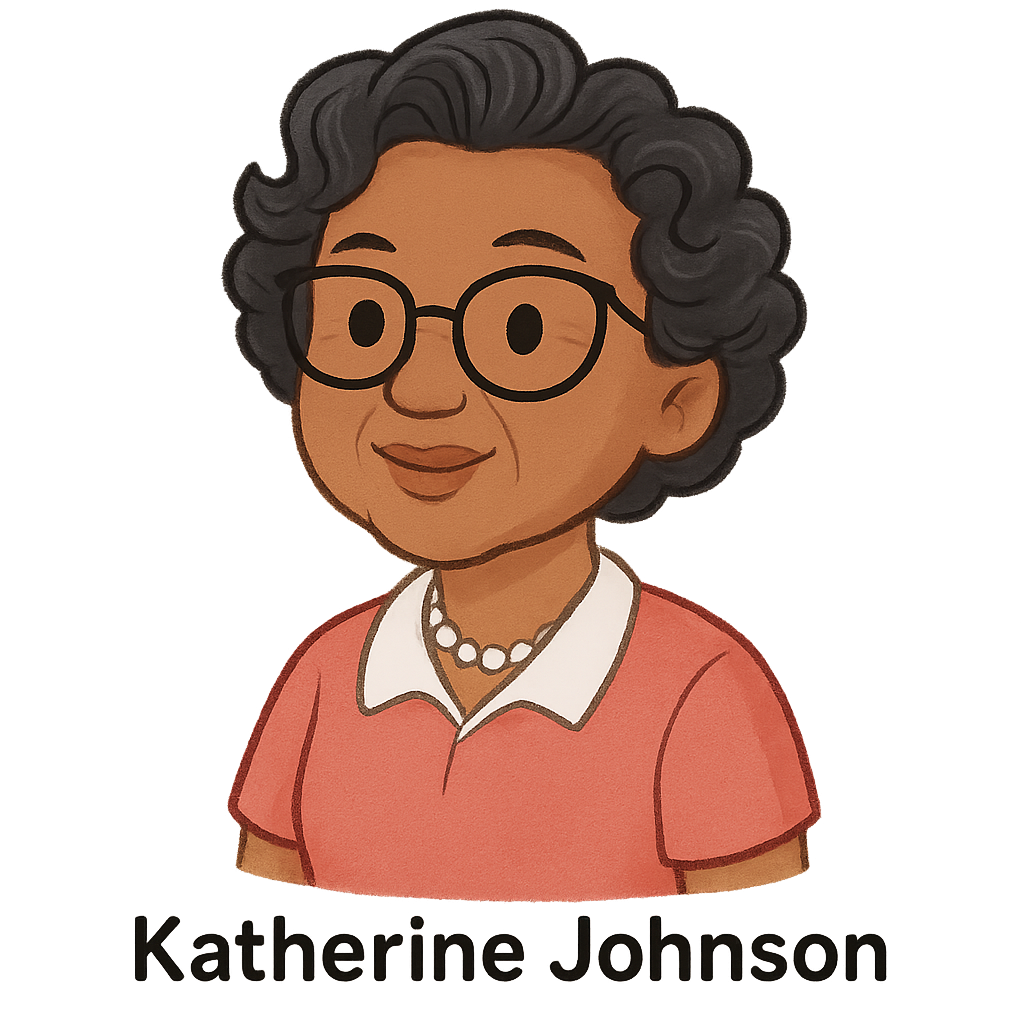
Katherine Johnson: The Girl Who Loved to Count
Hello there. My name is Katherine Johnson, and I want to tell you a story about numbers, stars, and believing in yourself. My journey began in a small town called White Sulphur Springs, West Virginia, where I was born on August 26th, 1918. From my earliest days, the world seemed like a giant puzzle, and numbers were the key to solving it. I counted everything. I counted the steps to the road, the plates on the table, the stars in the night sky. Numbers weren't just for school; they were a language I understood better than anything else. But in the 1920s, the world had rules that were hard to understand. In my town, schools for African American children like me only went up to the eighth grade. My parents knew my mind was hungry for more, so they made a decision that changed my life. They decided our family would move 120 miles away to a town where I could attend high school. Because I had learned so much so quickly, I started high school when I was only ten years old. I flew through my studies and graduated from college at eighteen. It was there I met a brilliant professor named Dr. W. W. Schieffelin Claytor, who saw something special in me. He created advanced math classes just for me, pushing me to solve problems that were far beyond what anyone expected. He prepared me for a future I couldn't yet imagine.
After college, my life took a more ordinary path for a while. I got married, started a family, and became a teacher, sharing my love of math with my students. But in my heart, I still yearned for bigger challenges. Then one day in 1952, I heard about an opportunity that made my heart race. A government agency called the National Advisory Committee for Aeronautics, or NACA, was hiring. They were looking for African American women to work in a special department, and their job title was 'computer.' In those days, before the electronic computers we know today, a 'computer' was a person. We were the ones who did all the complex calculations by hand, using our minds, pencils, and slide rules. In 1953, I took a job at their research center in Virginia, joining an all-black department called the West Area Computing unit. It wasn't always easy. The world was segregated then, which meant there were separate bathrooms and cafeterias for black and white employees. But I didn't let that stop me. I was there to do the math. I wasn't content to just get a stack of numbers to work on; I wanted to know the 'why' behind them. I started asking questions. I asked if I could go to the meetings with the male engineers. At first, they said no, but I was persistent. I knew that to do my job right, I had to understand the whole picture. Eventually, they let me in, and I proved that my mind belonged in that room just as much as anyone else's.
Everything changed in 1958 when NACA became NASA. Suddenly, we weren't just studying airplanes; we were in a race against the Soviet Union to explore space. The energy was electric. I was moved to the Flight Research Division, and my calculations became part of America’s first adventures beyond Earth. I plotted the exact path for Alan Shepard’s historic flight on May 5th, 1961, when he became the first American in space. It was thrilling work, but my most famous challenge was yet to come. In 1962, NASA was preparing to send astronaut John Glenn into orbit around the Earth, a feat no American had ever accomplished. To do this, NASA was using a brand-new electronic computer to calculate his trajectory. But John Glenn was a pilot, and he trusted people more than he trusted machines. He knew that one small error in the calculations could be disastrous. Before he would agree to fly, he asked the engineers to 'get the girl to check the numbers.' That girl was me. He said, 'If she says the numbers are good, I'm ready to go.' The pressure was immense. For days, I worked through the math, my pencil flying across the paper, checking every single calculation the electronic computer had made. The safety of a national hero rested on my work. When I was finished, I confirmed the numbers were correct. John Glenn trusted my math, and his flight was a spectacular success. That day, I felt a sense of pride that I will never forget.
My work on John Glenn's mission proved how essential human intelligence was to the space program. My journey didn't stop there. The next great challenge was even bigger: landing a human on the Moon. As part of the Apollo program, my job was to help figure out how to get there and, just as importantly, how to get back. I calculated the precise trajectory for the Apollo 11 mission. Think about that—I plotted the path that would take the command module to the Moon, allow the lunar lander to separate and land, and then rendezvous with the command module again for the trip home. On July 20th, 1969, when Neil Armstrong and Buzz Aldrin took their first steps on the lunar surface, I knew my numbers had helped make that impossible moment a reality. A few years later, my skills were put to an emergency test during the Apollo 13 mission. When an explosion crippled their spacecraft, the astronauts' lives were in danger. I worked tirelessly with the team to calculate a new, safe path to bring them home. Even after the Moon landings, I continued my work, contributing to the Space Shuttle program until I retired from NASA in 1986, after thirty-three years of service.
Looking back on my life, which came to a peaceful close on February 24th, 2020, it seems like a dream written in the stars. I was just a girl from West Virginia who loved to count, but my curiosity took me all the way to the Moon. I learned that you should never let anyone's limited expectations define you. Ask questions. Be persistent. Always do your best. One of the greatest honors of my life came on November 24th, 2015, when President Barack Obama awarded me the Presidential Medal of Freedom, the highest honor a civilian can receive. It was a wonderful feeling to be recognized for my work. Even more incredible was seeing my story, along with my brilliant colleagues Dorothy Vaughan and Mary Jackson, told in the book and movie 'Hidden Figures.' For so long, we were hidden. But now, our story is out there to inspire everyone. My message to you is simple: Math is powerful. It is the language of the universe. Never be afraid to ask questions, and never doubt your own potential. Find what you love, work hard at it, and you too might just reach the stars.
Activities
Take a Quiz
Test what you learned with a fun quiz!
Get creative with colors!
Print a coloring book page of this topic.










 Free for Educators