English
 Continue with Google
 Continue with Apple

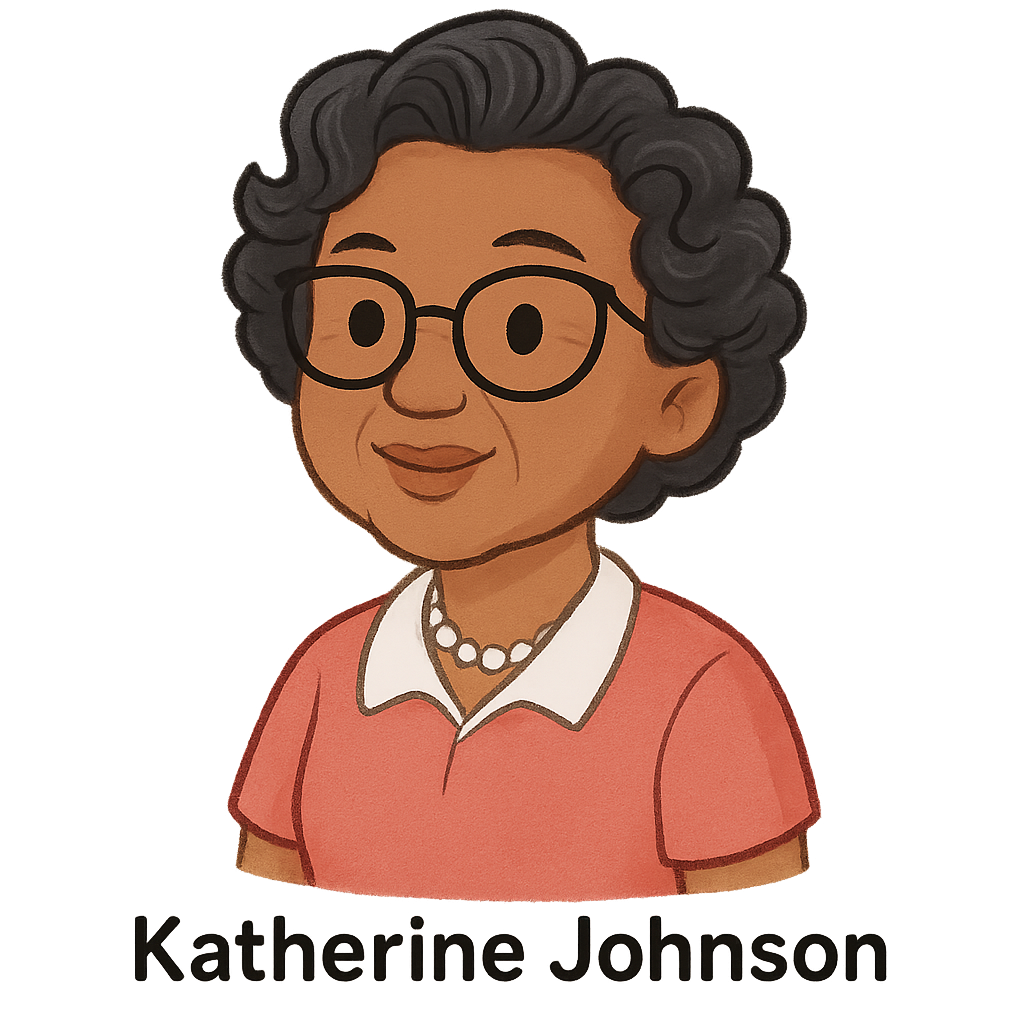
Katherine Johnson: The Girl Who Loved to Count
Hello there. My name is Katherine Johnson, and I've always believed that numbers tell a story. My own story began in a small town called White Sulphur Springs, West Virginia, where I was born on August 26th, 1918. From the moment I could talk, I was counting. I counted the steps to church, the dishes I washed, the stars in the night sky—everything. My mind was always buzzing with questions and numbers. I just couldn't help it. My parents, Joshua and Joylette Coleman, saw this fire in me and knew I needed to learn as much as I could. I loved school so much and was so quick with my lessons that I zoomed right past my classmates. Can you imagine starting high school when you are only ten years old? That was me. But back then, things were not always fair. Our town didn't have a high school for African American children. My father believed so strongly in my education that he moved our entire family 120 miles away to a town where my siblings and I could continue our studies. It was a huge sacrifice, but it showed me how powerful learning was. Because of my family’s support, I finished high school at fourteen and graduated from college when I was just eighteen. My love for numbers was my guide, and it was just the beginning of my journey.
After I finished college and worked as a teacher for a while, I heard about a special place called the National Advisory Committee for Aeronautics, or NACA. You probably know it by its new name: NASA. They were looking for mathematicians, and I knew I had to apply. In 1953, I was hired to be a 'human computer.' That might sound strange today, but before we had electronic computers, people did all the complicated math by hand. My job was to solve long, difficult equations for the engineers who were designing airplanes and, eventually, spacecraft. I worked in a department called the West Area Computing Unit, which was a group made up entirely of African American women. We were separated from the other workers, but our minds and our math were just as powerful. I was never satisfied just doing the math problems they gave me. I wanted to know why. Why was my math important? What was it for? I started asking questions. I asked to go to the meetings where the engineers talked about their plans. At first, they said no because women weren't allowed. But I didn't give up. I kept asking, and I kept showing them that my calculations were perfect. Soon, they realized they needed my brain in those meetings. It was an exciting time. America was in a 'space race' to explore the cosmos. On May 5th, 1961, I felt a nervous thrill as I calculated the flight path, called a trajectory, for Alan Shepard's spaceship. He was about to become the first American to fly into space, and my numbers were helping to guide him there and bring him home safely.
My most famous moment, the one people always ask me about, happened on February 20th, 1962. An astronaut named John Glenn was preparing for a very big mission: to be the first American to orbit, or circle, the entire Earth. By then, NACA had become NASA, and we had big, new electronic computers to figure out his flight path. But John Glenn was a pilot, and he knew that machines could sometimes make mistakes. He trusted people more. Before he climbed into his rocket, he looked at the engineers and said, 'Get the girl to check the numbers. If she says they're good, then I'm ready to go.' I was 'the girl' he was talking about. I spent more than a day re-doing all the math by hand, checking every single number. Knowing that a brave man's life depended on my calculations was a huge responsibility, but I felt so proud that he trusted my mind. My numbers were right, his flight was a success, and it was a giant leap for our country. My work didn't stop there. I later helped calculate the path for the Apollo 11 mission, which landed the first men on the Moon on July 20th, 1969. I retired from NASA in 1986, after a long and exciting career. In 2015, I received the Presidential Medal of Freedom, the highest honor a civilian can get. My journey on Earth ended in 2020 after 101 wonderful years, but I hope my story inspires you. Always be curious, ask questions, and never let anyone tell you that you can't do something just because of who you are.
Reading Comprehension Questions
Click to see answer