English
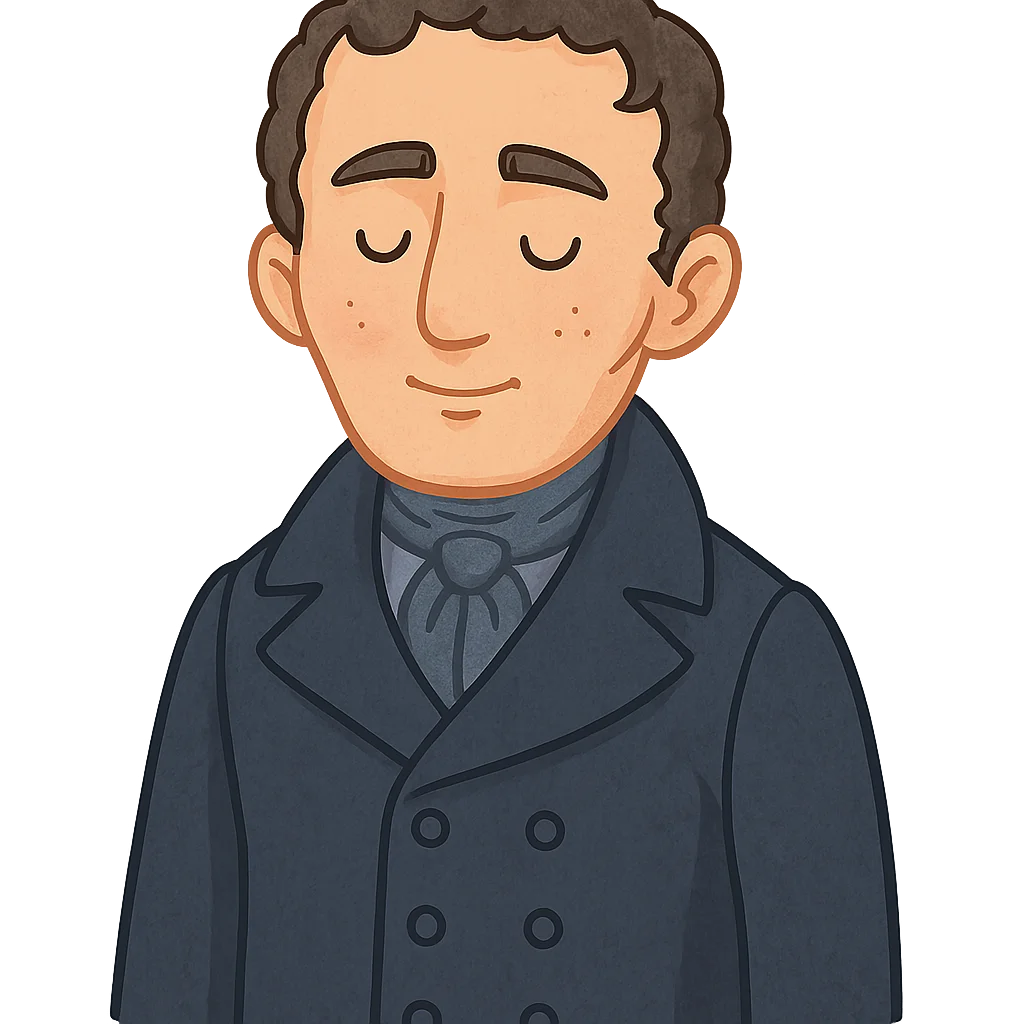
Louis Braille
Hello, my name is Louis Braille, and I want to tell you how I helped open up a world of reading for people who cannot see. My story begins in a small town in France called Coupvray, where I was born on January 4th, 1809. My father, Simon-René, was a leatherworker, and his workshop was my favorite place in the world. It was filled with the smell of leather and the sounds of his tools tapping and cutting. I loved to watch him work and dreamed of helping him one day. But when I was just three years old, a terrible accident happened. I was playing in the workshop and a sharp tool, called an awl, slipped and injured one of my eyes. An infection set in, and soon it spread to my other eye. Slowly, the world went dark, and by the time I was five, I was completely blind. Even though I couldn't see, my mind was still full of curiosity. I wanted to learn, to read books, and to discover everything about the world, just like the other children in my village. I knew there had to be a way.
When I turned ten years old, in 1819, a wonderful opportunity came my way. I was sent to Paris to study at the Royal Institute for Blind Youth. I was so excited to finally go to a real school. There, I discovered they had special books for us. These books had large letters that were raised off the page so you could feel them. But it was very, very slow. You had to trace each complicated letter with your finger, and the books were enormous and heavy. It could take a whole minute just to read one sentence. I was grateful to be able to read at all, but I felt frustrated. I dreamed of reading as quickly as people with sight. Then, in 1821, a soldier named Captain Charles Barbier visited our school. He showed us something he invented for soldiers called “night writing.” It was a code of twelve raised dots that allowed them to read messages on the battlefield in the dark without a light. His system was complicated, and it was based on sounds, not letters. It wasn't perfect, but as I felt those patterns of dots under my fingers, a brilliant idea sparked in my mind. It was like a little light turning on in the darkness.
That spark grew into a fire of determination. From the age of twelve, I spent every moment I could working on a new system. I would sit with my slate and stylus, pressing dots into paper in different patterns, trying to find the perfect code. Captain Barbier’s system used twelve dots, which was too many to feel with one fingertip. My big idea was to make it much simpler. I realized that if I used a small cell of just six dots—two across and three down—I could create every letter of the alphabet, every number, and all the punctuation marks we use. I experimented for hours and hours, often working late into the night. I arranged the dots in different combinations, feeling them with my fingertips until I had a complete system that was easy to learn and fast to read. By 1824, when I was only fifteen years old, I had finished it. I felt a huge sense of joy and excitement. I had created a key that could unlock the world of books for me and so many others.
As I grew older, I became a teacher at the same school where I had been a student. It was my greatest pleasure to share my six-dot system with the children there. I watched their faces light up as they learned to read and write with a speed they had never imagined possible. For the first time, they could take their own notes, write letters to their families, and read books for fun. My system, which people started to call Braille, gave them independence. It took many years for the leaders of the school to officially accept my invention, but I was patient. I knew how much it would change lives. My own life ended after an illness on January 6th, 1852, but my work lived on. Looking back, I am filled with happiness to know that my simple code of six dots has traveled all over the world. It has become a gift, allowing millions of blind people to learn, to imagine, and to connect with the world through the magic of reading.
Reading Comprehension Questions
Click to see answer