

 English

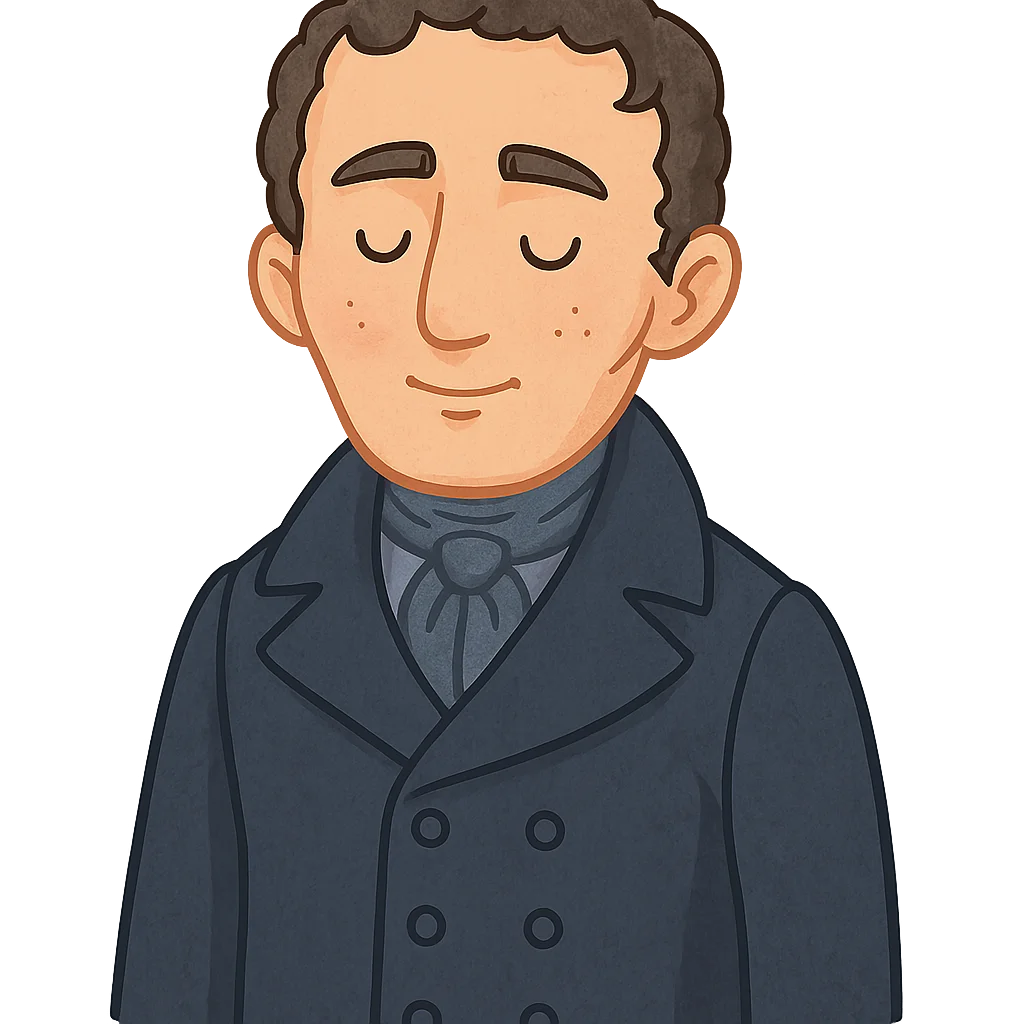
Louis Braille
My name is Louis Braille, and I want to tell you my story. I was born in a small French town called Coupvray on January 4th, 1809. My earliest memories are not of sights, but of sounds and smells. My father, Simon-René Braille, was a harness maker, and his workshop was my favorite place in the world. I loved the rich, earthy smell of the leather and the rhythmic tap-tap-tapping of his hammer. The sharp scent of wax and the soft feel of tanned hides under my fingertips were my entire world. I was a curious and happy child, always eager to help my father. One day, when I was only three years old, I was in his workshop trying to be just like him. I picked up one of his sharp tools, an awl, to punch a hole in a piece of leather. But the tool slipped from my small hands and struck me in the eye. The injury became infected, and soon, the infection spread to my other eye. By the time I was five, my world of light had faded completely into darkness. At first, I was lost. The world I knew had vanished, but slowly, a new one took its place. It was a world I learned through my fingers, my ears, and my heart. I could tell who was coming down the road by the sound of their footsteps, and I learned to navigate my village with a cane my father carved for me. My world had changed, but my desire to learn and explore had only grown stronger.
When I turned ten years old, in 1819, my parents made a brave decision. They sent me to Paris to attend the Royal Institute for Blind Youth. It was a long journey, and I was nervous, but my excitement was far greater. For the first time, I would be with other children like me, and I would learn to read and write. However, my excitement quickly turned to frustration. The books at the school were enormous and heavy. They were created by pressing letters onto thick paper so we could feel their shapes. Imagine trying to read by tracing each letter of a word. It was painfully slow. We could not write with this system, only read what others had printed for us. I longed for a way to read as quickly as sighted people and, more importantly, to write down my own thoughts. One day in 1821, a man named Captain Charles Barbier visited our school. He had invented a system called “night writing” for soldiers to send messages on the battlefield in the dark without speaking. It used a code of raised dots and dashes in a large grid. When I felt those dots under my fingers, a powerful idea sparked within me. His system was too complex and the symbols were too large to be read with a single touch, but the concept of using dots was revolutionary. I knew, right then, that this was the key I had been searching for.
From that moment on, my mission was clear. I spent every spare moment, often working late into the night after my classmates were asleep, dedicated to creating a better system. With a small slate and a stylus, a tool similar to the awl that had taken my sight, I began experimenting. I knew the system had to be simple and efficient. The entire symbol had to fit under the tip of one finger so it could be read instantly. Captain Barbier’s system used up to twelve dots for a single sound, which was far too large. I worked tirelessly, punching endless combinations of dots into paper. My breakthrough came when I simplified the entire concept down to a small rectangular unit, or cell, that was just two dots wide and three dots high. Within this six-dot cell, I could create 63 different combinations. This was enough for every letter of the alphabet, punctuation marks, numbers, and even musical notes. It was a complete language that could be both read and written with ease. By 1824, when I was only fifteen years old, the system was essentially complete. The first time I ran my fingers over a sentence I had written myself, it was like a light turning on in the darkness. Words flowed from the page into my mind as quickly as I could move my hand. For the first time, I was not just a reader; I was a writer. I had found a way to give a voice to myself and to others who could not see.
After finishing my studies, I became a teacher at the Royal Institute. It was my greatest joy to share my invention with my students. They loved it immediately. For the first time, they could take notes in class, write letters to their families, and read books without assistance. My system gave them independence. However, many of the sighted teachers and administrators were slow to accept it. They were used to the old, clumsy letter system and resisted the change. But we, the students, knew its power, and we used it in secret until it could no longer be ignored. Sadly, for much of my adult life, I battled a serious lung illness called tuberculosis. My health slowly declined, but I continued to teach and refine my system for as long as I could. On January 6th, 1852, just two days after my forty-third birthday, my life came to an end. It was a quiet end to a life spent in pursuit of a single, powerful idea. Though I did not live to see it, my dream was fully realized. Two years after my death, in 1854, France officially adopted my system for all of its blind students. From there, it spread across the globe. My simple six dots unlocked the world of knowledge, literature, and music for millions. It is a legacy that is not seen with the eyes, but one that can be felt with the heart and, quite literally, with the fingertips.
Activities
Take a Quiz
Test what you learned with a fun quiz!
Get creative with colors!
Print a coloring book page of this topic.











 Free for Educators