English
 Continue with Google
 Continue with Apple

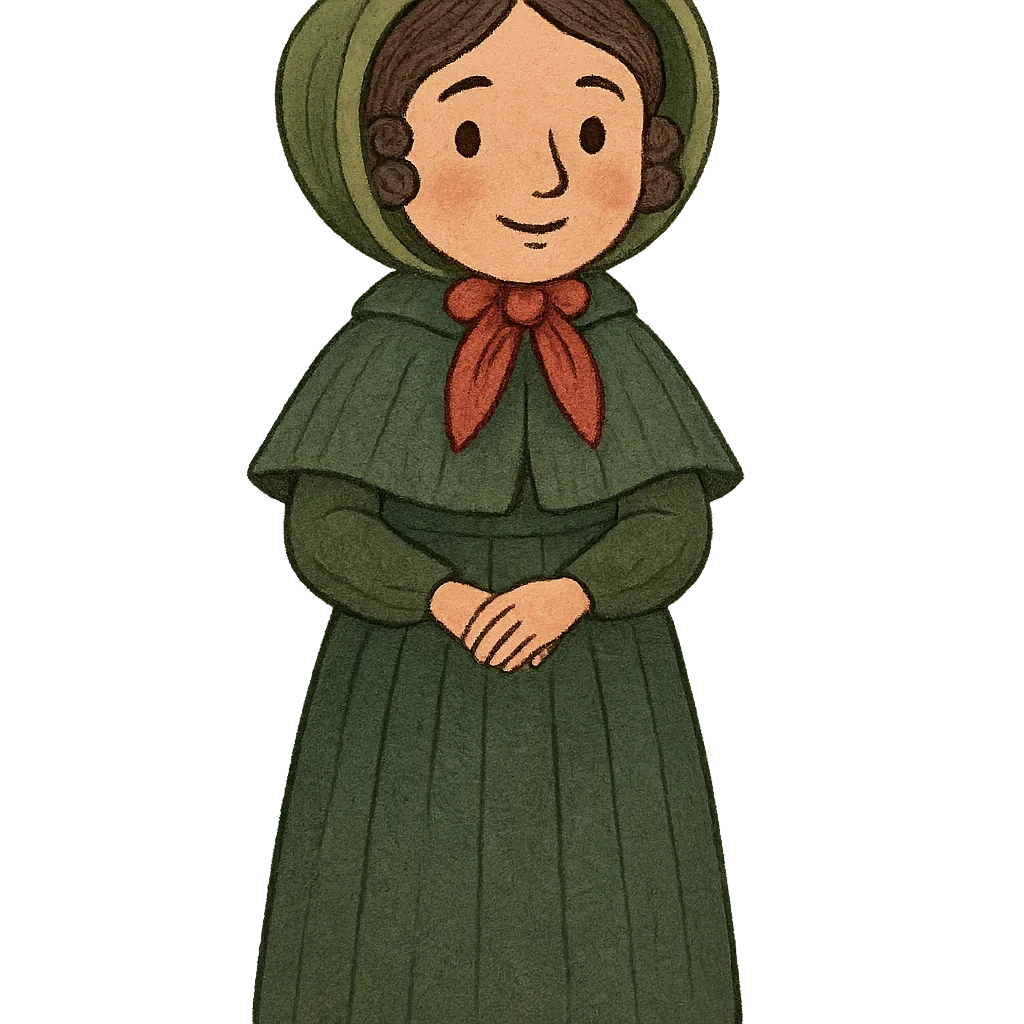
Mary Anning
My name is Mary Anning, and my story is one of mud, stone, and the bones of ancient monsters. I was born on May 21st, 1799, in a small seaside town in England called Lyme Regis. Our town was nestled against towering, crumbly cliffs that the stormy sea was always eating away at. These cliffs held secrets, and my father, Richard, a cabinetmaker by trade, taught me how to read them. He showed me how to find ‘curiosities’—what we now call fossils—that tumbled from the cliffs after a storm. We would sell them to tourists from a small table outside our home. My childhood was marked by struggle. We were poor, and life was hard. In fact, my life almost ended before it truly began. When I was just a baby, a woman held me under a tree during a thunderstorm, and lightning struck, tragically killing her and two others. I, however, survived. Some townsfolk always said the lightning strike made me clever and curious. My world turned upside down in 1810 when my father died from a fall, leaving our family in debt. I was only eleven years old, but I knew what I had to do. The hobby of fossil hunting had to become our lifeline.
My brother Joseph and I spent countless hours on those dangerous, slippery shores. In 1811, a year after our father’s death, Joseph found a strange, enormous skull. For months, I carefully chipped away at the surrounding rock until I uncovered the entire skeleton of a creature unlike anything anyone had ever seen. It was over 17 feet long with a long snout like a dolphin and fearsome teeth. People called it a ‘sea-dragon,’ but scientists would later name it an Ichthyosaur. That discovery made my name known among fossil collectors and scientists. My work continued, and in 1823, I made an even more astonishing find: the first complete skeleton of a Plesiosaur. This creature was bizarre, with a tiny head, a neck as long as a serpent, and the body of a turtle with four flippers. When a drawing of it was shown to the great French scientist Georges Cuvier, he declared it a fake. He couldn't believe such an animal could have ever existed. It was only after other experts examined the fossil that he admitted his mistake. A few years later, in 1828, I found the first British Pterosaur, a flying reptile. I didn’t just find bones; I studied them. I was the one who discovered that the strange, stone-like objects found inside skeletons were actually fossilized droppings, which I named coprolites. By studying them, we could learn what these ancient animals ate.
Despite my discoveries, which were changing how people understood the history of the Earth, my path was not an easy one. In the 1800s, science was a world for wealthy gentlemen. I was a woman, and I was poor. I was not allowed to join the Geological Society of London or publish my own scientific papers. Often, the male scientists who bought my fossils would write about them and present them as their own findings, sometimes forgetting to even mention my name. It was deeply frustrating to see my work credited to others. But I would not be defeated. I knew my knowledge was valuable. I saved my money to buy scientific journals and taught myself to read the complex articles. I learned about anatomy and biology, and I made detailed, accurate drawings of my fossils. I became more than just a collector; I was an expert. Scientists from all over Europe began to travel to my small shop in Lyme Regis not just to buy my fossils, but to learn from me and to hear my theories about the creatures I had unearthed.
My life was one of constant work, but I was not entirely alone. I formed a close friendship with another fossil collector, Elizabeth Philpot, and I earned the respect of scientists like William Buckland and Henry De la Beche, who did their best to make sure I received credit and financial support. Near the end of my life, the Geological Society, which had never allowed me to become a member, began to recognize my incredible contributions. After a long battle with illness, my life came to an end on March 9th, 1847. My legacy, however, was set in stone—literally. The sea-dragons and ancient monsters I pulled from the cliffs of Lyme Regis helped prove that life on Earth was far older and more varied than anyone had ever imagined. My story shows that it doesn’t matter where you come from or what challenges you face. If you have curiosity in your heart and the determination to keep searching, you can change the world’s view of itself.
Reading Comprehension Questions
Click to see answer