

 English

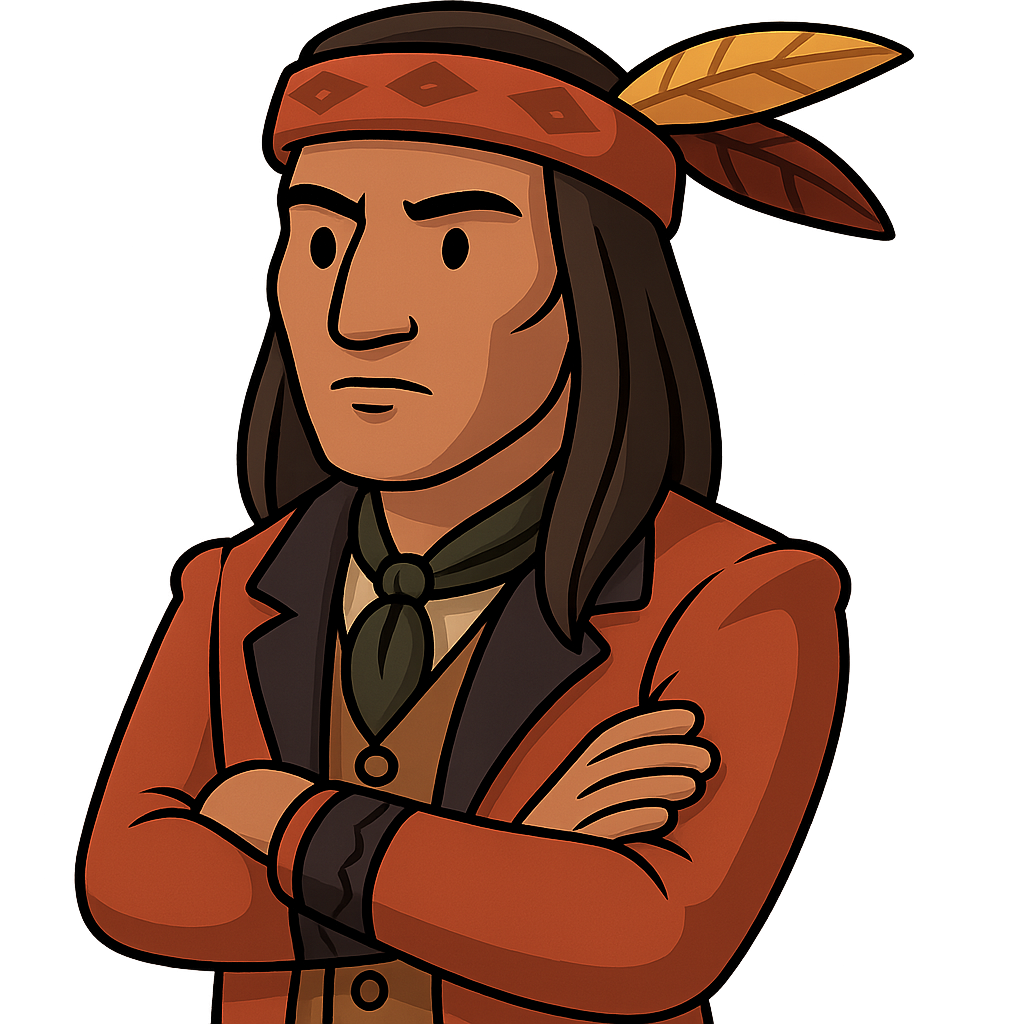
Tecumseh
Hello, my name is Tecumseh. In the language of my people, the Shawnee, my name means 'Shooting Star,' a light that streaks across the sky. I was born around the year 1768, in a time when the world was green and the rivers ran clear in the land you now call Ohio. My family lived in a village surrounded by ancient forests, and from my earliest days, I learned to listen to the whispers of the wind in the trees and the stories of the flowing water. My elders taught me that the earth was our mother and that every animal, every tree, and every person was connected. We were taught to hunt with respect, to take only what we needed, and to always give thanks for the gifts of nature. My father, Puckeshinwa, was a great and brave chief, and I looked up to him more than anyone. But a deep sadness fell over our village when I was only six years old. My father was killed in a battle, defending our land. Losing him filled my heart with a pain I had never known, but it also planted a seed inside of me. It was a fierce determination to protect my people and our way of life, so that no other child would have to feel the sorrow I felt.
As I grew older, I trained to become a warrior. I learned to be swift and strong, but my heart told me that true strength was not about being the fiercest fighter. It was about having courage and compassion. I remember one battle where some of our warriors captured prisoners and wanted to harm them. I stood before them and said that we would not act with such cruelty. A true warrior, I told them, shows mercy and honors even their enemies. From that day on, no prisoners were ever mistreated by my warriors. This was a difficult time for all tribes. More and more settlers were arriving from the east, cutting down our forests and building farms on our hunting grounds. They believed they could buy and sell the land, a strange idea to us. How can one person own the air you breathe or the ground you walk on? I believed the Great Spirit gave us the land as a gift to share, not to be divided and sold in pieces. It was during this time that my brother, Tenskwatawa, began to have powerful spiritual visions. He became known as The Prophet, and his words inspired many. Together, we built a town called Prophetstown on the banks of the Tippecanoe River. It was a special place where members of many different tribes—Shawnee, Potawatomi, Kickapoo, and others—came to live together in peace, sharing our traditions and our hope for a better future.
My heart held a dream bigger than any single village or tribe. I saw that we were all facing the same threat. If one tribe was forced from their land, it would not be long before the next one was, too. I realized that if we stood alone, we would be like single twigs, easily broken. But if we joined together, we would be like a thick bundle of sticks, impossible to snap. This was my dream: to unite all the Native American tribes, from the Great Lakes in the north to the warm waters of the south, into one great confederacy. It would be a family of nations, standing together to protect our homes and our future. I traveled for thousands of miles on foot and by canoe, visiting tribes I had only heard of in stories. I sat by their council fires and spoke from my heart, sharing my vision of unity. I urged them to stop fighting one another and to join hands against our common problem. Many listened and agreed. But while I was on one of these long journeys, a terrible tragedy struck. American soldiers, led by a man named William Henry Harrison, attacked our beloved Prophetstown. They burned our homes and destroyed our food supplies. The news reached me like a cold wind, and it broke my heart. Our peaceful community was gone, but my dream was not. The fire that burned our town only strengthened the fire in my spirit.
The attack on Prophetstown showed me that we needed powerful allies to help us protect our lands. A new conflict was starting between the Americans and the British, called the War of 1812. I decided to join forces with the British, believing it was our last and best chance to stop the settlers from taking everything. We fought side by side in many battles. Then, on a grey afternoon on October 5th, 1813, we faced the American army at the Battle of the Thames. I knew this could be my last fight, and I fought with all my strength for the future of my people. My life ended on that battlefield. I never saw my great confederacy become a reality, and my people continued to face many hardships. But a dream of unity and strength can never truly die. I hope my story reminds you to stand up for what you believe is right, to care for your community, and to always remember that we are stronger together than we could ever be apart.
Activities
Take a Quiz
Test what you learned with a fun quiz!
Get creative with colors!
Print a coloring book page of this topic.















 Free for Educators