

 English

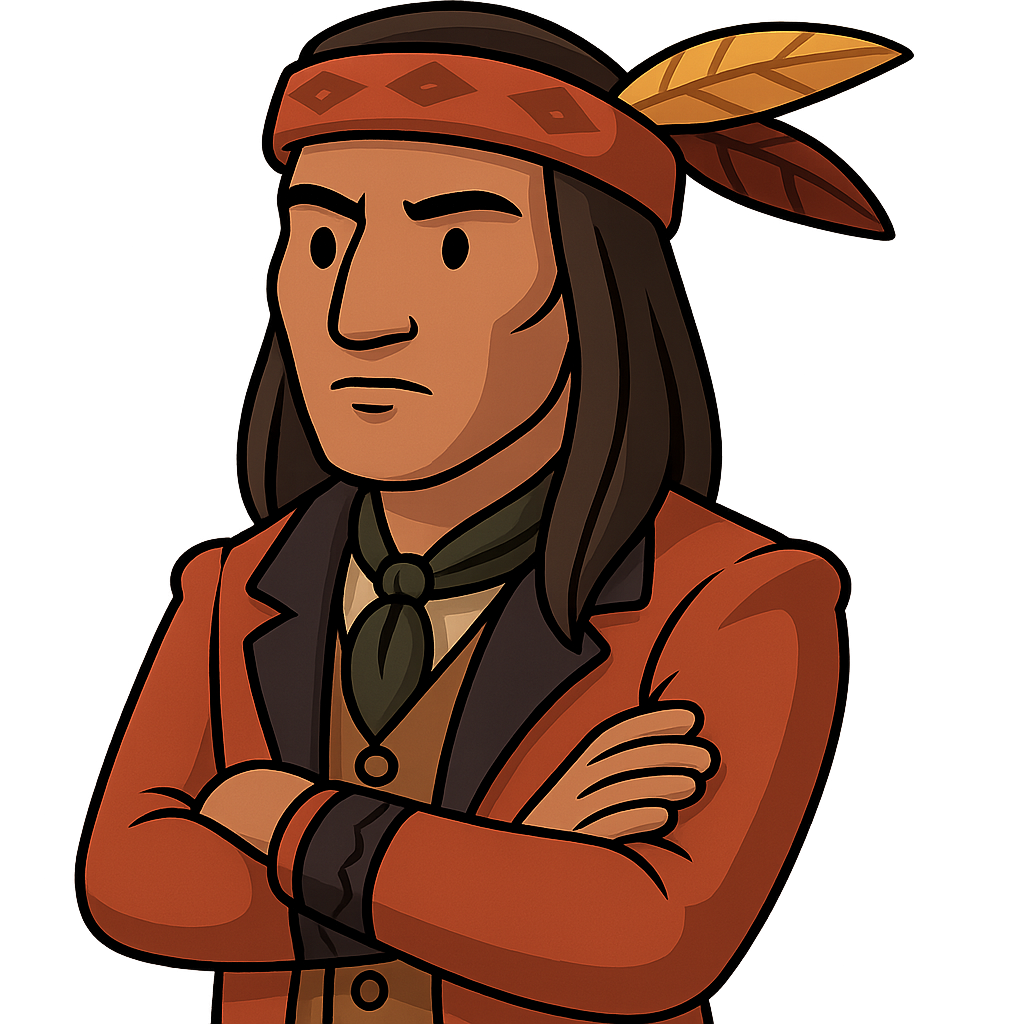
Tecumseh: A Warrior's Dream
My name is Tecumseh, a name that means 'Shooting Star' or 'Panther Across the Sky' in the Shawnee language. I was born around the year 1768, when the leaves of the great forest were turning to gold, in the heart of the Ohio country. This land of deep woods, sparkling rivers, and wide-open skies was the home of my people, and we lived as one with the rhythm of the seasons. But the world I was born into was trembling with change. From the east, American colonists were pushing westward, hungry for more and more land. They brought with them rifles, treaties written on paper that we did not always understand, and a way of life that threatened to erase our own. When I was just six years old, my world was shattered. My father, a brave Shawnee war chief, was killed in a battle against these colonists in 1774. His death was a deep wound, but it also planted a seed of determination in my heart. I knew then, even as a boy, that I would spend my life fighting to protect our lands, our families, and the future of all our people.
As I grew from a boy into a young man, my older brother, Cheeseekau, took me under his wing. He was a skilled warrior and a wise hunter, and he taught me everything he knew. We tracked deer through silent forests, learned the songs of the birds, and practiced with our bows until our arms ached. He taught me how to be brave in the face of danger, but he also taught me that true strength was about more than just fighting. I remember one day, after a raid, when our war party brought back prisoners. Some of our warriors wanted to torture them, as was sometimes the custom in those harsh times. But as I watched, a powerful feeling rose inside me. I stood before them and spoke out, declaring that such cruelty was a sign of weakness, not strength. I argued that a true warrior shows mercy and honor, even to his enemies. It was a difficult thing to do, to go against the others, but I knew it was right. From that day forward, the elders and other warriors began to see me not just as a skilled fighter, but as someone with a strong spirit and a mind for leadership.
My purpose grew clearer as the years passed. It was a dream of unity, a vision I shared with my brother, Tenskwatawa. He had experienced a powerful spiritual awakening and became known among the people as The Prophet. He urged our people to turn away from the colonists' ways and return to the traditions of our ancestors. His words were like a fire, spreading from village to village. Inspired by his vision, we founded a new community in 1808 along the Tippecanoe River, which we called Prophetstown. It was meant to be a special place, a home for Shawnee, Potawatomi, Kickapoo, and members of any tribe who believed in our cause. From there, I began my great mission. I traveled for years, covering thousands of miles on foot and in my canoe. I journeyed north to the Great Lakes and south to the warm lands of the Muscogee and Choctaw. In every village, I delivered the same message. I told them we could no longer think of ourselves as separate tribes. We were one people, with one destiny. I pleaded with them to stop selling our land, for it did not belong to any single chief to give away. It was the shared inheritance of all our children, and only by standing together could we hope to protect it.
Our growing movement did not go unnoticed. The governor of the Indiana Territory, a man named William Henry Harrison, saw our unity as a threat. He was determined to secure more land for American settlement, and he did not care how he got it. The breaking point came with the Treaty of Fort Wayne in 1809. While I was away, Harrison persuaded a few chiefs to sign a piece of paper that sold away three million acres of our ancestral hunting grounds for a tiny sum of money. When I heard the news, my heart burned with anger. This land belonged to all of us, not just a few. I traveled to meet Harrison and looked him directly in the eye. I told him that the land was ours, and we would not give it up. I told him he and his people had pushed us from the sea and would soon push us into the Great Lakes if we did not stand our ground. But my words fell on deaf ears. In the autumn of 1811, while I was south recruiting more allies for our confederacy, Harrison saw his chance. He marched his army to our home and, in the Battle of Tippecanoe, he attacked. My brother and our warriors fought bravely, but they were defeated. Harrison’s soldiers burned Prophetstown to the ground, destroying our home and scattering our people. It was a terrible blow to our dream.
With our central village destroyed and our people scattered, I knew we needed a powerful ally to have any chance of stopping the Americans. Soon after, a new conflict began, the War of 1812, between the United States and Great Britain. For me, the choice was clear. The British had their own reasons for fighting the Americans, but they promised to help us protect our lands. I saw this alliance as our last, best hope. I gathered my warriors and joined the British forces as a brigadier general, leading fighters from many different tribes into battle. We fought side by side, and our alliance achieved several important victories, including the capture of Detroit in August of 1812. The British commanders respected my knowledge of the land and my ability to lead. For a time, it seemed our dream might still be possible. But as the war dragged on, I saw the British will to fight begin to weaken. They were not fighting for their homes, as we were. I began to fear that our allies might abandon us, leaving my people to face the Americans alone.
My fears became reality on a cool autumn day, October 5th, 1813. The British were retreating, and we were forced to make a final stand against Harrison's army at the Battle of the Thames. I knew the odds were against us, but I would not run. I painted my face for battle and urged my warriors to stand firm. In the fierce fighting that followed, my life came to an end. But do not think of my death as a failure. I died as a warrior, fighting for the land I loved and the people I was sworn to protect. Though my confederacy of tribes did not survive without me, my dream never truly died. The story of our fight for unity, for dignity, and for our home has been passed down through generations. It serves as a reminder that the love for one's land and the spirit of a people determined to be free can never be completely extinguished.
Activities
Take a Quiz
Test what you learned with a fun quiz!
Get creative with colors!
Print a coloring book page of this topic.















 Free for Educators