

 English

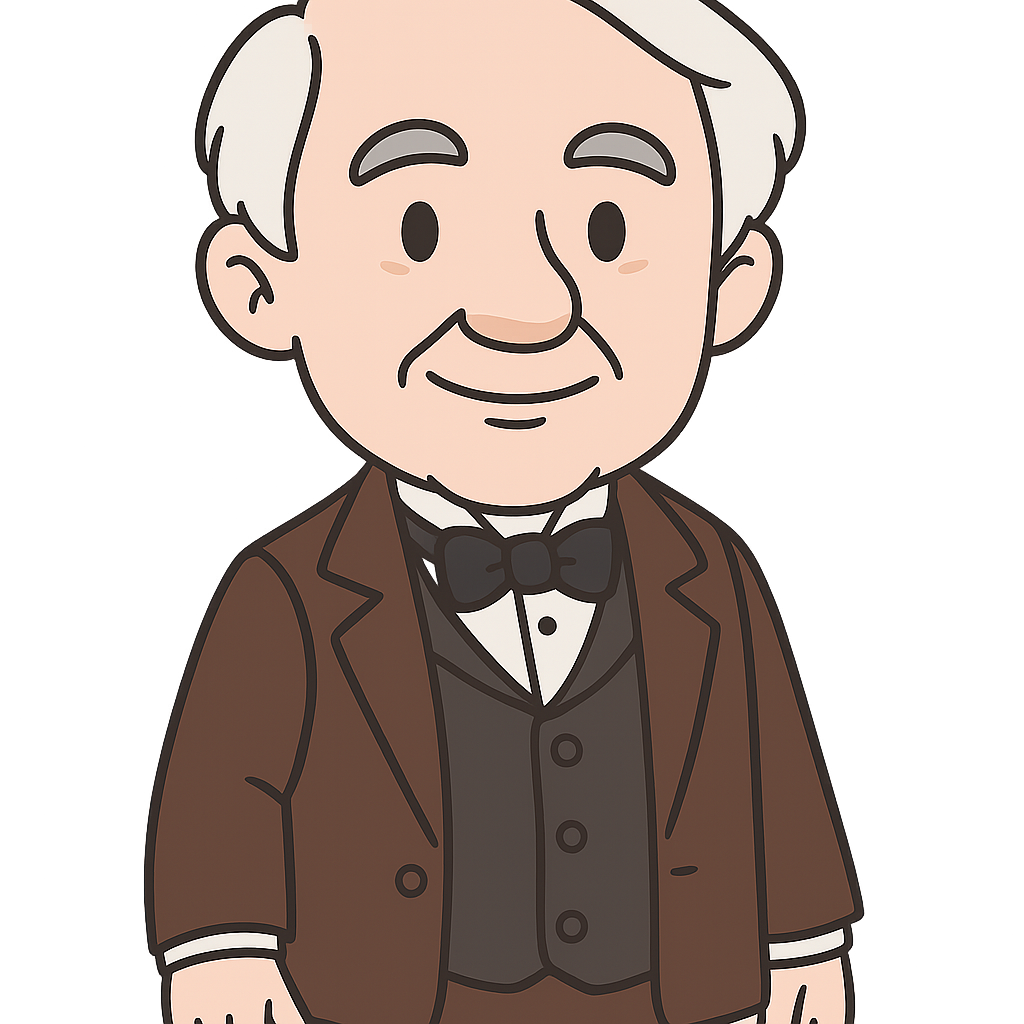
Thomas Edison: The Wizard of Menlo Park
Hello there. My name is Thomas Alva Edison, and I was an inventor. You might know me best for creating the electric light bulb, but my life was filled with more than 1,000 inventions that helped shape the modern world. My story began on February 11th, 1847, in a small town called Milan, Ohio. From my earliest days, my mind was like a whirlwind of questions. I didn’t just want to know that the sun rose in the morning; I wanted to know why. I would take apart clocks, music boxes, and anything else I could get my hands on, just to see the gears and springs that made them tick. This endless curiosity didn’t always sit well with others. When I started formal school, my teacher thought I was a difficult student because I asked too many questions and couldn't sit still. After only three months, my mother, Nancy Matthews Elliott, who had been a teacher herself, decided to take me out of school and teach me at home. It was the greatest gift she could have given me. She let me read books on science and history and encouraged me to build my own chemistry experiments in our basement. She understood that my mind needed freedom to explore. When I was a boy, I had a bout of scarlet fever, which left me with very poor hearing. While some might see this as a great loss, I found it helped me. The world outside became quiet, allowing me to concentrate deeply on my thoughts and experiments without distraction. It taught me that sometimes, what seems like a challenge can become your greatest strength.
As I grew into my teenage years, my hunger for knowledge and experimentation only intensified. I got a job selling newspapers and candy on the Grand Trunk Railroad. The long trips gave me plenty of time to read, and I even convinced the conductor to let me set up a small chemistry lab in an empty baggage car. It was my own rolling laboratory. One day, a bit of phosphorus accidentally started a fire, and the conductor threw me and my lab off the train. It was a setback, but it didn't stop me. Around that same time, a life-changing event occurred. I saw a little boy wandering onto the tracks in front of a rolling boxcar and pulled him to safety just in time. The boy's father, the station agent, was so grateful that he offered to teach me how to use the telegraph. I fell in love with it immediately. The telegraph was the most advanced communication technology of its time, sending messages in dots and dashes over electrical wires. It was my first real entry into the world of electrical science. I worked as a telegraph operator for several years, but my mind was always working on ways to improve the technology. My first big breakthrough came when I invented a much better version of the stock ticker, a machine that printed stock market prices. I sold the patent for a surprising sum of money, which was enough to leave my job and become what I had always dreamed of being: a full-time professional inventor. In 1876, I moved to a small village in New Jersey called Menlo Park and built something the world had never seen before: a laboratory dedicated entirely to inventing. It was an 'invention factory,' a place where ideas could be turned into reality.
At Menlo Park, my team and I worked day and night, fueled by excitement and endless cups of coffee. In 1877, we created something that felt like pure magic. I was trying to invent a device that could record telegraph messages, but I ended up creating the phonograph, the first machine that could record and play back the human voice. I recited 'Mary Had a Little Lamb' into a horn, and when the machine played my voice back to me, we were all stunned. People called me 'The Wizard of Menlo Park.' But my greatest challenge was yet to come. The world was lit by gas lamps, which were dim, smelly, and dangerous. I had a grand vision of lighting up entire cities with safe, bright, electric light. The problem was creating a small, inexpensive lamp—a light bulb—that could burn for hundreds of hours without burning out. Many had tried and failed. I famously said that 'genius is one percent inspiration and ninety-nine percent perspiration,' and this invention proved it. We tested thousands of different materials for the filament, the tiny part inside the bulb that glows. We tried everything from platinum to bamboo fibers. Failure was a daily event, but I saw each failed experiment not as a loss, but as another step forward, because it taught us what didn’t work. Finally, on October 22nd, 1879, we tested a bulb with a carbonized cotton thread filament, and it glowed for over 13 hours. We had done it. On New Year's Eve, we held a public demonstration, and people came from all over to see our laboratory and the nearby streets illuminated by this incredible new light. But I knew the bulb alone wasn't enough. We had to invent an entire electrical system—generators, switches, sockets, and wiring—to bring that light into every home.
My work didn't stop with the light bulb. After my first wife, Mary, passed away, I eventually remarried a wonderful woman named Mina Miller and built a new, even larger laboratory in West Orange, New Jersey. There, my imagination continued to run wild. I was fascinated with the idea of creating moving pictures to go along with the sound from my phonograph. This led to the invention of the Kinetoscope in 1891, an early type of movie viewer. You would peer into a peephole to see a short film loop. It was the beginning of the motion picture industry. Over the course of my life, I was granted 1,093 patents for my inventions, which ranged from improvements to the telephone to a way to make cement. My life came to an end on October 18th, 1931, but my work lived on in the lighted homes, recorded music, and moving pictures that filled the world. My story is not just about inventions; it is a testament to the power of perseverance. I believed that the key to success was hard work and refusing to give up, no matter how many times you fail. The world is full of problems waiting for solutions and ideas waiting to be discovered. I hope you remember that every great achievement starts with a curious mind and the determination to see an idea through. You, too, have the power to imagine, to create, and to light up the world in your own special way.
Activities
Take a Quiz
Test what you learned with a fun quiz!
Get creative with colors!
Print a coloring book page of this topic.














 Free for Educators