

 English

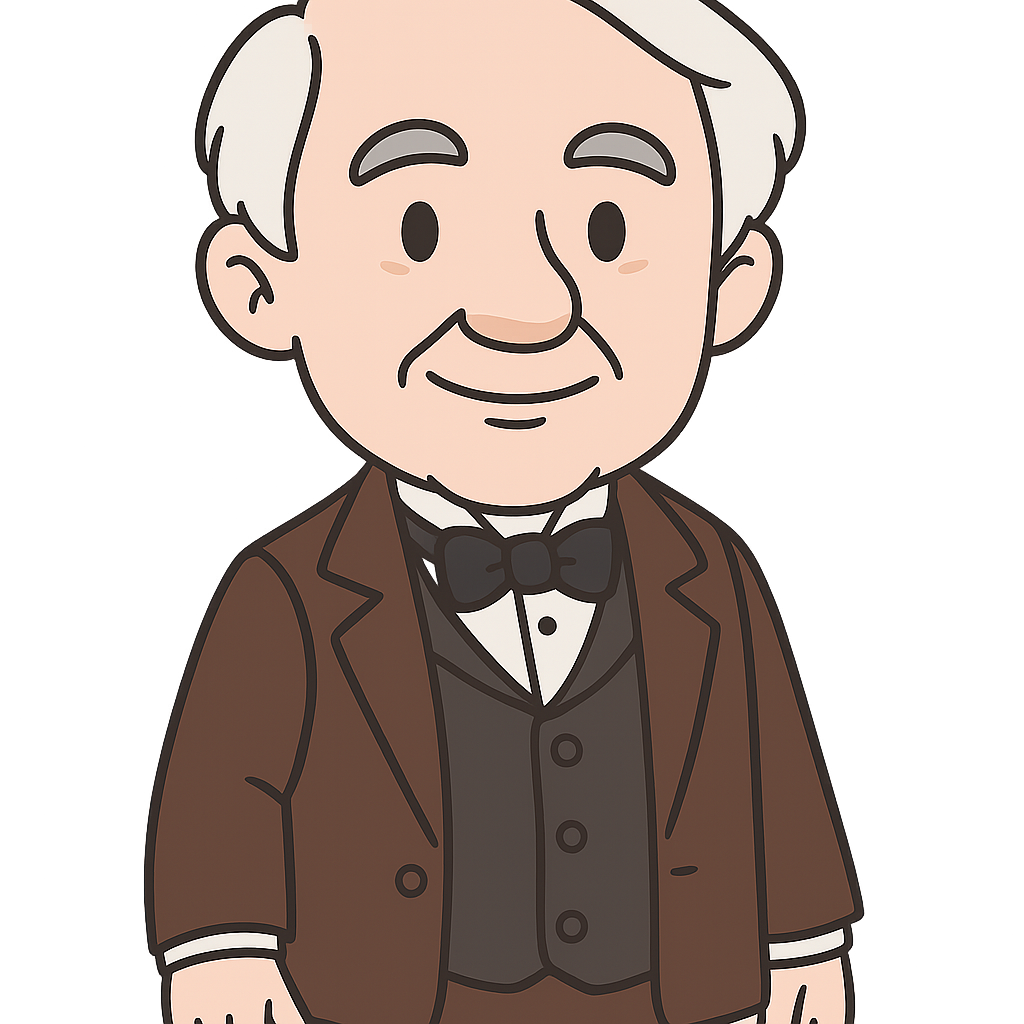
Thomas Edison: The Boy with Bright Ideas
Hello there. My name is Thomas Edison, but you can call me Tom. I was born on a chilly day, February 11th, 1847. Even when I was a little boy, my mind was like a busy beehive, always buzzing with questions. 'Why is the sky blue?' 'How do birds fly?' I wanted to know everything. I had some trouble hearing, which made school a little tricky. But my wonderful mother, Nancy, became my teacher right at home. She let me read all the books I wanted and taught me that my hearing problem wasn't a problem at all. It was like wearing earmuffs that blocked out all the noise so I could focus on my big, bright ideas. She told me, 'Tom, you can figure anything out.' And I believed her.
My favorite thing to do was experiments. I turned our basement into my very own laboratory. It was filled with bottles, wires, and all sorts of gadgets. To pay for my supplies, I had a clever idea. I got a job selling candy and newspapers on the trains that chugged through my town. With the money I earned, I could buy more chemicals and tools for my lab. It was on the train that I also learned how to use a telegraph. It was a machine that sent messages using dots and dashes through a wire. Click-clack-click. It was like the world’s very first text messaging machine, and it sparked so many new ideas in my brain.
When I grew up, I wanted a place where I could invent all day long. So, in 1876, I built a special laboratory in a place called Menlo Park, New Jersey. I called it my 'invention factory' because we created new things all the time. One of my favorite inventions came to life in 1877. It was the phonograph. I spoke into a horn, and a needle recorded my voice on a cylinder. When I played it back, I heard my own voice say, 'Mary had a little lamb.' It was like magic. My team and I also worked on a very big challenge: creating a light that wouldn't burn out. We tried thousands and thousands of ideas. People said, 'You've failed so many times.' But I told them, 'No, I've just found thousands of ways that won't work.' Finally, on October 22nd, 1879, we did it. We created an electric light bulb that glowed and glowed for hours.
Having one light bulb was wonderful, but I dreamed of lighting up entire cities. My team and I worked hard, and in 1882, we did something amazing. We flipped a switch, and a whole street in New York City lit up with bright, steady light. It was like creating a thousand tiny suns to chase away the darkness. My inventions, like the light bulb and the phonograph, helped change the world, making it brighter and connecting people in new ways. I passed away on October 18th, 1931, after a long life filled with creating. But I want you to remember this: never, ever give up on your ideas. Every time you try something and it doesn't work, you've learned a valuable lesson. Keep trying, keep asking questions, and you can light up the world, too.
Activities
Take a Quiz
Test what you learned with a fun quiz!
Get creative with colors!
Print a coloring book page of this topic.
















 Free for Educators