

 English

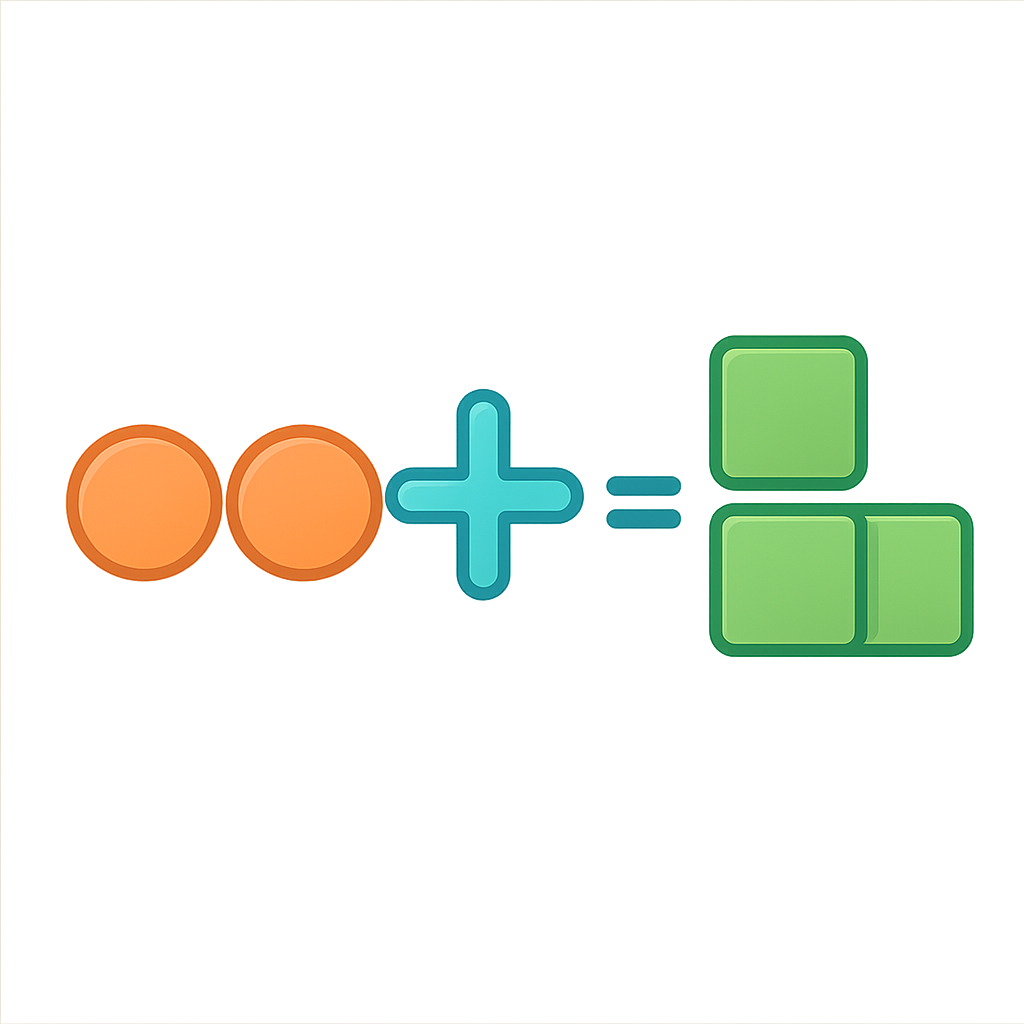
I Am Addition: The Story of More
Have you ever felt me. I am the quiet magic that happens when one thing joins another. Picture a smooth, gray stone alone on a sandy shore. It is beautiful, but it is just one. Then you find another, a speckled white one, and place it beside the first. Suddenly, you have a collection. You find a third, then a fourth, and soon your small hand is full of treasure. That feeling of growth, of things coming together to become something greater, is me. I am the harmony when one voice in a choir is joined by ten more, creating a sound that can fill a cathedral. I am the warmth that spreads when a few logs on a fire are joined by more, pushing back the cold night. I am the deliciousness that happens when flour, sugar, and eggs stop being separate ingredients and become a cake. Before anyone knew my name, they felt my presence in the world, this wonderful, invisible pull that turns 'one' into 'many'.
I am Addition. For thousands of years, I was an instinct, a feeling people understood without needing a name for me. Long before cities or written words, about 20,000 years ago, early humans used me to survive. They would carve notches onto a piece of bone, like the famous Ishango bone found in Africa. Each mark was a day, a season, or an animal in a herd. One notch, then another, then another. They were using me to track the world around them. As civilizations blossomed, I became their most essential tool. In ancient Egypt, builders used me to calculate the exact number of stone blocks needed to raise their magnificent pyramids toward the sun. In Mesopotamia, Babylonian farmers used me to measure their fields and count their harvests, ensuring everyone had enough to eat. They scribbled on clay tablets, using their unique symbols, but it was always me they were calling upon to help them build, trade, and organize their entire world.
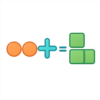
For a long, long time, writing me down was a complicated affair. Each culture had its own way, and none were very simple. Imagine trying to explain a complex idea using only long, descriptive sentences. It was like that for me. Then, slowly, I was given a face that everyone could recognize. My transformation began in a book about business math published in 1489. A German mathematician named Johannes Widmann was looking for a shorthand way to show a surplus, a little extra. He drew a simple cross, what you now call the plus sign (+). It was the first time my symbol appeared in a printed book. Then came my other famous symbol. In 1557, a Welsh scholar named Robert Recorde was writing a book on algebra called 'The Whetstone of Witte'. He grew incredibly tired of writing the words 'is equal to' again and again. In a moment of brilliant frustration, he drew two parallel lines (=) instead, explaining his choice by saying, 'noe 2 thynges, can be moare equalle'. With these two simple marks, the plus sign and the equals sign, I finally had a universal language. Anyone, anywhere in the world, could now see me, write me, and understand me instantly.
Even with my new symbols, my full potential was still locked away. I was powerful, but I was missing a key partner. That partner was nothing, or rather, the idea of nothing as a number. For centuries, the concept of zero was a puzzle. How could 'nothing' be 'something'. Then, around the 7th century CE, brilliant mathematicians in India, like a man named Brahmagupta, truly cracked the code. They weren't the first to think of a placeholder, but they were the ones who treated zero as a true number with its own rules. They showed how to add, subtract, and multiply with it. This single idea was like a lightning bolt. Zero supercharged me. It allowed for the creation of the place-value system, where the position of a digit determines its value. Suddenly, working with huge numbers became simple. Ten could become one hundred, then one thousand, then one million, all with the elegant power of zero. I was no longer just about counting sheep; I could now help people count the stars.
Today, you can find me everywhere, working silently in the background of your world. I am in the lines of code that make your favorite video games work, adding points to your score and creating new levels to explore. I am in the complex calculations that NASA engineers use to send rovers to Mars, adding thrust and adjusting trajectories. I am in the digital bank account that holds your savings, and in the recipe that tells you how to combine ingredients for your dinner. But my greatest power isn't just in numbers. I am the spirit of collaboration and growth. Every time you add one person's idea to another's during a class project, you are using me. Every time one act of kindness is added to another, making a community stronger, you are feeling my energy. I am the simple, beautiful truth that when we put good things together, we create something bigger, better, and more wonderful than what we had before.
Activities
Take a Quiz
Test what you learned with a fun quiz!
Get creative with colors!
Print a coloring book page of this topic.










 Free for Educators