
 English
 Continue with Google
 Continue with Apple

The Story in the Stone
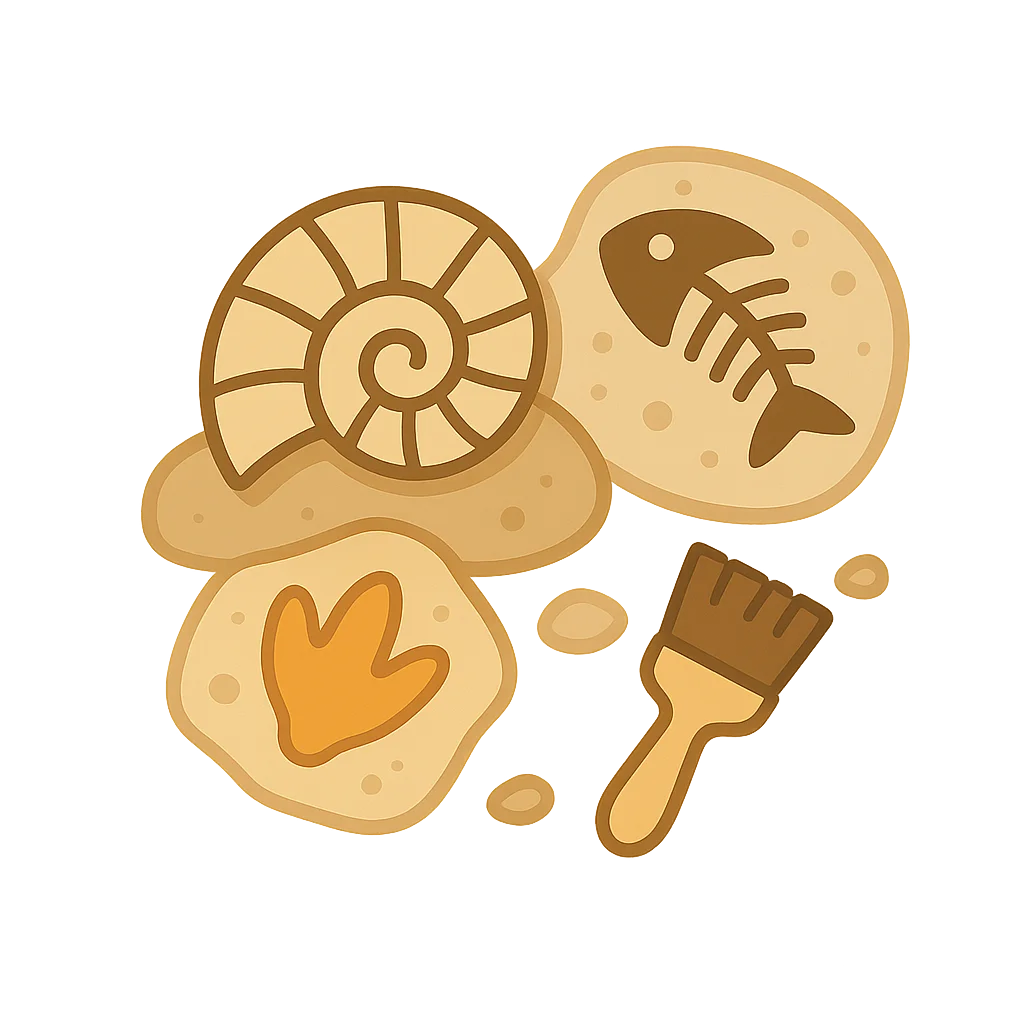
I am a memory of a world you have never seen, a silent shape held captive in stone for millions of years. Sometimes I am a giant bone from a creature that would tower over your house, a curved rib or a knobby vertebra whispering of immense power. Other times, I am the delicate, leafy pattern of a fern pressed onto a slab of shale, a perfect shadow of a sunlit forest that vanished eons ago. I can be the perfect spiral of a sea creature's shell found on a mountaintop, a mystery that hints at oceans where there are now only clouds. For ages upon ages, I slept under crushing layers of dirt, sand, and rock, my story sealed away in darkness. The world above changed, mountains rose and eroded, ice ages came and went, but I remained, patient and still. Then, slowly, the wind and rain wore away my stone blanket, or perhaps a river cut a new path, exposing my edge to the light. Sometimes a curious hand with a pickaxe and a brush carefully chipped me free from my prison. When you find me, you are not just holding a rock. You are holding a story, a tangible puzzle piece from Earth's deep and tumultuous past. I am a Fossil, and I am the voice of ancient life, waiting for you to listen.
For a very long time, when people stumbled upon me, they didn't know what to make of my strange and often colossal shapes. They imagined my enormous bones must have belonged to mythical giants who once roamed the land, or perhaps to the fearsome dragons of their legends. My story was tangled in folklore and fantasy. But slowly, curiosity gave way to scientific inquiry. In the 17th century, a Danish scientist named Nicolaus Steno was studying a large shark head and had a brilliant realization. He noticed that its teeth were identical to mysterious triangular stones known as 'tongue stones,' which were often found embedded in rocks. This was a monumental clue. It meant that these rocks, even those found far inland, had once been at the bottom of the sea. My true identity, however, really began to unfold in the early 19th century, thanks to a remarkable young woman in England named Mary Anning. Living in the seaside town of Lyme Regis, she spent her days meticulously searching the crumbling coastal cliffs. In 1811, she and her brother discovered the complete skeleton of a creature that looked like a bizarre fish-lizard. It was the first Ichthyosaur skeleton to be correctly identified, a marine reptile no human had ever seen alive. Mary went on to find other incredible sea monsters, like the long-necked Plesiosaur and the winged Pterosaur. Her astonishing discoveries provided undeniable proof that strange and wonderful creatures had existed and then vanished long ago. Around that same time, a brilliant but stern scientist in France named Georges Cuvier was meticulously studying my bones. By comparing my anatomy to that of living animals, he proved that my shapes did not belong to any species currently on Earth. This led him to propose a revolutionary and unsettling idea: extinction. He argued forcefully that entire species of animals had been wiped out by past catastrophes. This changed everything. People were forced to accept that the planet had a long, dramatic, and previously unknown history—and I was the star witness. Scientists finally pieced together the puzzle of my creation. They learned that when a plant or animal dies, it must be buried quickly by mud, sand, or volcanic ash to protect it from scavengers and decay. Over millions of years, as more layers pile on top, the pressure mounts, and water seeps through the sediment. This water carries dissolved minerals that slowly crystallize within the empty pores of the bones, shells, or wood, gradually replacing the original material. What’s left is a perfect, heavy, stone copy of the original organism—me.
Today, I am far more than just a curious rock or a museum piece. I am a time traveler's guide, an essential tool for scientists called paleontologists. They study me to assemble the vast, sprawling timeline of life on Earth. I show them how the first simple, single-celled organisms evolved over billions of years into the complex creatures that fill our world. I am the evidence that shows how fish grew sturdy fins that eventually became legs, allowing them to crawl onto land and begin a new chapter of life. I tell the epic tale of how the mighty dinosaurs rose to rule the world for over 150 million years, and then how they vanished in a cataclysmic event, making way for mammals to thrive. I am also a climate historian. A fossilized palm leaf found in the now-chilly state of Wyoming proves that the region was once a warm, tropical paradise. My very presence on a mountaintop shows how immense geological forces have lifted ancient seabeds thousands of feet into the air. I am the concrete proof that our world is in a constant state of change, that continents have drifted apart, and that life must continually adapt, thrive, or disappear. Every time someone unearths one of my siblings—whether it's the colossal skeleton of a Tyrannosaurus rex or the tiny, delicate footprint of an ancient insect trapped in stone—a new page of Earth's autobiography is opened for all to read. I am a profound reminder that our planet's story is magnificent and ancient, and that you are a part of its newest, most exciting chapter. So keep your eyes open when you're hiking a trail or exploring a beach. A secret story, millions of years old, might be lying right at your feet, waiting for you to pick it up and listen.
Reading Comprehension Questions
Click to see answer