

 English

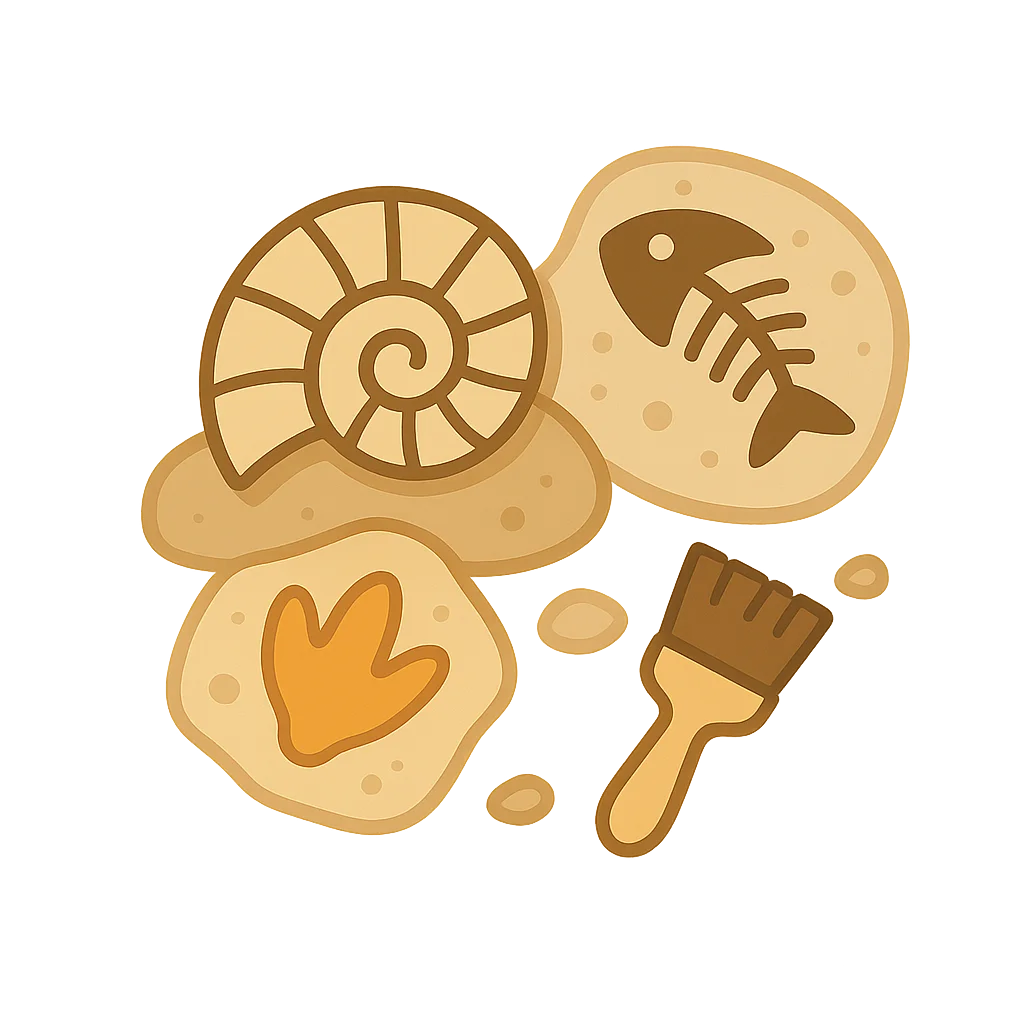
A Whisper in the Stone
For millions of years, I slept inside layers of rock, feeling the weight of mountains and oceans press down on me. Sometimes, a storm would shake the cliffs by the sea, and a piece of my stone shell would break free, tumbling down to the shore. People would walk by and pick me up, turning me over in their hands. They saw my strange, swirly shape or the long, bony ridge running down my back. “What a funny-looking rock,” some would say. Others, with more imagination, would whisper that I was a dragon’s bone, a thunderbolt frozen in stone, or the skeleton of a giant from a fairytale. They were close. I did belong to giants, but not the kind from stories. I hold the memory of a world you’ve only seen in books, a world of giant ferns unfurling in a warm, damp breeze and strange, armored fish swimming in ancient seas. I remember the ground shaking from the footsteps of enormous creatures with teeth as long as your arm. Can you imagine a world like that. I hold its secrets, locked away in stone. I am a Fossil, a whisper from a long-lost world.
For centuries, my true story remained a mystery. I was a curiosity, something to be placed on a shelf, but no one really knew what I was. Then, a very special person came along who listened carefully to my stone whispers. Her name was Mary Anning, and she lived in a small seaside town in England called Lyme Regis. In the early 1800s, when she was just a young girl, she didn't see me as a magical charm; she saw me as a puzzle. After big storms, she would bravely scramble along the crumbling, muddy cliffs, her eyes searching for any hint of my stony shape. Around the year 1811, she and her brother Joseph uncovered something incredible. It was a skull at first, with a huge eye socket and a long snout full of sharp teeth. Over the next few months, they carefully dug out the rest of a giant skeleton. It looked like a lizard mixed with a fish. The world had never seen anything like it. It was an Ichthyosaur, and Mary’s discovery proved that unbelievable creatures had once lived in the oceans. A few years later, on a cold day in 1823, she found another one of my secrets: a Plesiosaur, with its fantastically long neck and flippers like a sea turtle. Mary’s discoveries showed everyone that I was a window into a forgotten time. I wasn't magic, but something even more amazing: real. I am made when a plant or animal dies and is quickly buried by mud or sand. Over millions and millions of years, water seeps into the ground, carrying tiny bits of rock called minerals. Slowly, so slowly you could never see it happen, those minerals replace the bones or leaves, creating a perfect stone copy.
Today, I am no longer a mystery. I am a key. I am a time machine that allows special scientists called paleontologists to travel back millions of years. When they find me, they carefully brush away the dust and dirt, piecing together the story of life on Earth. A sharp tooth tells them what a dinosaur ate. A footprint turned to stone shows them how it walked. The impression of a leaf reveals what the forests looked like long before the first flower ever bloomed. I am the proof that life changes, that new creatures appear and old ones disappear forever in a process called evolution. I tell the planet’s long and amazing story, one stony piece at a time. So the next time you see a picture of a dinosaur or visit one of my skeletons in a museum, remember me. I am a reminder that the world has a deep, incredible history. And the most exciting part is that so many of my stories are still buried under your feet, waiting for a curious person, maybe someone just like you, to find them and uncover a new secret from the past.
Activities
Take a Quiz
Test what you learned with a fun quiz!
Get creative with colors!
Print a coloring book page of this topic.













 Free for Educators