
 English
 Continue with Google
 Continue with Apple

The Invisible Line
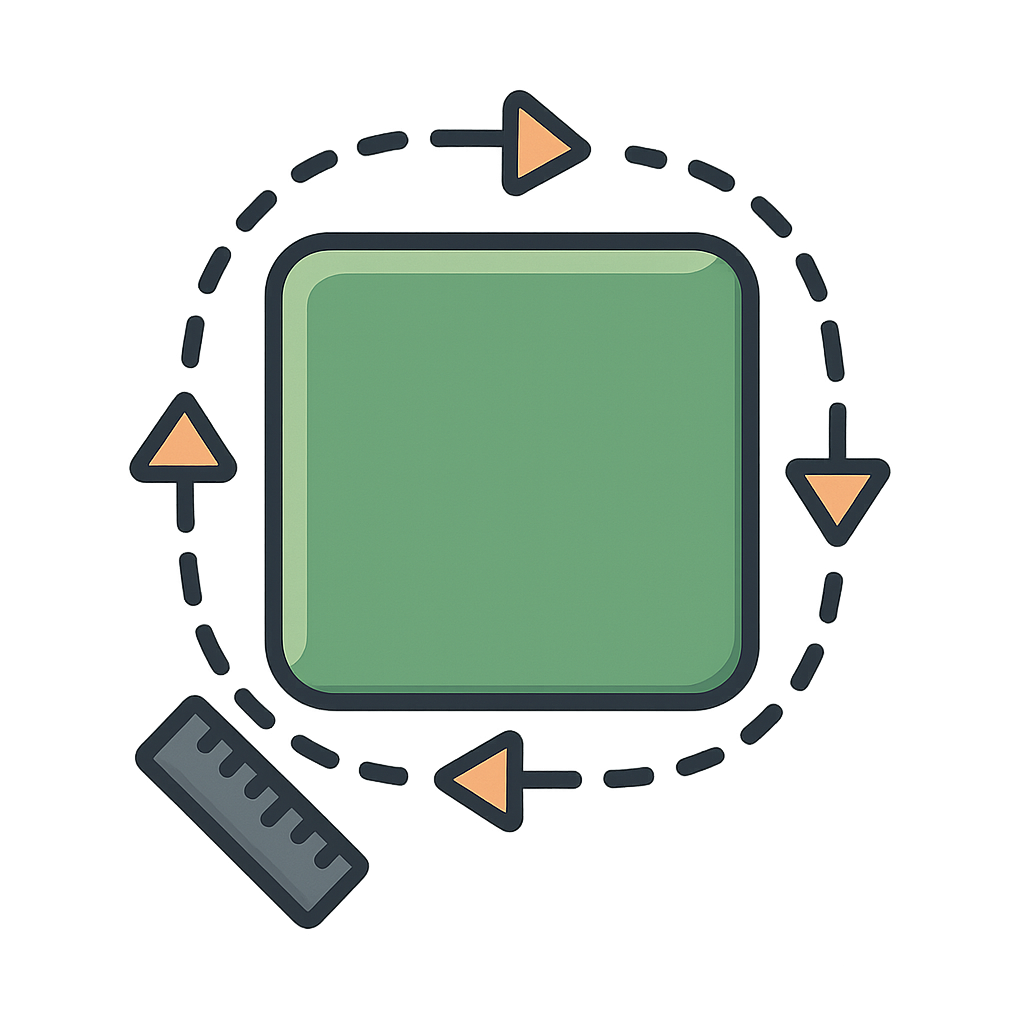
Have you ever walked around the edge of a playground, or traced the crust of a pizza slice with your finger? Have you noticed the white lines that box in a soccer field, or the wooden frame that hugs a beautiful painting? That’s me. I’m the line you follow, the edge you trace, the boundary that holds things together. Before you knew my name, you knew my job. I show you where something begins and where it ends. I’m the fence that keeps a puppy safe in the yard and the coastline that meets the ocean. I am the measured path that takes you all the way around something and brings you right back to where you started. People don't always see me, but they use me every single day to give shape and order to their world. I am the distance around everything. I am Perimeter.
For a long, long time, thousands of years before calculators or even paper, people needed me desperately, even if they didn't call me by name. Imagine you're a farmer in ancient Egypt, living by the great Nile River. Every year, the river would flood, washing away the markers for your fields. When the water went down, how would you know which land was yours? That's where I came in. Special surveyors, who history sometimes calls 'rope-stretchers,' used knotted ropes to measure the edges of the fields and redraw the boundaries. They were measuring me. This practical need was one of my first and most important jobs. Around the same time, in a place called Mesopotamia, people were building incredible cities and towering ziggurats. They needed to measure the outside of their building foundations to make sure everything was strong, stable, and straight. Again, that was me, helping them plan and build their world. For centuries, I was a tool for solving real-world problems. But then, some very curious people in ancient Greece started thinking about me in a new way. They weren't just using me; they were studying me.
The ancient Greeks loved puzzles, patterns, and big ideas. A brilliant mathematician named Euclid, who lived around 300 BCE, decided to gather and write down everything that was known about shapes, lines, and angles. In his famous book, Elements, he gave me a proper introduction to the world. He helped cement my name, which comes from two Greek words: 'peri,' meaning 'around,' and 'metron,' meaning 'measure.' Suddenly, I wasn't just a rope for measuring fields; I was an abstract idea. I became a key part of a whole branch of math called Geometry. Mathematicians developed rules, or formulas, to calculate me for different shapes without having to measure them physically. For a square, you just add up its four equal sides, or multiply one side by four. For a rectangle, you add the lengths of all four sides. They even figured out a special relationship for circles, giving my cousin a unique name: Circumference. Thanks to Euclid and other Greek thinkers, people could now understand and calculate me for almost any shape they could imagine, opening up a new world of design and engineering.
Today, I’m busier than ever. Think about the house or apartment you live in. An architect used me to design the floor plan, figuring out the length of every wall to make sure the rooms were the right size. City planners use me to lay out streets, parks, and neighborhoods. When you play sports, I'm the boundary line that tells you if a ball is in or out of bounds. I'm even inside your computer. Video game designers use me to create the edges of the game world, so your character doesn't just fall off the screen into nothingness. I help engineers build stronger bridges by calculating the length of the outer supports, artists create perfectly proportioned frames for their masterpieces, and conservationists measure the boundary of a forest to protect it from harm. I am a simple idea—the distance around a shape—but I help you create, organize, play, and explore. Every time you walk around a city block, hang a picture on your wall, or even just close a container, you are using me. I am a reminder that boundaries can be beautiful and useful, helping to give form to our world and our biggest ideas.
Reading Comprehension Questions
Click to see answer