English
 Continue with Google
 Continue with Apple

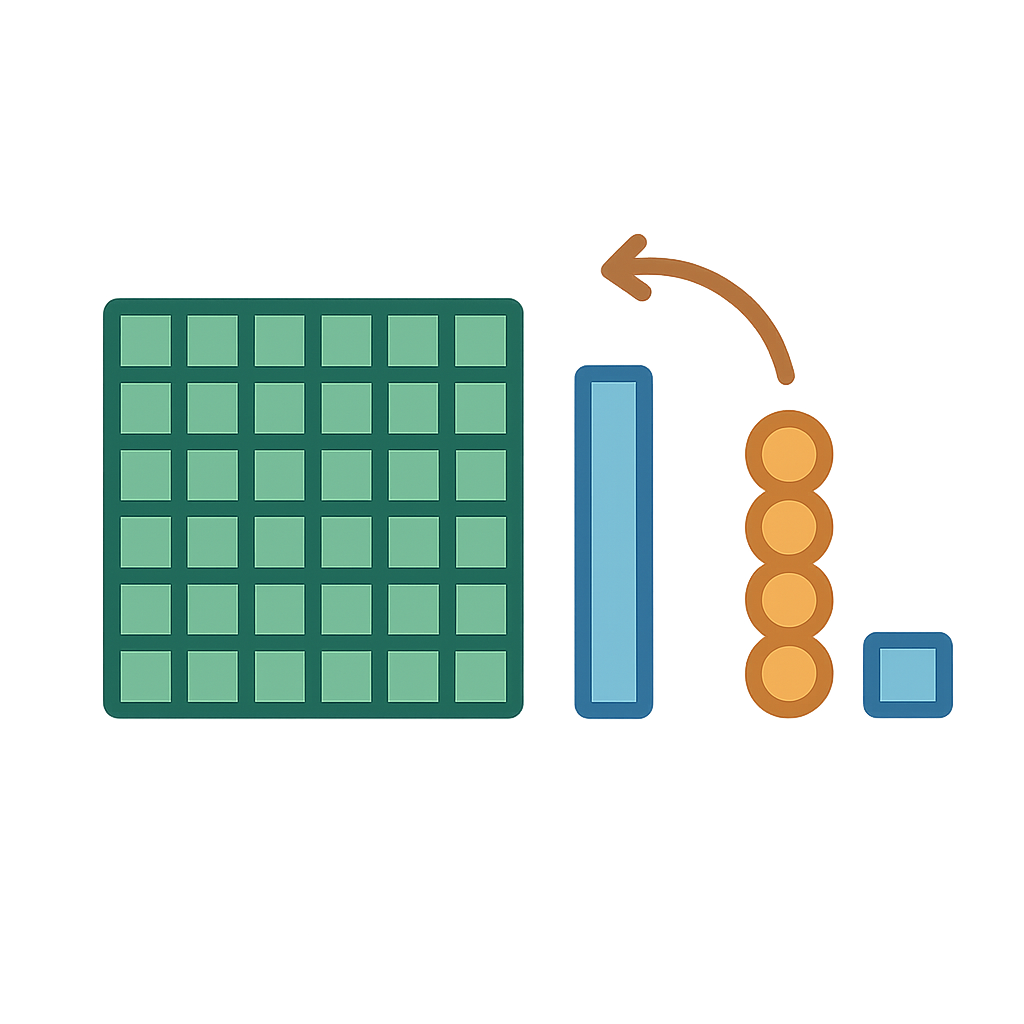
The Power of Position
Have you ever stopped to wonder about the magic of numbers. Think about the number nine. It feels so complete, the biggest single digit you can write. But add just one more, and suddenly you have ten. It’s a completely different kind of number, made of two digits, a one and a zero. The same thing happens at ninety-nine. It’s the peak, the top of the two-digit mountain. Add one, and boom, you arrive at one hundred, a grand, three-digit giant. How can adding just one little thing make such an enormous difference. The secret is me. I am the invisible force that gives each digit its power, its meaning, its very identity, all based on where it stands. I am the reason the '1' in the number 100 is a hundred times mightier than the '1' you might see standing all by itself. I am the quiet architect of every number you’ve ever known, the silent rule that transforms simple symbols into gigantic quantities or the tiniest fractions. I give numbers their homes, their neighborhoods, their value. I am Place Value.
But I wasn’t always understood, and for thousands of years, the world of numbers was a clumsy, confusing place. Imagine being an ancient Roman merchant trying to multiply CXXIII by XLVII. It was a nightmare. Their numbers were just letters with fixed values that you mostly added together. The position didn’t change the value of an 'X' or a 'C'. It was like trying to build a skyscraper with stones of all different shapes that didn't fit together neatly. It was slow, complicated, and full of opportunities for error. For centuries, this was the reality for many civilizations. Then, travel with me back in time, about four thousand years ago, to ancient Babylonia. The Babylonians were brilliant astronomers and mathematicians, and they had an early inkling of my existence. They used a base-60 system, which we still see today in how we measure time with minutes and seconds. They even started leaving a space to show that a position was empty. But it was an imperfect solution. Was that gap an intentional empty spot, or did the scribe just make a mistake. It was like trying to read a sentencewithnospacesorpunctuation. It worked for them, but it was messy and could easily lead to misunderstandings. The world needed a better way.
The great breakthrough, the moment when I could finally show my true potential, came from the brilliant minds of ancient India. For centuries, mathematicians there had been exploring numbers in a way no one else had. Then, around the 7th century CE, a scholar named Brahmagupta did something revolutionary. He wrote down the rules for a special, powerful new number that had been floating around as an idea: zero. Suddenly, my greatest challenge was solved. The empty space was no longer a confusing gap; it was a number in its own right, a hero named Zero. With my friend Zero, I could finally work my magic perfectly. The number '101' was now clearly and beautifully different from '11', because Zero stood proudly in the tens place, holding it for me. This elegant and powerful system, which you now know as the Hindu-Arabic numerals, was born. But an idea this good couldn't stay in one place. It began to travel along the bustling trade routes, carried in the minds of merchants and scholars. In the 9th century, a brilliant Persian mathematician named Muhammad ibn Musa al-Khwarizmi, living in Baghdad's House of Wisdom, wrote a book explaining this amazing new way of doing arithmetic. His book was so influential that it introduced me and my friend Zero to the Middle East and eventually Europe. His own name, al-Khwarizmi, gave the world the word 'algorithm,' and the title of another of his books gave us 'algebra.' He was my greatest champion, helping to share my power with the world.
Today, I am everywhere, working silently in the background of your world. I am in every computer, every smartphone, every video game console. Computers speak a language called binary, which uses only two digits: 0 and 1. It is my job to give those simple digits their incredible power based on their position, allowing them to represent everything from a simple letter to a complex video. I help engineers design bridges that can withstand incredible forces, and I help scientists measure the mind-boggling distances to faraway stars. When bankers calculate interest or you check the score of a game, I am there, organizing the numbers so they make sense. Every time you read the time on a clock, measure ingredients for a recipe, or enter a phone number, I am the invisible structure that makes it all possible. My story is a reminder that even the simplest ideas, like giving a number a specific home, can completely change the world. I am the power that lets you count, build, dream, and understand the universe, one powerful position at a time.
Reading Comprehension Questions
Click to see answer