English
 For Schools
 For Homeschool

The Cosmic Dance
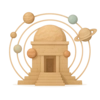
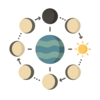
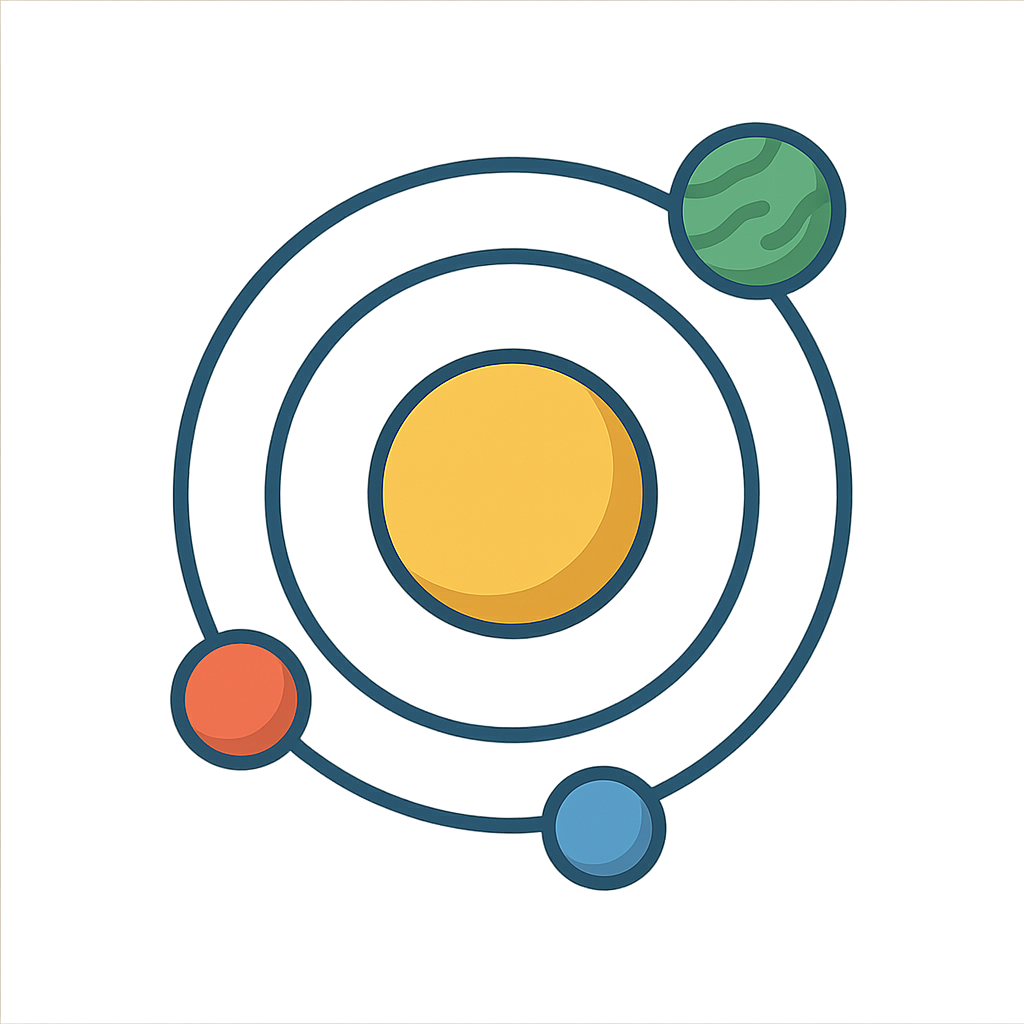
Have you ever spun in a circle so fast that you feel a pull? Imagine doing that for billions of years without ever stopping. That’s a little like what I do. I am the invisible path that planets follow as they waltz through space. I don't use strings or ropes, but a gentle, constant tug that keeps everything from Earth to giant Jupiter from flying off into the cold, dark emptiness. I guide them on a long, looping journey around a star, like a race car on an endless track. Before people knew my name, they would look up at the night sky and see my work. They watched the Moon glide across the sky and saw bright lights that seemed to wander among the fixed stars. They called these wanderers ‘planets,’ and they knew something special was happening, a grand and silent dance that repeated over and over. They could feel the rhythm in the changing seasons and see it in the phases of the Moon. They just didn’t know what was leading the dance. I am that dance. I am a Planetary Orbit.
For thousands of years, people thought I was a perfect circle, and that everything in the sky danced around the Earth. Can you imagine thinking the whole universe spun around you? It made sense at the time, but a few curious stargazers started to notice that the steps of my dance were a little more complicated. A man named Nicolaus Copernicus, way back in 1543, had a revolutionary idea. He suggested that maybe, just maybe, the Earth wasn't the center of the dance floor. He thought the Sun was, and that Earth and the other planets were its dance partners. This idea was so huge it took a long time for people to accept it. Later, in the early 1600s, a very patient astronomer named Johannes Kepler spent years watching the planet Mars. Night after night, he recorded its position, trying to map its path. He used his observations to figure out my true shape. He discovered I wasn't a perfect circle after all. I'm actually a slightly squashed circle, an oval shape called an ellipse. He also noticed that planets speed up when they get closer to the Sun in their journey and slow down as they move farther away, as if they are hurrying past the star before gliding away again. But the biggest question remained: why? What was the invisible force that led the planets along my path? That puzzle was solved by a brilliant thinker named Isaac Newton. On July 5th, 1687, he published a book explaining that the same force that makes an apple fall from a tree to the ground is the one that holds the Moon in its path around Earth. He called it gravity. It was gravity’s gentle, persistent pull that created me, shaping the elegant, elliptical paths for all the planets.
Today, understanding me is more important than ever. I am the roadmap for every rocket and satellite sent into space. When scientists want to send a rover to explore Mars or a probe to take pictures of Saturn’s rings, they use the rules of my dance—the laws discovered by Kepler and Newton—to chart the perfect course. They have to calculate exactly how gravity from the Sun and other planets will pull on their spacecraft. I am the reason our Earth stays in the 'Goldilocks zone'—not too hot, and not too cold, but just right for life to flourish. I keep our seasons predictable and our planet stable as it makes its yearly trip around the Sun. I am a reminder that the universe is full of order and wonder, governed by rules that we can understand if we are curious and patient enough. Every time you look up at the Moon or see a picture of a faraway planet, you are seeing my work. I will keep guiding our home through space, and I will be waiting to guide your explorers to new worlds, forever dancing to the silent music of gravity.
Activities
Take a Quiz
Test what you learned with a fun quiz!
Get creative with colors!
Print a coloring book page of this topic.