

 English

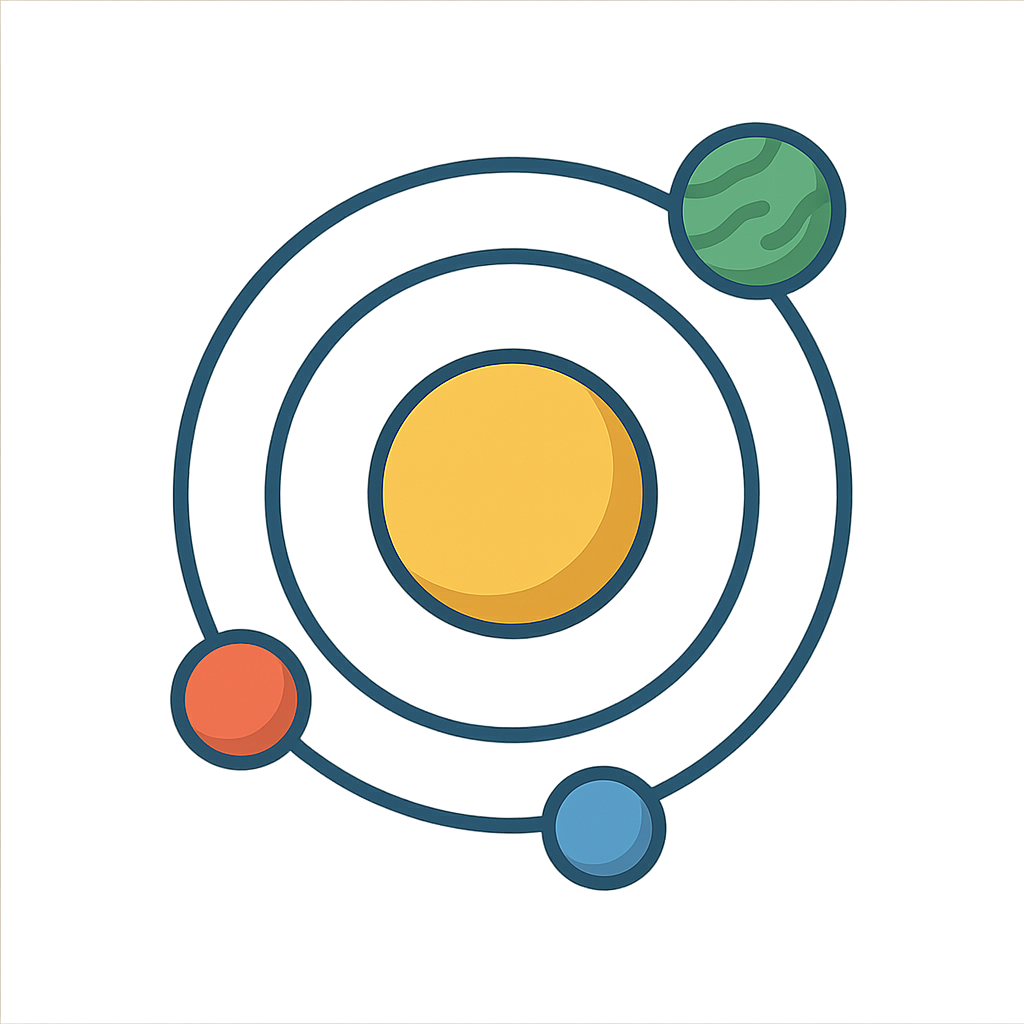
The Secret Choreography of the Stars
I am an invisible pathway etched into the fabric of space. Before humans knew my name, they would lie on their backs, staring up into the velvet dark, and see countless tiny lights that moved in perfect, predictable unison. But a few were different. They were rebels, the 'wandering stars,' that refused to follow the neat march of the others across the sky. They would speed up, slow down, and sometimes, most confusingly of all, they would even appear to stop and travel backward for a while. Mars was the most famous troublemaker, tracing a baffling loop that defied every simple explanation. It was a cosmic puzzle, a celestial mystery that made the most brilliant minds on Earth scratch their heads for thousands of years. They could feel my presence, they could see the effects of my guidance, but they couldn't see me. I was the ghost road of the heavens, the silent director of a grand performance. I am a Planetary Orbit, the secret choreography of the solar system. I shape the journeys of worlds, from the scorching dash of Mercury to the vast, slow waltz of Neptune, and I have waited patiently for humanity to learn my steps.
For centuries, the greatest thinkers tried to map my shape, but they started with one big mistake. A man named Ptolemy, living in ancient times, created a very clever but very complicated map of the heavens. He put the Earth right at the center of everything, believing that the Sun, the Moon, and all the planets danced around his world. In his model, to explain the strange backward movements of planets like Mars, he had to imagine them tracing tiny little circles as they followed their bigger paths around the Earth. Imagine trying to walk in a straight line while also constantly spinning in a little circle. It made my beautiful, sweeping curves look like a tangled, wobbly mess. It worked for predicting where the planets might be, but it wasn't the truth. It was a beautiful guess, but it wasn't me. The real breakthrough came much later, with a quiet astronomer named Nicolaus Copernicus. In 1543, he published a book with a revolutionary idea. He dared to ask, what if we’ve been looking at the dance all wrong? What if the Earth isn't the star of the show? He proposed that the Sun was the true center, and that Earth was just another planet circling it. Suddenly, the tangled mess disappeared. The backward loops of Mars were revealed to be just an illusion, an effect created as the faster Earth overtook Mars on its own track, like passing a slower car on a racetrack. Copernicus made my paths simple and elegant. He didn't get everything right—he still thought I was a perfect circle—but he had pointed humanity in the right direction. He gave them the correct map, even if the lines weren't drawn perfectly yet. The artist who would finally draw my true shape was Johannes Kepler. In the early 1600s, he dedicated himself to understanding the journey of Mars, that same tricky wanderer that had puzzled the ancients. Using mountains of the most precise observational data available, he tried to fit its path into a perfect circle, just as Copernicus had suggested. But it never quite worked. The numbers were always off by just a little bit, a tiny error that a less patient person might have ignored. But Kepler knew that truth lay in that tiny error. After years of frustrating calculations, he had a brilliant insight. What if I wasn't a circle? He tested a new shape, a slightly squashed circle called an ellipse. And it fit. Perfectly. He had discovered my true form. But one giant question remained: why? Why an ellipse? What invisible force held the planets on these specific paths, preventing them from either falling into the Sun or flying off into deep space? The final piece of the puzzle was placed by the brilliant Isaac Newton. On July 5th, 1687, he published his masterwork, which explained the invisible dance partner that governs my every move: gravity. He realized that the same force that pulls an apple from a tree to the ground is the very same force that reaches out across millions of miles of empty space to hold the Moon in its path around the Earth, and the Earth in its path around the Sun. It is a constant, gentle pull, a cosmic tether that balances a planet's forward momentum, bending its path into the elegant, elliptical shape that Kepler had discovered. Newton gave my dance its reason, its music. He revealed the universal law that I have followed since the beginning of time.
Knowing my true nature isn't just about solving an ancient riddle; it's like having a master key to the entire solar system. Because humanity understands my rules—the elegant ellipse of Kepler and the powerful gravity of Newton—they can perform incredible feats. I am the roadmap they use to launch satellites into just the right spot above the Earth, the ones that beam down GPS signals to your family’s car or provide the weather forecasts you see on the news. I am the precise pathway they calculate to send robotic explorers on multi-year journeys to other worlds. When they sent the Perseverance rover to Mars, they weren't just aiming at a planet; they were aiming for a specific point on my path, years in the future, trusting me to deliver the precious cargo safely. My reliability is what makes space exploration possible. And my influence extends far beyond our own family of planets. When astronomers point their powerful telescopes at distant stars, they look for clues of my presence there, too. They can’t see the planets directly, but they can see a star wobble ever so slightly, a tiny dance caused by the gravitational pull of an unseen world circling it. By studying that wobble, they can figure out the size and shape of my cosmic cousin, the orbit of an exoplanet hundreds of light-years away. They use the very same principles to find new worlds. I am the underlying pattern of the cosmos, the silent structure upon which galaxies are built. So the next time you look up at the night sky, remember me. I am the path to yesterday’s discoveries and the guide for tomorrow’s adventures, forever waiting to lead you on humanity's next great journey into the beautiful, starry unknown.
Activities
Take a Quiz
Test what you learned with a fun quiz!
Get creative with colors!
Print a coloring book page of this topic.









 Free for Educators