English
 Continue with Google
 Continue with Apple

A Web of Words
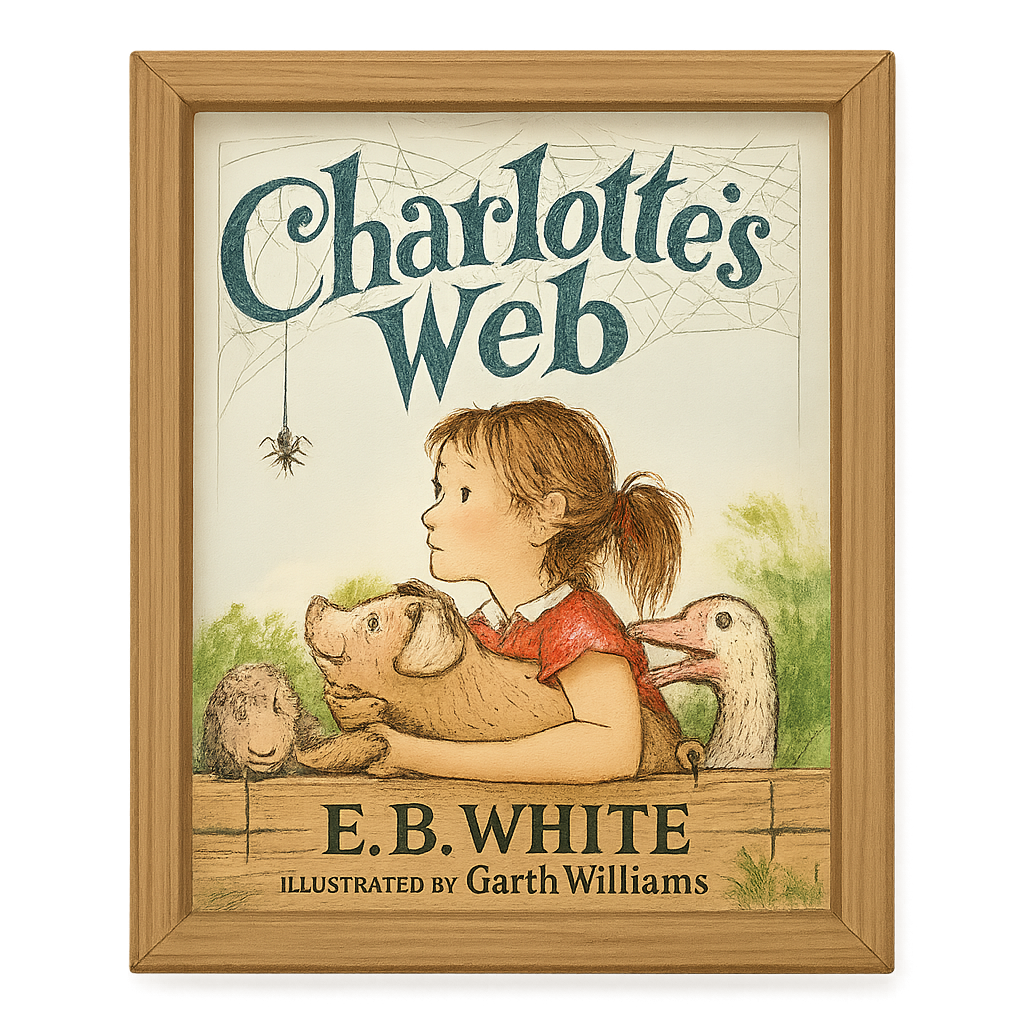
Before my covers are even opened, I am a feeling. I am the scent of aging paper and dark ink, a quiet weight in your hands, a promise of a story sleeping inside. If you listen closely, you can almost hear the world within my pages: the sweet, dusty smell of hay in a sunlit barn, the gentle, rhythmic chewing of cows, and the high-pitched squeak of a piglet who is very new to the world and very, very worried about his future. He is the runt of the litter, small and vulnerable, but his heart is big and full of hope. Above him, in the shadows of the rafters, a quiet, steady voice spins words like silk, a mystery unfolding in the dusty sunbeams. This is a world of simple truths, of changing seasons, and of a friendship so strong it could change a pig's destiny. The barn is a sanctuary, a stage, and a home where the most ordinary creatures are about to do something extraordinary. The story waits, patient and whole, for a reader to turn the first page and let it live. I am the story of a loyal spider and a terrific pig. I am Charlotte's Web.
My pages are filled with the sights and sounds of the Zuckerman farm, but my own story begins on a real farm in Brooklin, Maine. It was there that my creator, a quiet, thoughtful man named Elwyn Brooks White, lived and wrote. He was a man who paid attention to the small wonders of the world. One autumn day in 1949, he was in his own barn when he noticed a large grey spider diligently spinning her web. He watched her for weeks, mesmerized by her intricate work and her patient existence. He saw her build a silken egg sac for her children and felt a pang of sadness when he found her lifeless in her web one day. He carefully took the egg sac back to his house and watched in awe as hundreds of tiny spiders emerged. This small, true story of life, death, and continuity planted a seed in his mind. He began to think about his own farm animals, especially his pigs, and the inevitable fate that awaited them. He wanted to write a story that could somehow save a pig's life. He wanted to write a book that was both honest about the sorrow of loss but also a comforting testament to the power of friendship. He spent three years carefully weaving the words together, making sure every sentence was just right. To give my characters their faces, an artist named Garth Williams was chosen. He spent time on farms, sketching pigs until he captured the perfect look of innocence and humility for Wilbur. He drew countless spiders to make sure Charlotte looked both wise and kind, a true friend and a brilliant artist. Finally, with the words and pictures united, I was ready. I was first published and shared with the world on October 15th, 1952, ready to spin my own web across the hearts of readers.
When people first began to read me, something magical happened. Families gathered in living rooms and children huddled under blankets with flashlights, listening as the story of Wilbur and Charlotte unfolded. They could hear the geese cackle and feel Wilbur’s panic when he learned of his fate. And then, they witnessed Charlotte's brilliant plan. It wasn't a plan of escape, but a plan of words. Readers held their breath as the first message appeared, spun in silky thread in the middle of the web: 'Some Pig.' It was a simple phrase, but it changed everything. People traveled for miles to see the miracle in Zuckerman's barn. Then came 'Terrific,' followed by 'Radiant,' and finally, the perfect word for a pig who had learned so much about friendship and sacrifice: 'Humble.' These words were not just descriptions; they were irrefutable proof of Wilbur's worth, spun into existence by a friend who saw the best in him. They were acts of love that saved his life. As readers turned my final pages, they felt a mix of joy and sorrow—a bittersweet feeling. They celebrated Wilbur's safety but grieved for Charlotte, who used the last of her strength to save her friend before her own life came to its natural end. I taught them that true friendship is about giving everything you have, and that a life, no matter how short, can be profoundly meaningful if it is lived with love and purpose.
A story, like a spider's web, is a delicate thing, but it can also be incredibly strong. For decades, I have been passed from the hands of one generation to the next, a bridge of shared feelings connecting parents to their children. My pages have been creased, my corners softened, but the story inside remains as true as the day it was written. I continue to teach lessons about loyalty, about facing fear, and about the quiet beauty of the natural world and its cycles of life and death. My story lives on not just on bookshelves, but in the hearts of those who remember Wilbur and Charlotte. Every time someone stands up for a friend, or shows kindness to a creature smaller than themselves, or sees the wonder in the ordinary world, my web is spun anew. And I remind everyone that in the grand, complicated story of life, true friendship never truly ends. It just changes form, its goodness echoing forever in the world.
Reading Comprehension Questions
Click to see answer