

 English

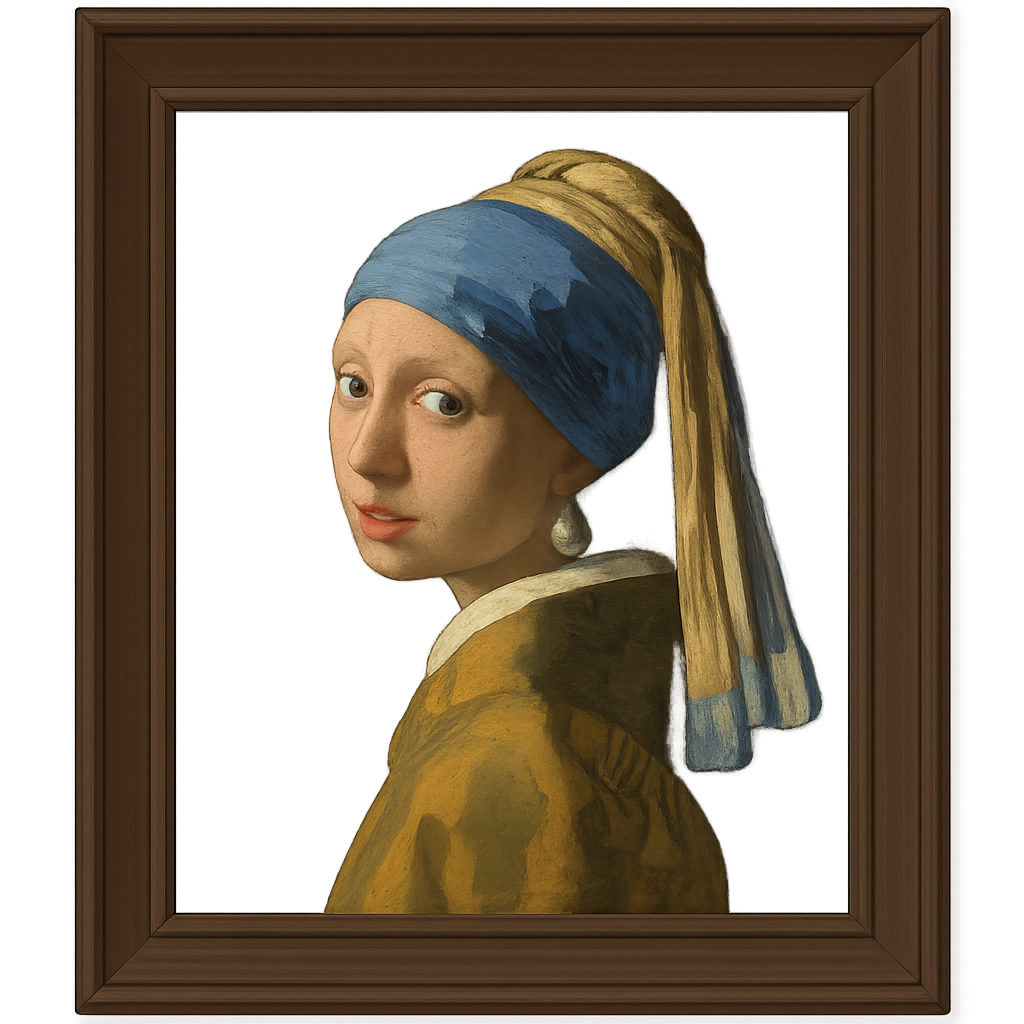
I Am the Girl with a Pearl Earring
For as long as I can remember, I have existed in a world of profound darkness, a quiet void where time itself seems to stand still. My reality is defined not by the shadows, but by the light that cuts through them. It is a gentle, knowing light, falling from the left, that gives me form. It kisses my cheek, creating a soft, luminous glow against the deep, velvety black that surrounds me. It catches in my eye, a tiny spark of life that holds a silent question. Most of all, it pools into a single, magnificent point on my ear, a shimmering orb of white and grey that seems to contain all the light in the world. I am turned toward you, as if you just called my name, my lips parted as if I am about to answer. But what is my expression? Am I pleased to see you? Am I filled with a quiet sorrow? Or am I holding onto a secret that I might share if you just look a moment longer? My gaze holds a story, a mystery wrapped in a blue and yellow turban, anchored by a single, perfect gleam. People have wondered about me for centuries, this quiet girl looking out from the canvas. I am the Girl with a Pearl Earring.
My life began in the 17th century, in the bustling Dutch city of Delft. It was a time you now call the Dutch Golden Age, a period of immense wealth, scientific discovery, and artistic genius. My creator was a man named Johannes Vermeer, a master of his craft, though he was not famous like some others during his lifetime. His studio was his sanctuary, a room filled with maps, rich fabrics, and most importantly, that beautiful, clear light from a window on the left. Vermeer was a patient, meticulous man. He wasn't just a painter; he was a magician of light. He studied how it fell across a pearl, how it reflected on silk, and how it gave warmth to a person’s skin. He didn't want to create stiff, formal portraits of wealthy patrons, the kind that hung in grand halls to show off status. Instead, he was fascinated by the quiet, intimate moments of everyday life. He wanted to capture something fleeting and personal—a glance, a thought, a feeling suspended in time. He worked slowly, producing only about 34 known paintings in his entire life. I was not meant to be a portrait of a specific person, but an exploration of an expression, a study of how light and shadow could create an unforgettable human presence.
Becoming me was a slow and deliberate process. I felt the gentle pressure of his brush, each stroke a whisper of intention. He built me from layers of oil paint, a technique that gave my skin its soft, lifelike depth. He used a palette of earth tones—ochres and browns—for the background, making me emerge from the darkness as if stepping into the light. For my turban, he used something extraordinary. The brilliant blue is ultramarine, a pigment made by grinding the precious gemstone lapis lazuli, which had to be imported from far-off Afghanistan. In the 1600s, it was more valuable than gold. This choice shows how much he cared about capturing the perfect color. I am what art historians call a “tronie.” This means I am not a portrait of a paying client, but a study of a captivating character, focusing on an interesting facial expression and an exotic costume. My power is in the details Vermeer so carefully crafted. My gaze follows you no matter where you stand, creating a direct and personal connection. My slightly parted lips give the impression that I am in the middle of a breath, about to speak to you. And my pearl earring? It is the ultimate illusion. It is not a detailed rendering of a pearl at all, but just two masterful dabs of white paint—one for the bright reflection and a softer one for the glow against my neck. With those simple strokes, he created an object of perfect, luminous beauty.
After my creator, Vermeer, passed away in 1675, a long silence fell over me. For nearly two hundred years, I was lost to the world, my significance forgotten. I was passed from one owner to another, my true identity obscured by time and layers of darkened, yellowed varnish. The brilliant blue of my turban grew dim, and the soft tones of my skin were hidden under a grimy film. Then, in 1881, I found myself at an art auction in The Hague. I was in such poor condition that almost no one recognized my quality. A collector named Arnoldus Andries des Tombe saw something in my gaze, a flicker of the magic that lay beneath the dirt. He purchased me for a shockingly small sum—just two guilders and thirty cents. It was the beginning of my reawakening. Des Tombe had me carefully cleaned and restored. It was like waking from a long, deep sleep. As the layers of old varnish were gently removed, the light returned. My colors blazed forth once more, the vibrant ultramarine and the sunny yellow of my turban shining as they had in Vermeer’s studio. The soft light on my face was revealed, and my creator’s signature became visible again. I was reborn. When Des Tombe passed away in 1902, he generously donated me to the Mauritshuis museum in The Hague, giving me a permanent home where everyone could finally see me as I was meant to be seen.
Today, I hang on a dark wall in the Mauritshuis, and people travel from every corner of the globe just to stand before me. Why do they come? I think it is because of the mystery I hold. No one knows for certain who the girl in the painting was. Was she Vermeer's daughter, a maid, or a model he imagined? Because her story is unwritten, every person who looks at me can create their own. I become a mirror for their own thoughts and feelings. My direct and intimate gaze breaks down the barrier of time. When you look at me, it feels as if I am looking right back at you, a young woman from the 17th century making a connection with someone in the 21st. I am more than just oil paint on a canvas; I am a timeless whisper across the centuries. I am an invitation to wonder, to feel a bond with the past, and to remember that a single, quiet moment of human creativity can become a masterpiece that speaks forever without ever saying a word.
Activities
Take a Quiz
Test what you learned with a fun quiz!
Get creative with colors!
Print a coloring book page of this topic.













 Free for Educators