English
 For Schools
 For Homeschool

Last Stop on Market Street: My Story
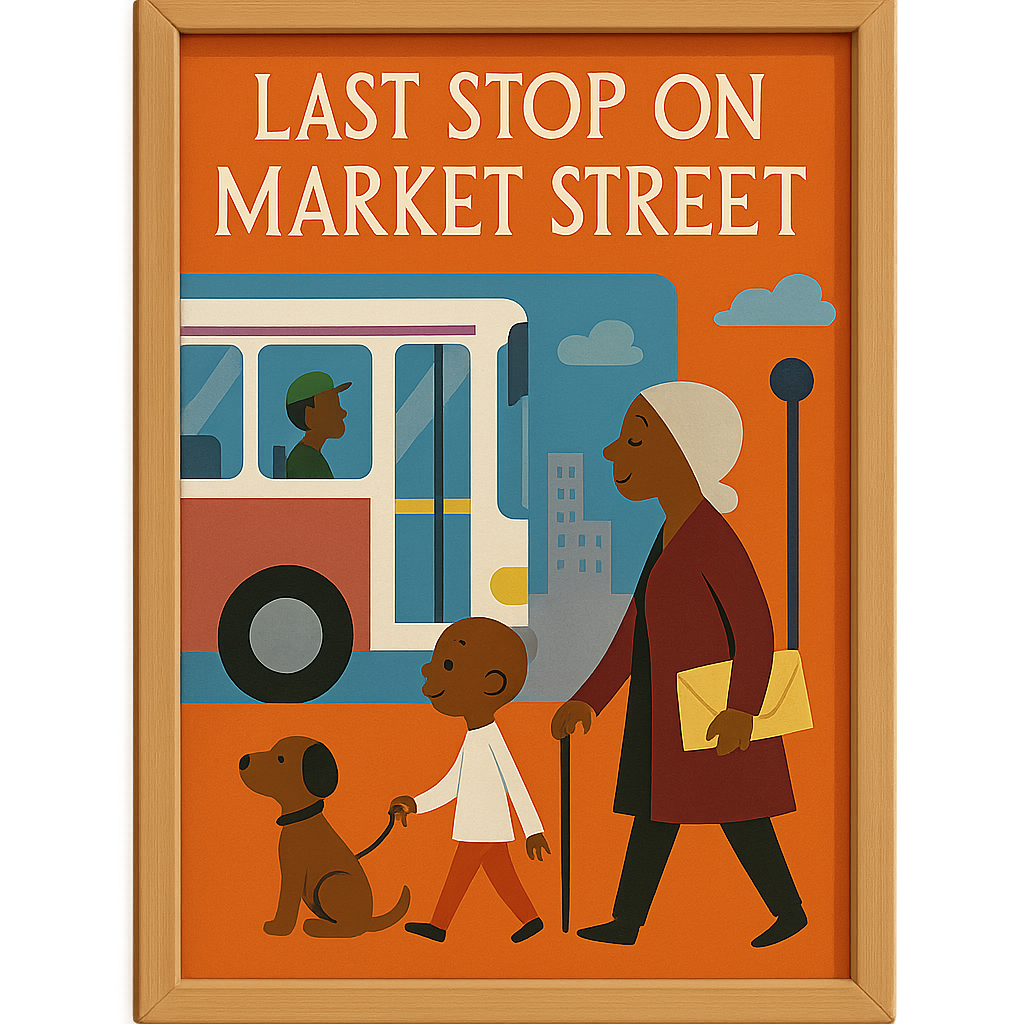
Breathe in. Can you smell that? It’s the scent of fresh paper and crisp ink, a promise of a world waiting just for you. Listen. That’s the soft whisper of my pages turning, each one a step on a journey. When a reader opens me, the first thing they often feel is the gentle patter of rain against a window. It’s a sound that fills the air as a young boy named CJ and his wise Nana board a city bus, its engine rumbling like a friendly giant’s sigh. CJ looks out at the wet, shimmering streets, at the blur of faces and buildings passing by. He feels a little sorry for himself. Why don’t they have a car? Why does he have to go here after church every Sunday? His questions hang in the damp air, and his Nana answers each one not with a simple fact, but with an invitation to see things differently. She encourages him to close his eyes and listen to the world’s music. Through their journey, you can feel the pulse of the city and the warmth of a grandmother’s love, a steadying force against a child’s confusion. I am more than just paper and ink. I am a journey you can hold in your hands. I am the book, Last Stop on Market Street.
I came into being from the minds and hearts of two thoughtful people, a word-weaver and a color-magician. My author, Matt de la Peña, was the word-weaver. He wanted to write a story that felt like a 'thank you letter' to the world, a story that would show how beauty can be found in the most unexpected places—not just in fancy houses or shiny cars, but in the rhythm of a bustling city and the kindness of strangers. He carefully wove my words together, capturing the gentle, loving conversations between CJ and his Nana. He wanted every word to feel true, to honor the kind of quiet wisdom that grandmothers often share. Then came the color-magician, my illustrator, Christian Robinson. He is the one who gave my world its shape and vibrancy. Instead of just drawing, Christian created his art using a unique combination of acrylic paint and collage. He cut shapes from paper and pasted them together, creating characters and scenes that seem to dance with energy. His style is simple but full of emotion, and he made sure to fill my pages with people of all colors, shapes, and sizes, so that every child, especially those living in cities, could see their own community reflected in my world. Matt and Christian worked together, blending words and pictures seamlessly, until I was ready to be shared. On my birthday, January 8th, 2015, I was published, and my journey into the hands of readers officially began.
My own story begins just as CJ and Nana’s does, right after they leave their church on a rainy Sunday. As they step onto the bus, the real adventure starts. My pages introduce you to a whole cast of characters who make their ride special. There’s a man with a guitar who coaxes beautiful music from its strings, filling the bus with a melody that makes CJ’s spirit soar. They meet a woman who carries a jar full of fluttering butterflies, a tiny, magical world she shares with the curious boy. Each person they encounter adds another layer to the city’s song. Throughout the ride, CJ continues to ask questions born from disappointment. He sees his friend in a car and wishes he had one. He looks at the grittier parts of the neighborhood and wishes for something prettier. But with every complaint, his Nana gently reframes his perspective. She teaches him to see the beauty in the everyday. The dirty part of town? To her, it needs the rain more than anywhere else, a sign of nature’s care. Their last stop isn’t a store or a playground. It’s a soup kitchen on Market Street. Here, they are not coming to get something, but to give. They volunteer, serving food to people who are hungry. This is the heart of my message. I was made to show readers that true richness isn't about what you own, but about how you see the world and how you connect with the people in it. The most beautiful things are often the acts of kindness we share with one another.
After I was born, I began to travel, finding my way into libraries, schools, and homes. Then, something incredible happened. On January 11th, 2016, I was given the Newbery Medal. This award is one of the highest honors for children’s literature, but it is almost always given to long novels filled with hundreds of pages of text. For a picture book like me, with just a few carefully chosen words on each page, winning was a huge surprise. It was a recognition that a powerful story can be told with both words and pictures working together. On that same day, Christian’s beautiful art was recognized with a Caldecott Honor, another prestigious award celebrating the best illustrations. These honors were like a passport, allowing me to journey even farther, to be translated into different languages and shared with children all over the world. But my true purpose isn't to sit on a shelf with medals. I am an invitation. I ask you to look out your own window, ride your own bus, or walk through your own neighborhood and find what is beautiful. I hope to remind you that every single person has a story worth hearing, and that helping others is one of the most beautiful journeys you can ever take, connecting us all in a shared story of kindness.
Activities
Take a Quiz
Test what you learned with a fun quiz!
Get creative with colors!
Print a coloring book page of this topic.