

 English

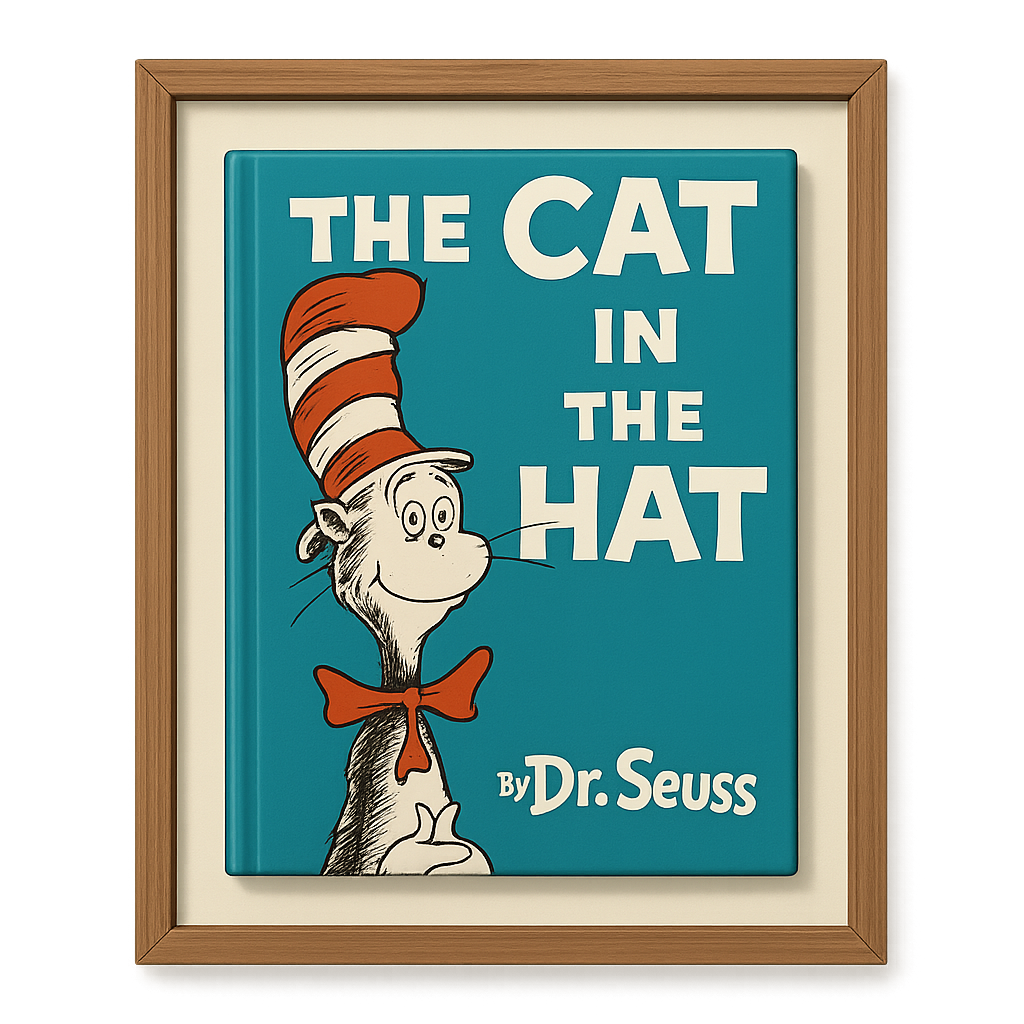
The Cat in the Hat
Feel the smooth gloss of my cover beneath your fingertips, the satisfying stiffness of my spine. When you open me, you can almost smell the faint, sweet scent of paper and ink, a perfume of possibility. Inside my pages, the world is quiet and gray. A fine drizzle streaks down a windowpane, where two children, Sally and her brother, sit with long faces, their day drained of all fun. Their pet fish floats listlessly in his bowl, just as bored as they are. The whole house seems to be holding its breath, waiting for something, anything, to happen. The clock on the wall ticks with a slow, monotonous rhythm, each second a tiny drop of dullness. It is a world sealed in silence and sogginess, a perfect picture of a day with nothing to do. Then, it happens. A sound that doesn't belong. BUMP. It's a loud, sudden, and wonderfully disruptive noise that shatters the quiet like a dropped plate. The children jump. The fish swishes. Something has arrived. Into this gray world steps a splash of impossible color and energy: a cat. But not just any cat. He is tall, astonishingly tall, with a mischievous grin that stretches from whisker to whisker. He wears a floppy red bow tie and, perched perfectly on his head, a towering red-and-white-striped hat. He is chaos and charm all wrapped in one. I am not just paper and ink. I am a promise of adventure. I am the book called The Cat in the Hat.
My story didn't begin on that rainy day with Sally; it began with a problem. Back in the 1950s, many people were worried. Children weren't learning to read as quickly as they should, and a writer named John Hersey published an article in May of 1954 suggesting why. The books they were given in school, the ones meant to teach them, were dreadfully boring. They were filled with polite children named Dick and Jane who never did anything exciting. They were predictable, dull, and utterly forgettable. A publisher read that article and saw not just a problem, but a challenge. He called up a man known for his wildly imaginative drawings and clever rhymes, an artist named Theodor Geisel, whom you know as Dr. Seuss. The challenge was immense: write a story so captivating that a first-grader couldn't put it down. The catch? He could only use words from a specific list of 250 simple words that every six-year-old was expected to recognize. For over a year, Ted stared at that list. It was a creative prison. How could he build a world of fun out of words like 'the,' 'and,' and 'is'? He felt stuck, frustrated, and on the verge of giving up. One day, as he scanned the list for the hundredth time, his eyes landed on two words that rhymed: 'cat' and 'hat.' In that instant, an image popped into his head—a tall, jaunty cat in a striped hat. The floodgates opened. The story tumbled out, a cascade of bouncing rhythm and hilarious nonsense, all built from that restrictive list. He painstakingly chose every single word, 236 in total, to craft a tale of delightful mayhem. I was finally published on March 12th, 1957, a book born from a challenge, ready to prove to the world that learning to read could be the greatest adventure of all.
When I first started arriving in homes and classrooms, I was a bit of a shock. Teachers and parents were accustomed to stories where children were well-behaved and everything stayed neat and tidy. I was the exact opposite. I brought chaos tucked between my covers. The Cat balanced a fishbowl on an umbrella while hopping on a ball. He unleashed two blue-haired whirlwinds of trouble, Thing One and Thing Two, who flew kites inside the house, knocking over everything in their path. For children, this was revolutionary. They saw their own secret wishes for a little bit of mischief played out on my pages, and they were mesmerized. For the first time, many of them felt a powerful connection to the words they were learning. My simple, rhyming text wasn't just easy to follow; it was fun to say aloud. The rhythm was like a song, and the repetition helped build confidence. A child who struggled with 'See Spot run' could suddenly read an entire book by themselves, from beginning to end. They weren't just sounding out words; they were participating in a fantastic, funny story. My success was immediate and overwhelming. I showed everyone that educational books didn't have to be boring. In fact, I helped my creator start a whole new publishing company called Beginner Books, with a simple mission: to create stories that were easy enough for beginners but entertaining enough to make them want to read more. I wasn't just a book; I was the start of a reading revolution.
My journey has lasted for decades, far longer than a single rainy afternoon. My pages, once crisp and new, have been softened by millions of little hands. My story of that chaotic cat has been translated into dozens of languages, shared in classrooms from Ohio to Osaka. That tall cat in the striped hat has become more than just a character in a book; he is a global ambassador for literacy and imagination. He is a symbol that reminds everyone that learning can be joyful and that a little creative rule-breaking can open up a world of possibilities. When you see his red-and-white-striped hat, you know that fun is just around the corner. I stand on shelves in libraries and bedrooms as a testament to an idea: that a difficult challenge can spark the greatest creativity. Dr. Seuss took a restrictive list of words and, instead of seeing limitations, he found freedom. He proved that you don't need fancy, complicated language to tell a story that will last forever. So the next time you find yourself staring out the window on a dull, rainy day, remember me. I am proof that even on the grayest of days, a grand adventure is waiting inside the pages of a book. I am a promise that fun is never truly done, and it often starts with those three simple words: 'Read a book.'
Activities
Take a Quiz
Test what you learned with a fun quiz!
Get creative with colors!
Print a coloring book page of this topic.









 Free for Educators