

 English

The Wave That Never Crashes
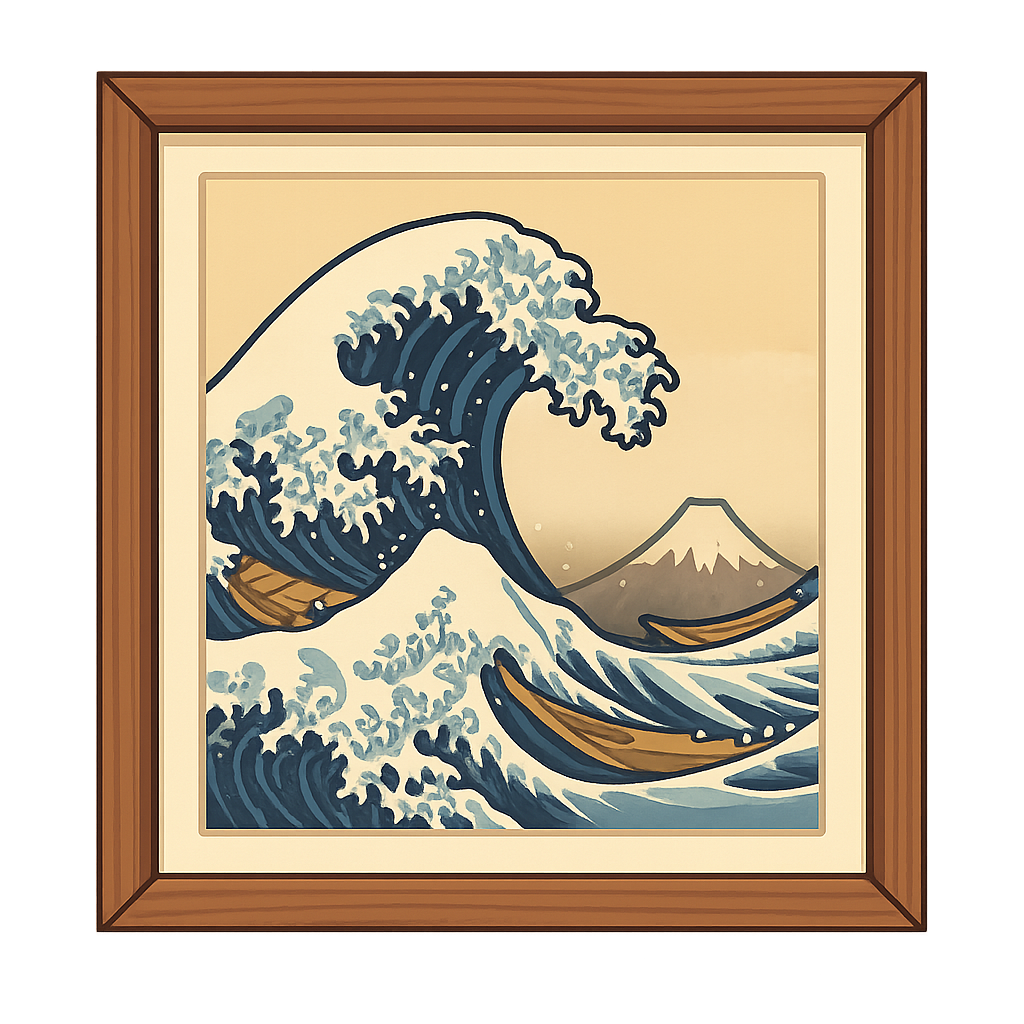
Feel my power. I am a mountain of water, a roaring giant of the deep, forever frozen at the peak of my strength. My crest curls into a thousand sharp claws of foam, reaching for the sky, while my body is a deep, magnificent Prussian blue, a color so intense it seems to hum with energy. Far below me, three slender boats, called oshiokuri-bune, are caught in my swell. They seem so fragile, like leaves tossed in a storm, yet the fishermen inside them are not panicked. They bow low, their bodies tense with effort and experience, ready to guide their vessels through the trough. In the distance, framed perfectly under my arching curl, stands the silent, dignified form of Mount Fuji. Its peak is white with snow, serene and unmoving, a stark contrast to my chaotic, surging power. I am a moment of intense drama suspended in time—a battle between humanity and the immense force of nature, all watched over by the sacred mountain. I am the image that has captured the world’s imagination. I am The Great Wave off Kanagawa.
I was born from the mind and brush of an extraordinary man, Katsushika Hokusai. When he created me around 1831, he was already over seventy years old, an age when many artists would be resting on their accomplishments. But Hokusai was different. He was obsessed with capturing the essence of the world around him, and most of all, he was captivated by Mount Fuji. To him, the mountain was a symbol of eternity, a spiritual anchor for Japan. He decided to create a series of prints called 'Thirty-six Views of Mount Fuji' to show its majesty from every possible angle, in every season, and through the lives of ordinary people. I was to be one of those views. My creation was a meticulous, collaborative process. First, Hokusai drew my design on thin paper with incredible precision. This drawing was then pasted onto a block of cherry wood. A master carver took over, painstakingly chiseling away the wood around Hokusai’s lines, leaving only my raised image. This was the key block, the skeleton of the design. But to give me color, more blocks were needed—one for each shade. A block for the pale yellow of the boats, another for the light blue of the sky, and of course, a special one for my deep, vibrant color. That brilliant blue was a modern marvel, an imported synthetic pigment called Prussian blue. It was more vivid and less prone to fading than the traditional indigo, and its use was revolutionary. Finally, a printer would apply the ink to each block in turn, carefully pressing a sheet of damp mulberry paper onto them, one after another, until I emerged, complete in all my roaring glory. I wasn't a single painting; I was a ukiyo-e print, an 'image of the floating world,' made to be reproduced so that many could own me.
During the Edo period in Japan, I lived a humble life. I was not locked away in a palace or a temple. Instead, I was sold in shops and stalls to merchants, samurai, and townspeople who wanted a beautiful image of their beloved landscape. I was art for the people, a souvenir of a pilgrimage to Mount Fuji or simply a decoration for a home. For decades, I was a familiar sight in Japan. But my greatest journey was yet to come. In 1853, Japan, which had been isolated for over two hundred years, opened its ports to the rest of the world. Suddenly, goods and art from Japan began to flow into Europe and America. I was packed up with silks, fans, and porcelain and sailed across the vast oceans I depicted. In cities like Paris, I caused an absolute sensation. Artists there were used to a very different style of art—one focused on realism, depth, and shadow. When they saw me, they were stunned. They were captivated by my bold, flat colors, my dramatic composition, and the way I captured a fleeting, powerful moment. Artists like Claude Monet, Edgar Degas, and Vincent van Gogh collected prints like me. They studied my lines and my unique perspective. My energy even inspired the composer Claude Debussy to write a piece of music called 'La Mer' (The Sea). This wave of excitement for Japanese art became a movement known as Japonisme, and I was at its very crest, showing the world a new way to see and feel.
My journey has never stopped. I have flowed from Hokusai’s 19th-century workshop into the 21st century, becoming one of the most recognized images in the world. I am no longer just a woodblock print. I am a symbol. To some, I represent the awesome, untamable power of nature. To others, I am a testament to human resilience, a picture of small figures facing an overwhelming challenge with courage. I have been printed on posters, painted on city walls, stitched onto clothing, and even transformed into a tiny emoji on your phone. I connect people across time and culture, from the fishermen in my boats to the art students studying me today. I am a reminder that in every moment of chaos, there is an underlying structure and a breathtaking beauty. And just like the calm, steady peak of Mount Fuji in my background, there is always a point of stillness to be found. I am the wave that will never crash, forever rolling onward to inspire awe and creativity in all who see me.
Activities
Take a Quiz
Test what you learned with a fun quiz!
Get creative with colors!
Print a coloring book page of this topic.















 Free for Educators