English
 Continue with Google
 Continue with Apple

The Story of The Hobbit
My existence began not with a thunderclap, but as a quiet whisper on a blank page. It was around the year 1930, in a peaceful, book-lined study in Oxford, England. My creator, a brilliant professor named John Ronald Reuel Tolkien, sat at his desk, his mind occupied with the tedious task of grading examination papers. The air was thick with the scent of old paper and pipe smoke, a place of deep thought and ancient languages. Suddenly, in a moment of unexpected inspiration, he turned over a student’s paper and scribbled a sentence that had appeared in his mind, fully formed and uninvited: “In a hole in the ground there lived a hobbit.” That single line was me. At first, I was just a seed, a curious thought. What was a hobbit? Why did it live in a hole? From that simple, spontaneous sentence, my entire world began to sprout. I am the story of that hobbit, a tale called 'The Hobbit, or There and Back Again.' I wasn't planned or outlined; I was a discovery, an adventure that my own creator embarked upon right alongside my hero, Bilbo Baggins. Professor Tolkien, a lover of myths, languages, and sagas, began to explore the world that sentence suggested, and as he wrote, I grew from a whisper into a voice, ready to tell a grand story of mountains, dragons, and the courage found in the most unexpected of hearts.
I was not written in a hurry. My growth was slow and thoughtful, nurtured over several years in the early 1930s. Professor Tolkien was more than just an author; he was a world-builder, a sub-creator, as he liked to call it. He didn’t just write a story; he gave me a soul. He drew detailed maps so my characters would never get lost on their way to the Lonely Mountain. He charted the paths through Mirkwood forest and located Smaug the dragon’s lair with geographic precision. He was a philologist, a scholar of languages, so he invented entire linguistic systems for the elves and dwarves who populated my pages. This gave my world a sense of immense history, a feeling that my events were unfolding in a place that had existed for thousands of years. Before I was ever a manuscript, I was a bedtime story. Tolkien first told my tale to his children, John, Michael, and Christopher. I can still feel the magic of those evenings, my words spoken aloud in a father’s warm voice. I saw the children’s eyes grow wide at the first appearance of Gandalf, heard them hold their breath during Bilbo’s riddle game with the creature Gollum deep under the mountains, and felt their excitement as the dwarves planned to reclaim their treasure. For years, I was a private family story, a beloved secret. But secrets like me have a way of getting out. A copy of my unfinished manuscript was passed around to trusted friends and colleagues, and eventually, in 1936, it found its way to a publisher in London named George Allen & Unwin.
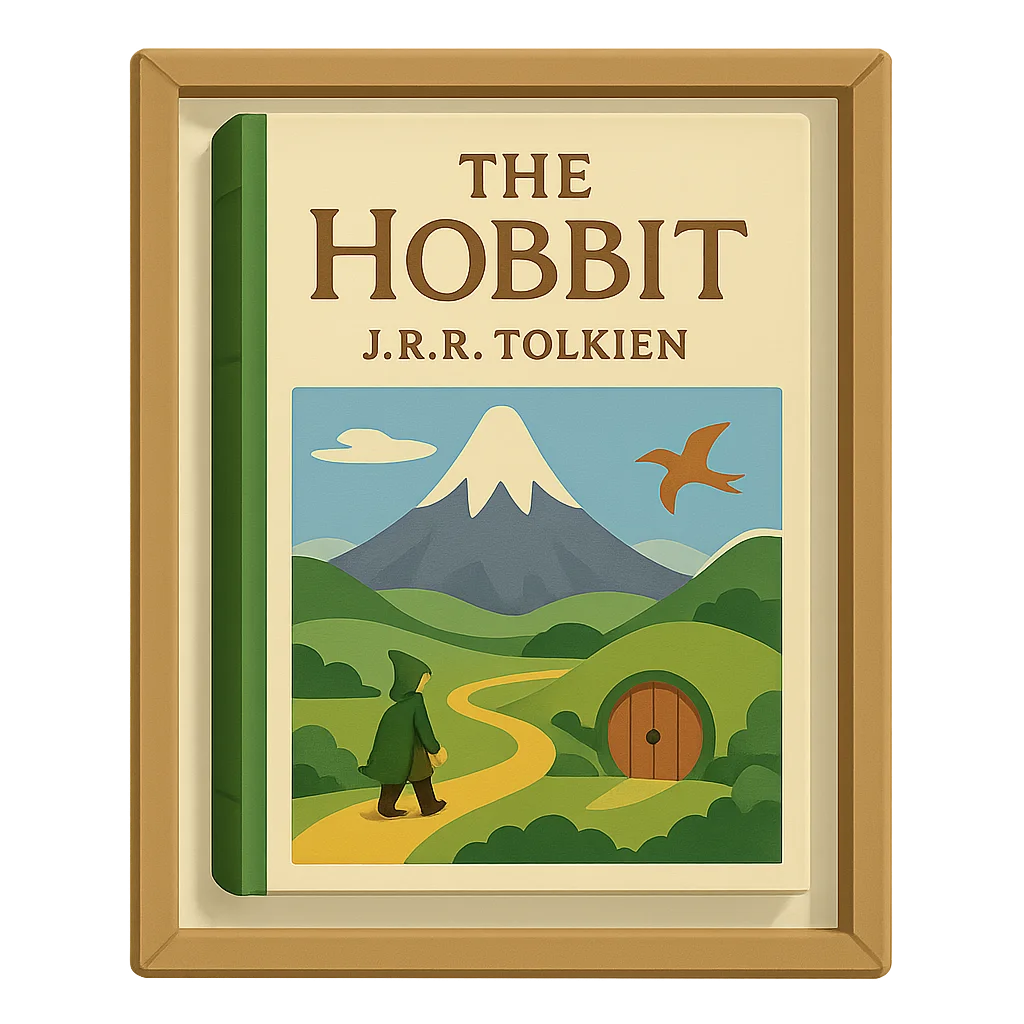
My journey from a private story to a public book depended on the opinion of a single, ten-year-old boy. The publisher, Stanley Unwin, was unsure if a story about hobbits and dragons would sell. So, he devised a clever test. He gave my manuscript to his son, Rayner Unwin, and offered him a shilling to read me and write a report. Imagine my nervousness. I was just a stack of typed pages, filled with peculiar names and fantastical creatures. Would a child understand my adventure? Would he find Bilbo’s journey compelling? My entire future rested on his review. I waited as he turned my pages, meeting trolls, escaping goblins, and soaring with giant eagles. Finally, Rayner delivered his verdict. He wrote that my story was good and “should appeal to all children between the ages of five and nine.” That was all it took. His father was convinced. On September 21st, 1937, I was finally born as a real book. My first edition had a beautiful dust jacket designed by Tolkien himself, showing the misty mountains and the dark green of the forest. I arrived in a world that was growing tense and fearful, with the shadow of World War II looming. Readers found comfort in my tale of a small, quiet person who, despite his fears, did the right thing and helped his friends. My success was immediate, and my publisher quickly asked for a sequel. That request would lead my creator back to his desk, ready to begin an even larger tale.
My journey did not end in 1937. In fact, it was only the beginning of a much longer and more unexpected adventure. Since that first day in the bookshops, I have traveled far beyond England. I have learned to speak in more than 50 languages, sharing Bilbo’s story with children and adults from Japan to Brazil. I have leaped from the page to the radio, the stage, and the cinema screen, my world brought to life for new generations to see and hear. My true strength, however, isn't found in the glitter of a dragon's treasure or the thrill of a great battle. It lives in a simple, powerful idea: that anyone, no matter how small or ordinary they may seem, possesses the capacity for extraordinary courage. Bilbo Baggins was not a warrior or a king; he was a hobbit who loved his cozy home and a good meal. Yet, when the call to adventure came, he found a strength within himself he never knew he had. I am more than just a book. I am an invitation. I am proof that you don't need a magic sword to be a hero. You just need a good heart and the courage to take that first step out your own front door. I hope I can inspire you to find the adventurer within yourself, because every great journey, like mine, begins with a single, simple step.
Reading Comprehension Questions
Click to see answer