

 English

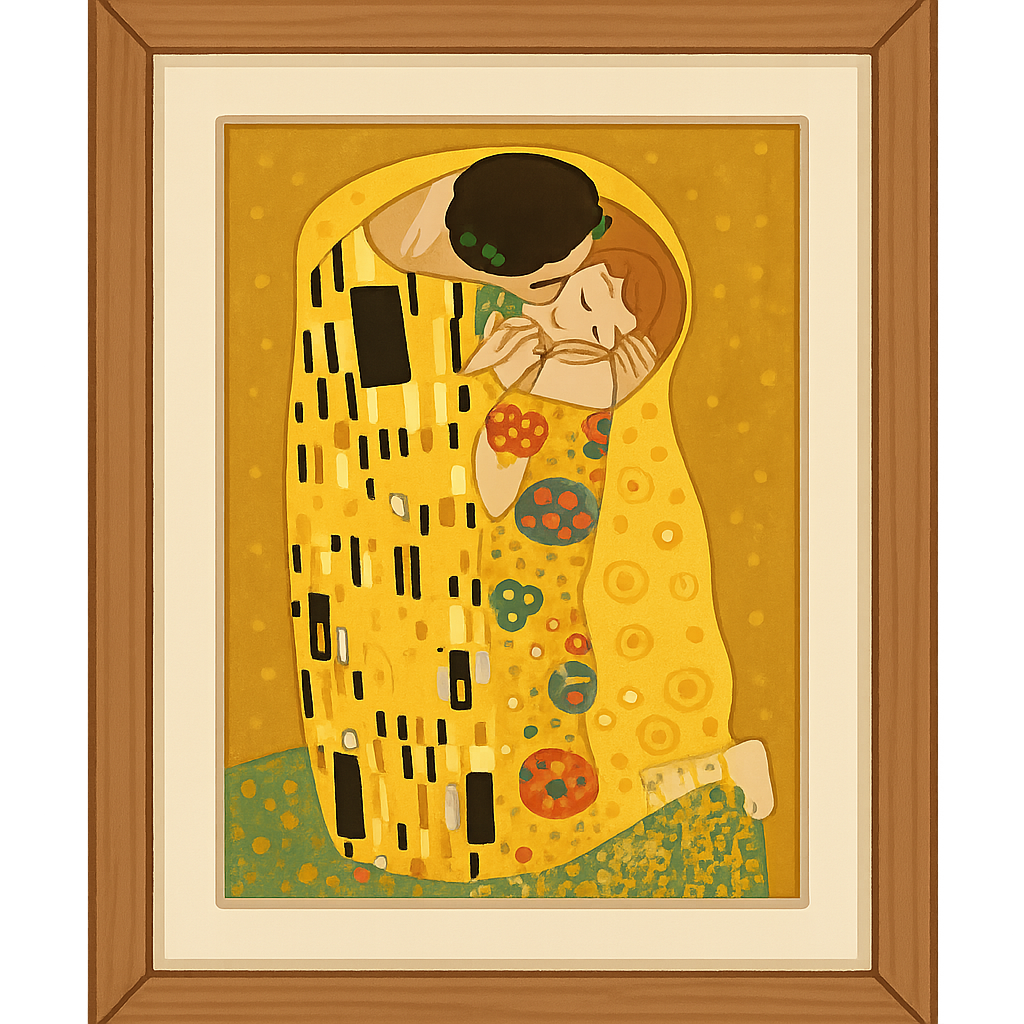
The Kiss: A Story Told in Gold
Before I had a name, I was a feeling. I am a world spun from light, a universe of shimmering gold. If you could step inside me, you would feel the warmth of a thousand suns and the coolness of starlight all at once. At my very center, two figures are locked in an eternal embrace, their bodies becoming one with the swirling patterns of their robes. The man, strong and protective, wears a cloak of bold, rectangular shapes, his head bowed to bestow a tender gesture. The woman, serene and accepting, is adorned in a gown of soft circles and flowers, her face tilted upwards in a moment of pure bliss. They stand on the edge of the world, a fragile cliff covered in a carpet of colorful blossoms, suspended against an endless, glittering abyss. I am more than just paint and gold leaf on a canvas. I am the silent, electric moment when two souls connect, a feeling made visible, a memory that never fades. I am The Kiss.
My story begins in the vibrant and bustling city of Vienna, Austria, with a quiet but revolutionary artist named Gustav Klimt. The year was 1907, a time when the world was changing rapidly, and art was changing with it. Gustav was at the peak of his creative powers, in a period that critics would later call his 'Golden Phase'. A few years earlier, in 1903, he had traveled to Ravenna, Italy, and had been completely mesmerized by the ancient Byzantine mosaics he saw in the churches there. They were vast, glittering images of saints and angels, made from tiny pieces of glass and gold, and they seemed to glow with a divine, otherworldly light. That experience planted a seed in his mind. He wanted to bring that same celestial radiance into his own work. He decided to use real gold leaf, a material previously reserved for sacred icons, to express the most sacred of human emotions. And so, he began to dream of me. My creation was a meticulous and delicate process. On a large, square canvas, Gustav first sketched the figures, capturing the perfect curve of the woman's neck and the protective arch of the man’s back. Then came the layers. He used traditional oil paints for the soft skin of the faces and hands, making them appear human and vulnerable amidst the divine spectacle. The carpet of flowers they stand on was painted with dabs of vibrant color, an earthly paradise at the edge of infinity. But the rest of me was born from metal and light. Gustav and his brother, Georg, a skilled gold gilder, would carefully apply thin, fragile sheets of gold and silver leaf onto the canvas. It was a painstaking process, each shimmering square laid down with precision to create the glowing background and the intricate patterns on the lovers’ robes. I was a part of a bold new art movement sweeping across Europe called Art Nouveau, which celebrated flowing, organic lines inspired by plants and nature. My swirling patterns and decorative beauty were a perfect expression of this new style. Gustav wasn't just painting a portrait of two people. He was creating an icon, a universal allegory for the transcendent power of love.
In 1908, even before the final touches of gold were applied, I was put on display for the first time at a major exhibition in Vienna called the Kunstschau. The reaction was immediate and profound. While some of Gustav's earlier work had been considered controversial, people were captivated by my shimmering beauty and powerful emotion. I was not just a painting; I was an experience. Representatives from the Austrian government saw me there and, recognizing that I was a modern masterpiece, purchased me on the spot for the state-run Moderne Galerie, which is now the Belvedere museum. It was a huge vote of confidence in Gustav’s vision, and I became a national treasure before I was even officially finished. For over a century, I have hung in the Belvedere, my golden surface catching the light and the gazes of millions of visitors. People from every corner of the globe have stood before me, sometimes in silence, sometimes whispering to their loved ones. They see themselves in the embrace, recognizing a feeling that needs no translation. My fame grew far beyond the museum walls. My image has been reproduced on countless posters, books, coffee mugs, and even umbrellas, carrying my message of love across the world. I have become a symbol, a reminder of the beauty that humans are capable of creating and feeling. Even now, so long after Gustav laid down his final brushstroke, my glow has not faded. I invite everyone who looks at me to step out of their ordinary world and into my golden one, to feel the warmth of that perfect, timeless moment, and to be connected to an emotion that unites us all.
Activities
Take a Quiz
Test what you learned with a fun quiz!
Get creative with colors!
Print a coloring book page of this topic.















 Free for Educators