English
The Wardrobe's Secret
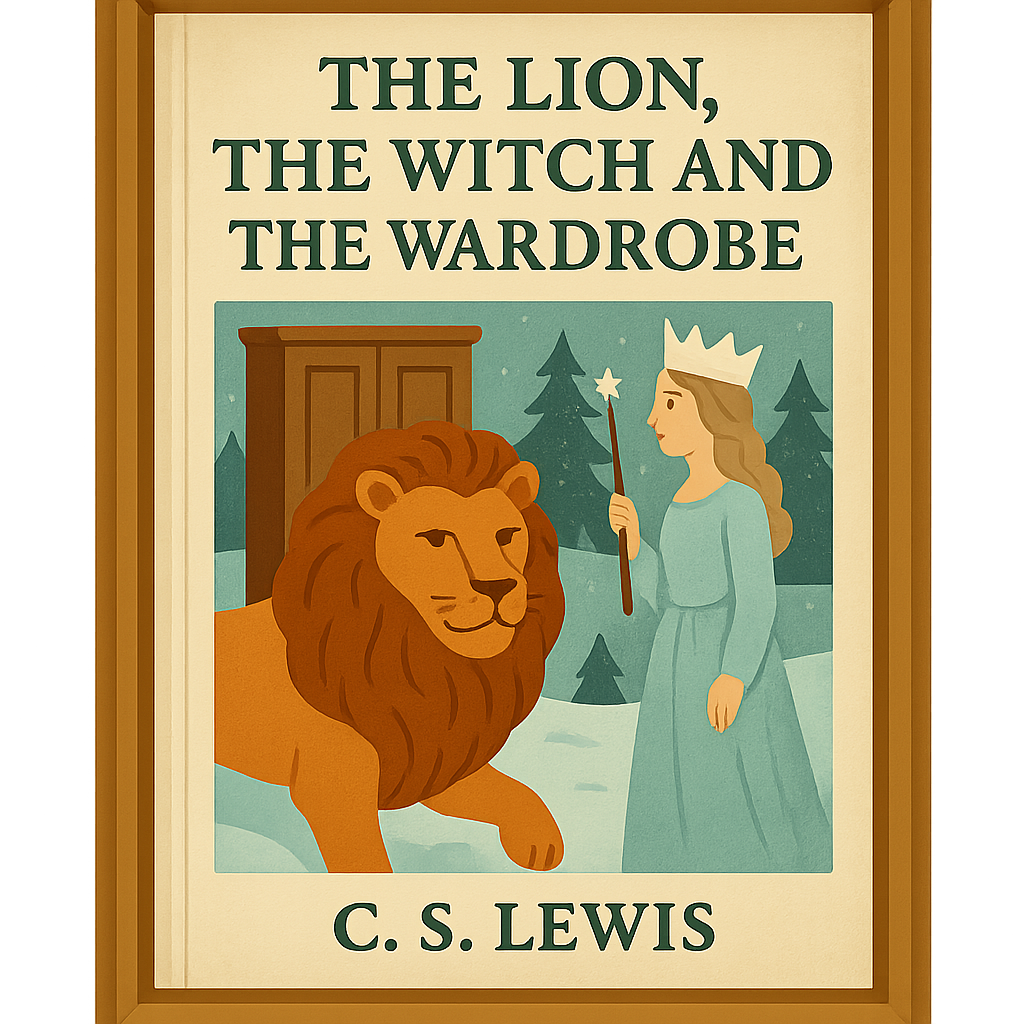
Before I had a cover or pages, I was a feeling, a whisper of another world carried on the wind. I was the sharp, clean scent of pine trees heavy with snow and the cold, musty smell of old fur coats hanging in the dark. I was the soft, satisfying crunch of boots on a forest floor blanketed in endless white. I was the solitary glow of a lamppost, a warm, golden circle of light in a silent, sleeping wood. Far in the distance, but clear as a bell, I was the deep, powerful roar of a great lion—a sound that could make your heart tremble with both fear and a strange, wonderful hope. For a long time, I was just a collection of these pictures and sounds, a story waiting for someone to find the key. I am a story. I am a doorway. I am The Lion, the Witch and the Wardrobe.
My story truly began in the mind of a brilliant man named Clive Staples Lewis, though all his friends just called him ‘Jack’. He was a professor at a very old and famous university called Oxford in England, a place filled with grand stone buildings and libraries overflowing with books. Jack’s mind was a bit like one of those libraries, filled with ancient myths, thrilling legends, and enchanting fairy tales. For decades, a few particular images lived inside his head. One was a faun—a creature half-man, half-goat—walking through a snowy wood, holding an umbrella and carrying parcels. Another was a magnificent, golden lion, the very picture of strength and goodness. And a third was a terrible, beautiful queen on a sledge, as cold and cruel as the ice she commanded. But these were just scattered pictures until a great and terrible war, the Second World War, began. During the war, starting around 1939, Jack saw children being evacuated from the city of London to keep them safe from the bombings. He even had some of them stay in his own country home. Seeing these children, brave but far from home, gave him the final, most important piece of my puzzle: four siblings, the Pevensies, who would be brave enough to stumble into a new world.
From that moment, I began to take shape, born from the steady scratch of a pen nib on crisp paper in Jack’s study. Every word he wrote was like a brick building my world. The land of Narnia, with its talking animals, its whispering trees, and its deep magic, grew with every sentence. Jack didn't keep me a secret. He shared my first chapters with his closest friends, a group of writers and thinkers who called themselves ‘The Inklings’. They would meet to read their new stories aloud, and among them was a man who wrote about hobbits and rings, J.R.R. Tolkien. It’s a funny secret, but Tolkien didn't actually like me very much at first. But Jack kept writing, and finally, on October 16th, 1950, I was finished. I was bound in a cover, my pages filled with ink, and sent out into the world. I still remember the feeling of being opened for the first time by a reader, the rustle of my pages as their eyes followed Lucy Pevensie stepping out of the dark wardrobe and into the snowy woods. They felt her wonder, then her brother Edmund’s foolish betrayal, and finally the thrill as all four siblings entered a land trapped under the spell of the White Witch, a place where it was ‘always winter but never Christmas’.
My journey didn't end there. I was only the beginning. Soon, I was joined by six other books, and together we became ‘The Chronicles of Narnia’. My adventures, and those of the friends who came after me, traveled far beyond England. I learned to speak in new tongues, over 47 different languages, so that children from Japan to Brazil could hear the story of Aslan’s sacrifice and the Pevensies’ courage. My world became so vivid to people that it couldn't be contained on my pages alone. I leaped onto theater stages, where actors brought my characters to life under bright lights. Later, I was transformed again, this time into enormous films seen by millions of people all over the globe. The noble lion Aslan, the treacherous White Witch Jadis, and even brave characters from my sibling books, like the valiant mouse Reepicheep, became as real to new generations as if they had met them themselves. My single doorway opened up a universe of stories.
After all these years, I have come to understand my true purpose. I am more than just paper and ink; I am a promise that imagination is one of the most powerful and real forms of magic in the world. I am a quiet lesson that true courage isn't about being fearless, but about choosing to do the right thing even when your knees are knocking together with fright. I am a whisper of hope, a reminder that even the longest, coldest, and most hopeless winter must eventually give way to the warmth and new life of spring. I am proof that there are other worlds hidden just beyond the edges of our own, waiting in the most ordinary of places. The greatest adventures, you see, always begin when you are brave enough to open a door and step through.
Reading Comprehension Questions
Click to see answer