

 English

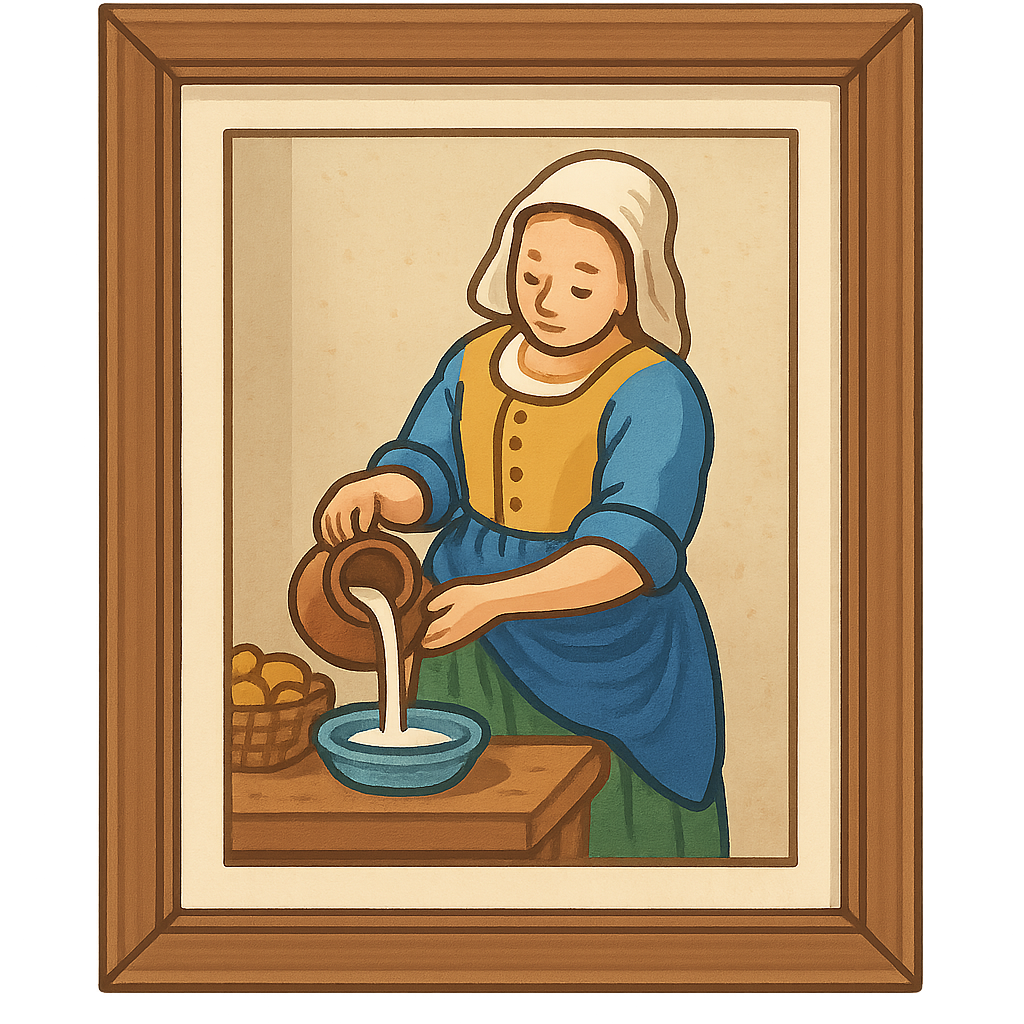
The Milkmaid
A stream of golden light pours through the window on my left, filling the quiet corner of a Dutch house with its soft, buttery glow. In this room, I am the stillness. I am the silent observer of a simple, focused moment. From my place on the wall, I can almost feel the cool air and see the dust motes dancing in the sunbeams. I watch a woman, her face a picture of calm concentration. She wears a sturdy yellow bodice and a deep blue apron, her arms strong and steady as she works. I hear the gentle, rhythmic sound that has echoed in this scene for centuries: the soft glug-glug of fresh milk flowing from a heavy earthenware jug into a wide bowl below. It’s a sound of nourishment and care.
On the table before her sits a wicker basket filled with bread. I know its texture intimately; I can see every crumbly ridge and crusty peak. The artist who made me wanted you to almost feel it, to imagine breaking a piece off. Beside the bread, other pots and pitchers gleam with a cool, smooth shine, their surfaces catching the light. Everything in the room speaks of quiet dignity and the importance of a task done well. There is no rush, only the profound peace of complete focus. For centuries, people have stood before me, lost in this simple moment. They lean in, trying to hear the pouring milk and feel the warmth of the light. I am a memory held in oil and light. I am the painting called The Milkmaid.
My story truly begins with the man who imagined me, a quiet and patient master from the city of Delft named Johannes Vermeer. Around the year 1658, he looked at the world around him and saw something extraordinary. While many other artists of his time were painting grand portraits of wealthy merchants or dramatic historical scenes, Vermeer wanted to capture a different kind of beauty: the profound grace found in an everyday task. He saw that true importance wasn't always loud or flashy; sometimes, it was as quiet as a stream of milk pouring into a bowl. He invited a kitchen maid into his studio, not to be just a model, but to be the subject of a masterpiece that would celebrate her work.
He was a master of light, and his process was meticulous. He didn't just copy what he saw; he painted the feeling of the light itself. He used a special technique, applying tiny dots of bright paint called 'pointillé' to create a shimmering, lifelike texture. If you look closely at the bread crusts or the rim of the pottery, you can see these pinpricks of color that make them seem to sparkle, as if they were truly catching the morning sun. It was his way of showing that even the simplest objects were worthy of wonder. Through his eyes, the milkmaid wasn't just a servant performing a chore. She was a symbol of dedication, strength, and the honest, essential work that makes a house a home. I became a celebration of the quiet heroism of daily life.
After Vermeer carefully placed his final brushstroke, my journey through time began. I was finished around 1660 and for many years, I lived in the private homes of art collectors in the Netherlands, watching silently as decades and then centuries passed by. I saw fashions change and cities grow, but the simple, peaceful moment I hold within my frame remained constant. Eventually, in 1908, I found my permanent home in a grand and beautiful museum, the Rijksmuseum in Amsterdam, where I live today. Here, people from every corner of the world come to stand before me, and they often fall silent, just as the room I depict is silent.
They don't come to see a dramatic battle or a famous historical event. They come to look through a quiet window into a moment from over 350 years ago that feels completely real and true. In the milkmaid's focused expression, visitors see a sense of peace and purpose that resonates with their own lives. I am more than just oil on canvas; I am a reminder that there is incredible beauty and importance in the small, ordinary moments that make up our days. I hope that when people look at me, they are inspired to find the light in their own kitchens, to see the wonder hidden in simple tasks, and to feel connected to all the people across time who have found dignity and grace in their daily work.
Activities
Take a Quiz
Test what you learned with a fun quiz!
Get creative with colors!
Print a coloring book page of this topic.















 Free for Educators