

 English

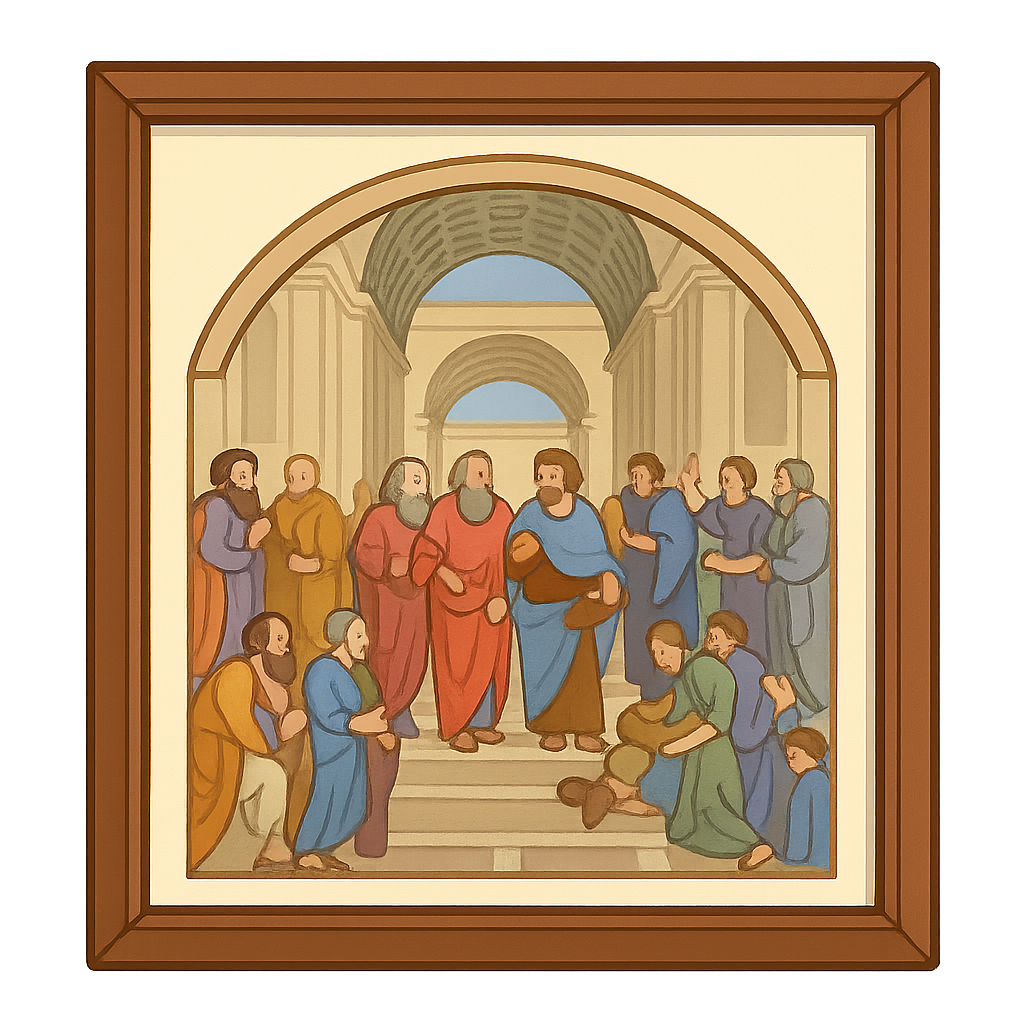
The School of Athens: A Conversation on a Wall
Imagine being a vast, sun-drenched wall in a magnificent room, the Stanza della Segnatura, deep within the heart of Vatican City. That is where I live. I am not just a flat surface; I am a gateway to another world. Grand, painted arches seem to stretch deep into my surface, creating an illusion of space that pulls you in. Beneath them, a bright blue sky dotted with perfect white clouds seems to go on forever. My surface is alive with a crowd of figures, more than fifty of them, all caught in a moment of intense thought, debate, or discovery. Their robes, in shades of sapphire, crimson, and gold, swirl with an almost silent energy. They are gathered on wide marble steps, some writing in books, others demonstrating theories with compasses, and many locked in passionate conversation. But who are they? They are the greatest minds of the ancient world, a silent, endless symposium frozen in time. I am a meeting place for ideas, a library of thinkers painted into existence. I am the fresco known as The School of Athens.
My story begins with a brilliant, ambitious young artist who was only 25 years old when he arrived in Rome in 1508. His name was Raphael. He was summoned by one of the most powerful and demanding patrons of the age, Pope Julius II, who wanted to transform his private apartments into a stunning showcase of art and intellect. My room was to be the Pope’s library, and Raphael was given the monumental task of decorating my walls. He chose to create me using a difficult but magical technique called fresco. This meant he couldn't just paint on a dry wall. Instead, fresh, wet plaster was applied to a section of my wall each day. Raphael then had to mix his pigments—ground-up minerals and earth—with water and paint directly onto that damp surface. He had to work with incredible speed and precision. Every brushstroke was a commitment, because as the plaster dried, the color bonded with it, becoming a permanent part of me. There was no room for error. Raphael’s vision was breathtakingly audacious: he wanted to create a masterpiece that celebrated human knowledge and philosophy, gathering all the famous thinkers from ancient Greece as if they were alive and learning from one another in this grand hall, right here in the heart of the Christian world. Between 1509 and 1511, he brought this vision to life, brushstroke by careful brushstroke.
Now, let me guide you through the crowd I hold. At the very center, framed perfectly by the final arch, walk two men who represent the heart of my conversation. The older man, with a long white beard and his finger pointing to the heavens, is Plato. He speaks of the world of ideas, of perfect forms and ideals that exist beyond our earthly realm. Walking beside him is his student, Aristotle, a younger man who gestures with his hand open towards the ground. He represents the importance of the physical world, of observation, evidence, and the things we can see and study right here on Earth. Their two gestures—one up, one down—symbolize the two great pillars of Western thought. But the gathering is much larger. Look to the lower left, and you’ll see the mathematician Pythagoras, bent over a book, furiously scribbling down his theories on the harmony of numbers. On the right, the geometer Euclid leans down, demonstrating a principle with a compass to a captivated group of students. And there, brooding alone on the steps, is the philosopher Heraclitus. For this figure, Raphael played a clever trick. He painted him to look exactly like his great artistic rival, the famously solitary and intense Michelangelo, who was painting the Sistine Chapel ceiling nearby at the very same time. It was a nod of respect from one genius to another. And if you look very carefully to the far right, just behind the man in the white robe, you will see a young man with dark hair and a black cap peeking out at you. That is my creator, Raphael, who painted himself into the crowd, a quiet signature on his masterpiece.
For over five hundred years, I have remained here, watching as generations of scholars, artists, and visitors from every corner of the globe have gazed up at me in awe. My purpose was to send a powerful message during the Renaissance: that philosophy, reason, and scientific inquiry were not enemies of faith, but partners in the human quest for truth. I was created to show that all knowledge could exist in harmony. My use of linear perspective—the technique that makes my flat wall look so deep and three-dimensional—was revolutionary, and it inspired countless artists who came after Raphael. But my truest legacy is the conversation I represent. It is a dialogue that never truly ends. Every time you ask a question, challenge an idea, or seek to understand the world a little better, you are joining this school. You become a part of the wonderful, endless human journey for understanding that I celebrate forever on my wall.
Activities
Take a Quiz
Test what you learned with a fun quiz!
Get creative with colors!
Print a coloring book page of this topic.













 Free for Educators