

 English

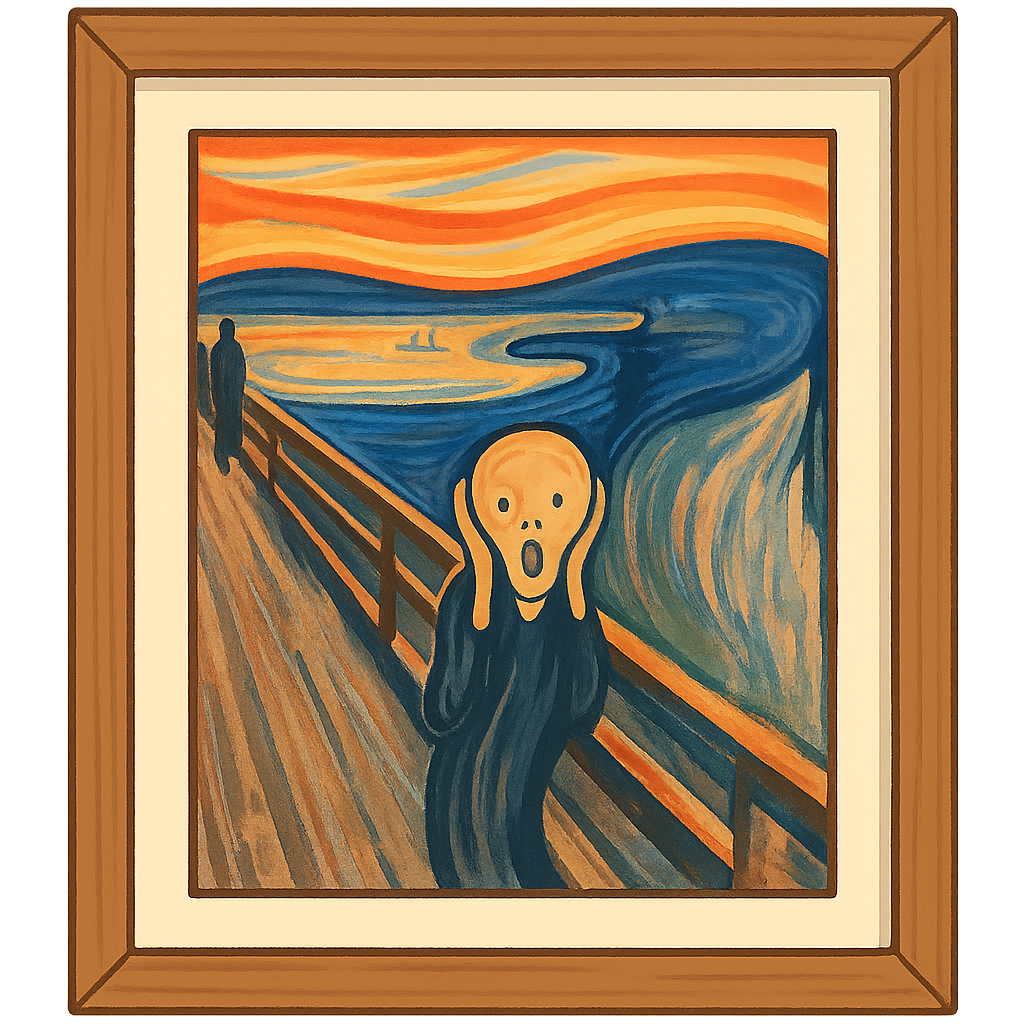
The Scream
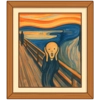
Look at me. Before you see a painting, see the sky. It is a swirl of blood-orange and furious yellow, a sky on fire. It is not peaceful. It feels alive, electric, buzzing with an energy that makes the air hum. I am not a calm, pretty sunset fading gently into night; I am a vibration you feel in your bones. Below this churning sky, a deep, dark blue fjord cuts through the landscape like a scar, and a long, straight bridge stretches across it. On that bridge, you can just make out two figures in the distance, walking away, completely unaware of the spectacle unfolding around them. They are part of the scenery, but they are not the story. The story is the figure in the front, the one who has stopped, who cannot walk away.
This figure is more of a feeling than a person. See the long, pale, skull-like face, the hands pressed tightly against the ears as if to block out an unbearable noise. Look at the wide, dark circles of the eyes and the gaping, open mouth. This is the shape of a scream. But it is not a sound you can hear with your ears. It is a silent scream, a wave of pure feeling that echoes from the fiery sky, through the dark water, and right through the very soul of this person. It is a feeling so immense, so powerful, that it has to come out, to be seen, to be understood. I am the picture of that feeling. I am The Scream.
My maker was a thoughtful, sensitive artist from Norway named Edvard Munch. He saw the world not just in shapes and objects, but in feelings and colors. He believed that art should be more than just a pretty picture; it should reveal the inner life of human beings. I was born from one of his own powerful memories. It happened on a walk he took in 1892, as the sun was setting over a fjord in Oslo, which was then called Kristiania. He was with two friends, the same two figures you see walking away on my bridge. He later wrote about this moment in his diary, describing how the sun went down and suddenly the sky turned ‘blood red.’ He said he felt a ‘great, infinite scream passing through nature.’
This wasn't a spooky ghost story. For Edvard, it was a moment of intense connection with the universe, a feeling of anxiety and awe all mixed together. He felt the raw energy of the world course through him, and it was overwhelming. He knew he couldn’t just paint the pretty view of the fjord. He had to paint the feeling itself. So, in 1893, he brought me to life. He chose to work with tempera and crayon on a simple piece of cardboard, not a fancy canvas. This choice was deliberate. The materials gave my colors a raw, urgent quality, as if the emotion was too strong to be contained by polished oil paints. Notice how the wavy lines of the sky flow into the landscape and continue right into the figure. Edvard did this to show how the feeling connected everything—the person and nature were experiencing this great scream together. He was so captivated by this memory that he didn't stop with me. He created several versions, including another painting, two pastel drawings, and even a lithograph stone so that my image could be printed and shared with many people. He needed the world to see and feel what he had felt.
When people first saw me in the late 1800s, they were shocked. They were accustomed to art that was realistic, showing heroes from history, or beautiful, serene landscapes. I was neither of those things. I was raw, emotional, and unsettling. I was an ‘Expressionist’ painting, which was a new idea at the time. My job was not to show the outer world of facts, but to express an inner world of emotion. Some critics were harsh, calling me disturbing or even unfinished. But others understood. They recognized that feeling of modern anxiety, that sense of being overwhelmed by the world, that can leave you speechless. Edvard’s purpose was to paint these deep, human emotions to help people feel less alone in their own struggles.
Over the decades, I became more than just a painting. I became a universal symbol. My image has appeared in movies, cartoons, advertisements, and even as an emoji on your phone. I am a visual shorthand for shock, fear, stress, and awe—a feeling too big for words. But I hope you see more than just fear in me. I am a powerful reminder that art can give a voice to our deepest, most complicated feelings. I show that it is not only okay, but human, to feel overwhelmed sometimes. I am a bridge between a person’s inner world and the vast universe outside, connecting people across more than a century through a single, shared, silent scream of wonder and humanity.
Activities
Take a Quiz
Test what you learned with a fun quiz!
Get creative with colors!
Print a coloring book page of this topic.








 Free for Educators