

 English

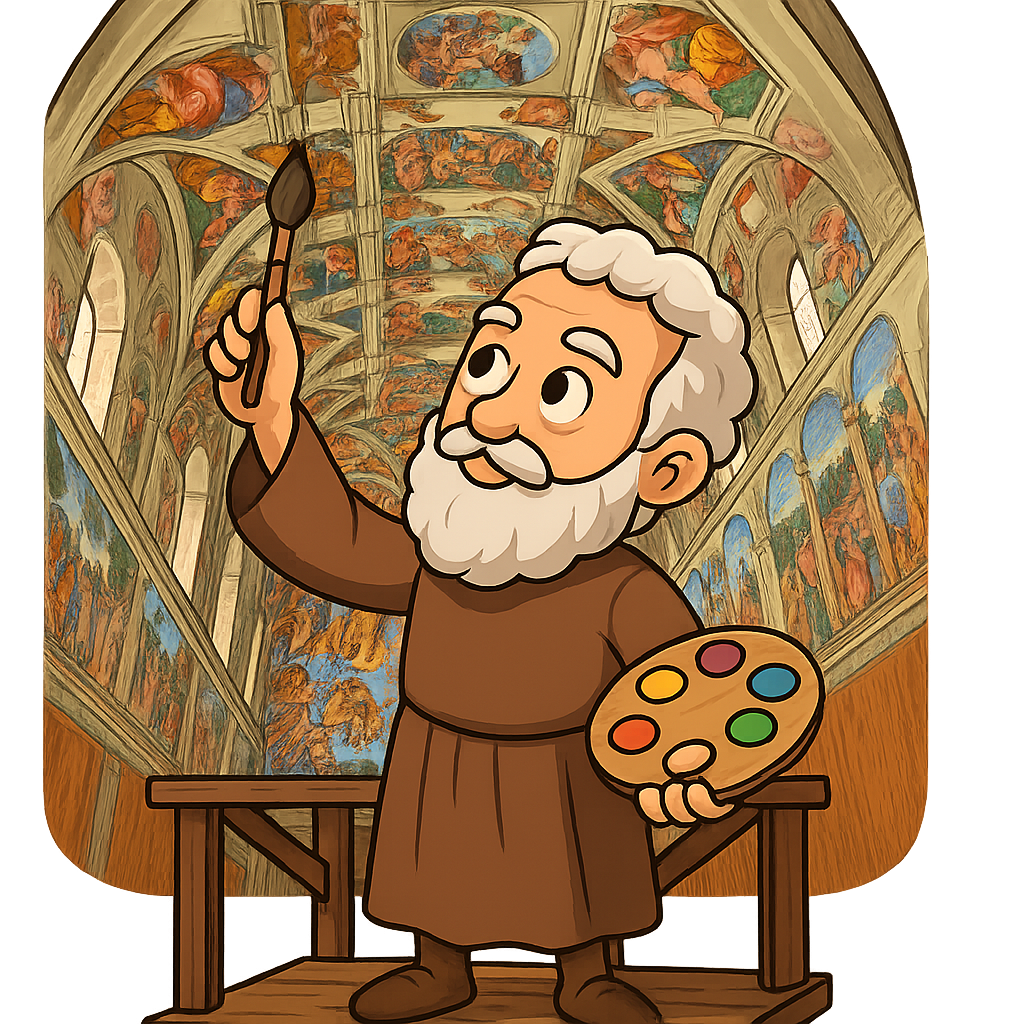
A Painted Sky: The Story of the Sistine Chapel Ceiling
Begin high above a quiet, sacred space. I feel the gentle echo of hushed whispers and shuffling feet from far below. I am a vast, curved canvas, a sky filled not with stars, but with powerful bodies, swirling robes, and colors that pulse with life. From my great height, I watch faces turn upward, their eyes wide with wonder as they try to take in all that I am. I hold hundreds of figures within my painted surface, each one part of an epic tale. There are scenes of light separating from darkness, of land and water being born, and of heroes and prophets whose stories have been told for thousands of years. People crane their necks to see me, to understand the stories I tell without a single word. They point to the central moment, a spark of life about to pass between two outstretched fingers. For over five hundred years, I have been this silent storyteller, a universe of art suspended in the air. I am the ceiling of the Sistine Chapel.
My story begins with a man who loved stone. His name was Michelangelo, and he was a sculptor, not a painter. He saw angels in blocks of marble and could make them breathe with his hammer and chisel. But in 1508, a powerful man named Pope Julius II gave him a different kind of challenge. He didn't want a sculpture; he wanted me, the chapel's plain, vaulted ceiling, to be covered in glory. Michelangelo protested, saying, 'I am not a painter!' He felt it was a task better suited for his rivals, and perhaps even a trap designed to make him fail. But the Pope insisted, his will as unyielding as the marble Michelangelo carved. Reluctantly, my transformation began. A giant wooden scaffold was built, a complex maze of platforms that brought Michelangelo close to my surface, allowing him to work standing up, not lying on his back as legends sometimes say, but with his head perpetually tilted back. For four long years, from 1508 to 1512, he endured this grueling posture. He had to learn the difficult art of fresco, a technique that requires painting quickly onto wet plaster before it dries. The wet plaster, called intonaco, could only be applied in small patches each day, an area known as a 'giornata' or 'a day's work'. Paint would drip into his eyes, and his neck and back ached constantly. Day after day, he mixed pigments—earthy reds, deep blues, and brilliant golds—and brushed them onto my skin, bringing to life the nine central stories from the Book of Genesis. He painted God separating light from darkness, creating the sun and moon, and breathing life into the first man, Adam. He filled my arches and corners with powerful prophets and graceful sibyls, wise figures who seemed to watch over the scenes unfolding, their bodies rendered with the strength and dimension of his sculptures. It was exhausting, lonely work, but Michelangelo poured all of his genius and determination into me. He wasn't just painting pictures; he was sculpting with color, giving each figure weight, muscle, and profound emotion.
When the scaffolding finally came down in the autumn of 1512, the world saw me for the first time. A collective gasp went through the chapel. No one had ever seen anything like it. The stories, the vibrant colors, the sheer power of the figures seemed to open a window directly to the heavens. I became a landmark of an amazing period of creativity called the High Renaissance, a time when art and science flourished in Italy. I showed what was possible when human imagination was pushed to its limits. Over the centuries, my fame grew. My most famous scene, 'The Creation of Adam,' became one of the most recognized images in the world—that electric gap between God's and Adam's fingers is a symbol of creation, potential, and the divine spark of life itself. Today, millions of people from every corner of the globe still walk into the chapel and do the same thing: they stop, they look up, and they fall silent. They bring cameras and guidebooks, but what they really seek is a moment of connection to a masterpiece that has endured for half a millennium. I am more than just old paint on a ceiling. I am a bridge that connects you to the passion of a great artist and the wonder of a timeless story. I am a reminder that one person’s vision, with enough courage and hard work, can create a sky of stories that inspires the world forever. I invite you to look up, to wonder, and to see what stories you might tell.
Activities
Take a Quiz
Test what you learned with a fun quiz!
Get creative with colors!
Print a coloring book page of this topic.














 Free for Educators