English
 Continue with Google
 Continue with Apple

The Flag That Inspired a Song
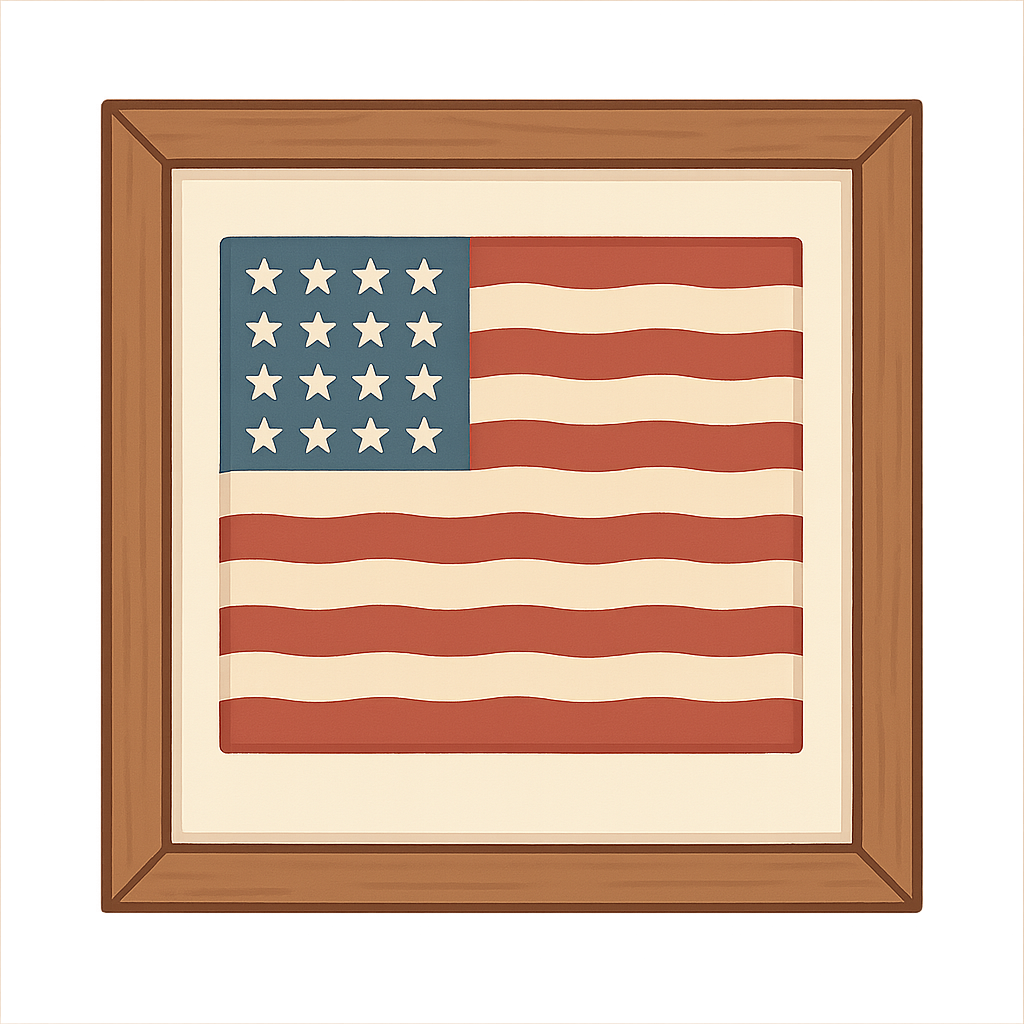
Can you imagine being so big that it takes a whole team of people just to carry you? I can. Before I ever flew in the breeze, I lay in the quiet dark, a giant quilt of colors waiting for my moment. I could feel the strong, sturdy texture of my wool bunting and the soft cotton of my fifteen bright white stars. My stripes, wide and bold, were the color of courage and snowy clouds, and my corner was a patch of the deep blue night sky. I am a flag, but not just any flag. I was born as the Great Garrison Flag, but history would come to know me by another name: the Star-Spangled Banner.
My story begins with a determined woman and a commander’s big idea. In the summer of 1813, a talented flag maker in Baltimore named Mary Pickersgill was given a very important job. A brave commander, Major George Armistead, was in charge of Fort McHenry, which protected the city’s harbor. He wanted a flag for the fort that was so enormous the British enemy would have no trouble seeing it from their ships miles away. It was his way of saying, “We are here, and we are not afraid.” But how do you make something so gigantic? Mary’s house wasn’t big enough. So, she and her team—her daughter, her two nieces, and a young apprentice named Grace Wisher—laid me out on the floor of a nearby brewery. For weeks, they worked, cutting my huge thirty-foot by forty-two-foot shape, stitching my giant two-foot-wide stripes, and carefully placing my fifteen stars. I was born from their hopeful hands, each stitch a prayer for the country's future.
My most important moment, the night I will never forget, arrived on September 13th, 1814. I was raised high on a flagpole over Fort McHenry just as British warships began to attack the city. The air filled with the deafening roar of cannons and the whistle of bombs. All through the rainy night, the sky was lit up by the fiery trails of rockets, what some called “the rockets’ red glare.” From my high perch, I could see everything. I also saw a young American lawyer named Francis Scott Key. He was on a ship in the harbor, watching the battle. He couldn't tell who was winning, and he paced back and forth, worrying if the fort, and our country, would survive the night. He strained his eyes in the dark, looking for a sign. When the sun finally began to rise on the morning of September 14th, the smoke cleared, and there I was. I was torn and battered, but I was still waving proudly in the dawn’s early light. Seeing me, Francis Scott Key was filled with so much relief and pride that he began to write a poem about what he saw.
That poem, which Francis Scott Key wrote on the back of a letter he had in his pocket, became much more than just words on a page. It was soon set to the tune of a popular song, and people all across the country began to sing it. They called it 'The Star-Spangled Banner.' Over a century later, in 1931, it became the official national anthem of the United States. After the war, I was carefully kept by Major Armistead's family for many years. As I got older, I became very fragile. Today, I have a special home at the Smithsonian Institution, where scientists and historians protect me. Millions of people come to visit me, looking at my faded colors and the holes left by the battle. I am more than just an old flag; I am a survivor, a witness to history, and a promise that even after the darkest night, there is always hope in the morning.
Reading Comprehension Questions
Click to see answer