

 English

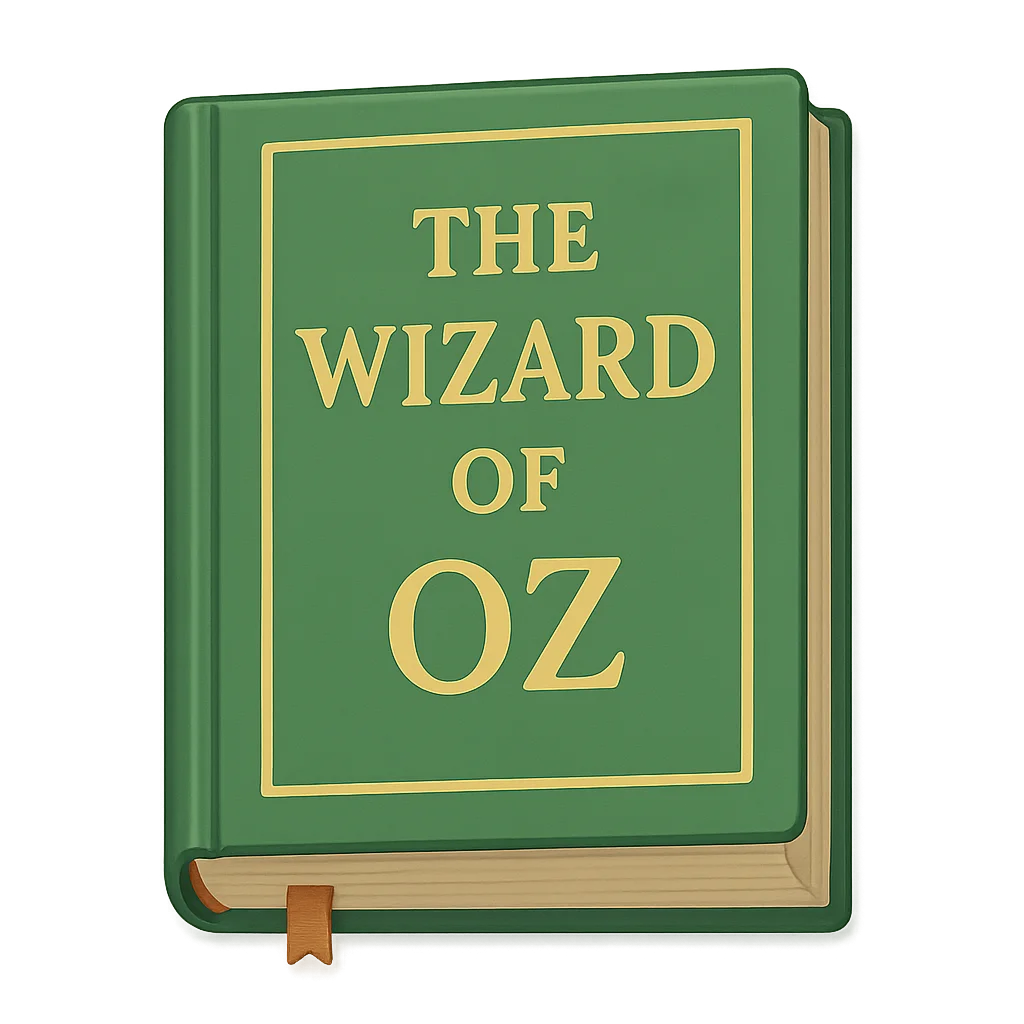
The Wonderful Wizard of Oz: My Story
Before you even know my name, you can feel me. I am the whisper of a Kansas tornado, the rustle of pages promising a journey far from home. I hold within me a world bursting with color—a road of yellow bricks, a city of shimmering emeralds, and fields of sleepy poppies. I am the story of a girl who feels lost, a scarecrow who thinks he isn't smart, a tin man who believes he has no heart, and a lion who is sure he has no courage. I am a promise of adventure, a quest for things thought to be missing, all bound between two covers. My pages smell of old paper and fresh ink, a scent that signals the beginning of a grand escape. When you hold me, you can feel the weight of the dreams packed inside. You are not just holding paper; you are holding a key to another world, a place just over the rainbow. I am a book, a world held in your hands. My full name is The Wonderful Wizard of Oz.
I came to life from the minds of two extraordinary men. One was a storyteller named L. Frank Baum, a man with a twinkle in his eye and a desire to create a new kind of fairy tale for American children. He was tired of the dark, frightening stories that came from Europe. He wanted to invent a land of wonder and delight, a place that was magical but also felt as familiar and hopeful as the American heartland itself. He imagined a world that was magical but also felt like it could be just over the rainbow. His partner in this dream was an artist, W. W. Denslow, whose bold, vibrant illustrations would define my look. He dipped his brushes in the brightest colors to show you exactly what Munchkinland looked like and how the Emerald City gleamed with an otherworldly light. They worked together in Chicago, Frank's words and William's pictures dancing on the page, each making the other stronger and more vivid. They envisioned me not just as a story, but as a beautiful object, a treasure to be held and cherished. On May 17th, 1900, after months of meticulous work, I was finally born in a printing press. My pages were filled with Denslow’s groundbreaking illustrations and colorful text, a true feast for the eyes in an era of plainer books. From the very beginning, children loved me. They followed Dorothy and Toto down my Yellow Brick Road, and they weren't scared; they were excited. I was an immediate success, and soon, Frank Baum wrote more stories about the friends he and I had made, creating thirteen more books to keep the magic of Oz alive for a new generation of dreamers.
A story as big as mine couldn't stay inside a book forever. My spirit was too adventurous to be confined to paper and ink. Soon, I was brought to life on stage in theaters as a musical extravaganza, with real actors singing and dancing as the Scarecrow and Tin Woodman. It was thrilling to see my characters take a breath and step into the real world. But my biggest journey was yet to come. In 1939, I leaped onto the movie screen in a flash of breathtaking Technicolor. This version of me was a little different—my Dorothy's magical silver shoes were changed to sparkling ruby slippers to show off the new color technology—but my heart was the same. The film was a technological marvel, beginning in black-and-white Kansas and bursting into vibrant color the moment Dorothy stepped into Oz. This visual spectacle allowed me to travel the whole world, reaching people who had never even held me as a book. My ideas became a part of everyday life. People would say 'We're not in Kansas anymore' when they found themselves in a strange new place, or hum 'Over the Rainbow' when they were dreaming of something better. The Yellow Brick Road became a powerful symbol for life's journey, with all its twists and turns, and the Emerald City represented a goal worth striving for, a place where dreams could come true. I had become more than a story; I was a shared dream, a piece of cultural history that belonged to everyone.
For over a century, people have traveled with Dorothy on her quest. And what have they discovered? They have learned the same profound truth that she did: the wizard wasn't the one with the real magic. The magic was in the journey itself and, more importantly, inside the travelers all along. The Scarecrow already had brilliant ideas, the Tin Woodman was full of love and empathy, and the Lion was braver than he ever knew. They just needed a journey with friends to help them see it for themselves. I am here to remind you that the brain, the heart, and the courage you search for are already inside you. My story has inspired new tales, like the musical 'Wicked,' which imagines the world of Oz from a different perspective, and countless other works of art. I am a doorway to a world of imagination, a place that proves that friendship and self-belief are the most powerful magic of all. So open my cover. The wind is beginning to blow, the road is waiting, and there is always, always no place like home.
Activities
Take a Quiz
Test what you learned with a fun quiz!
Get creative with colors!
Print a coloring book page of this topic.







 Free for Educators