English
 Continue with Google
 Continue with Apple

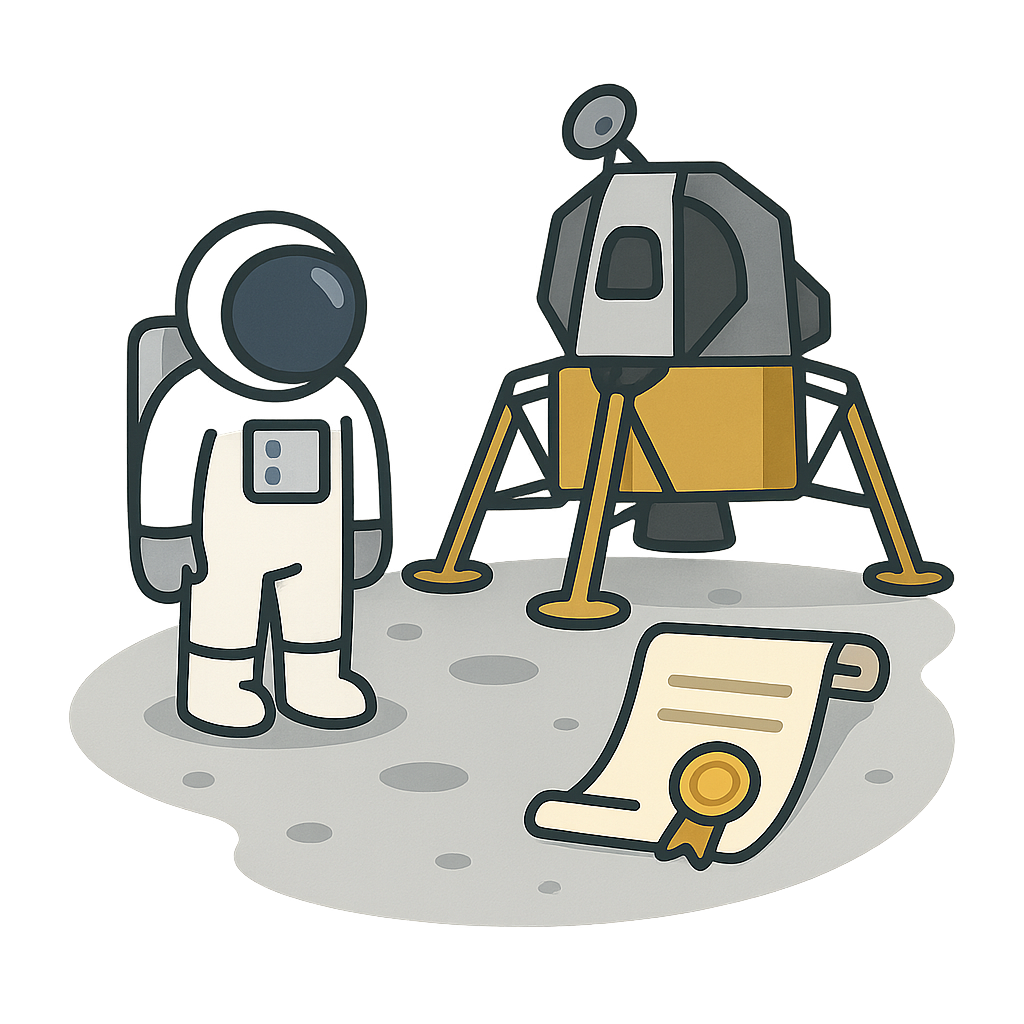
A Giant Leap: My Journey to the Moon
Hello. My name is Neil Armstrong, and I want to tell you a story about a dream that took me farther than anyone had ever gone before. It all started when I was just a boy growing up in Ohio. I was fascinated by anything that could fly. I spent hours building and flying model airplanes, dreaming of the day I could soar through the clouds myself. That passion never left me. In fact, I earned my pilot's license on my 16th birthday, even before I had a license to drive a car. At night, I would often look up at the sky, and my eyes would always find the Moon. It hung there, a silent, silvery world, so close yet impossibly far away. I’d wonder what it was like up there, what secrets it held. It felt like a fantasy, but that little spark of curiosity grew into a powerful dream. That dream guided me as I became a naval aviator, then a test pilot for experimental aircraft, and eventually, in 1962, I was selected to be an astronaut for NASA. My whole life had been about pushing the limits of flight, and now I was part of a team with the most audacious goal in human history: to land a man on the Moon.
The morning of July 16th, 1969, was buzzing with an energy I’ll never forget. My crewmates, Buzz Aldrin and Michael Collins, and I suited up, our bulky white spacesuits feeling like armor for the incredible journey ahead. Walking out to the launchpad, I looked up at the Saturn V rocket. It was a skyscraper of a machine, over 36 stories tall, humming with power and filled with millions of pounds of fuel. We rode the elevator to the top and strapped ourselves into our small capsule, the Apollo Command Module. As the final countdown began, my heart thumped in my chest—a mix of excitement and nerves. 'Three. Two. One. Liftoff.' The entire world seemed to explode beneath us. We were thrown back into our seats as five massive engines ignited, creating a controlled earthquake that shook every bone in my body. The roar was deafening, a testament to the immense power needed to break free from Earth's gravity. For eight long minutes, we were on the ride of our lives. Then, just as suddenly as it began, the engines cut off. The shaking stopped. The roar vanished, replaced by a profound, perfect silence. We were weightless, floating. I looked out the window and saw it: our home. The Earth was a stunning, swirling blue-and-white marble hanging in the black velvet of space. It was the most beautiful sight I had ever seen, and we were leaving it behind.
Four days later, on July 20th, 1969, came the most challenging part of our mission. Buzz and I had moved into our smaller spacecraft, the Lunar Module, which we had nicknamed the 'Eagle.' We separated from Michael, who would orbit the Moon alone in the main spacecraft, and began our descent. Everything was going according to plan until, suddenly, alarms began to blare inside our cockpit. The onboard computer, our guide to the surface, was overloaded. Warning lights flashed. My pulse quickened, but my years of training as a test pilot took over. I had to stay calm. As we got closer, I looked out the small triangular window to get my first good look at our landing site. My heart sank. The area the computer was taking us to wasn't a smooth plain; it was a crater filled with giant boulders and jagged rocks. Landing there would destroy the Eagle and strand us forever. We were running out of time and, more importantly, fuel. We had less than a minute's worth left. I knew I had to act. I took manual control of the spacecraft, my hands steady on the joystick. It felt like flying a strange, new kind of helicopter. I scanned the surface, desperately searching for a safe haven. 'Thirty seconds of fuel remaining,' Mission Control warned in my ear. Then, I saw it—a clear, smooth patch just ahead. I gently guided the Eagle forward and slowly lowered it down. With a soft bump, we were on the surface. The engines fell silent. For a moment, there was only the sound of our breathing. I keyed the microphone and said the words the whole world was waiting to hear: 'Houston, Tranquility Base here. The Eagle has landed.'
After hours of checks, it was finally time to step outside. The cabin depressurized with a hiss, and I opened the hatch to a world of absolute stillness. The lunar landscape was stark and beautiful, painted in shades of gray and brilliant white under a pitch-black sky where the stars never twinkled. I carefully backed down the ladder. My boots touched the footpad, and then I took the final step. My left boot pressed into the fine, powdery dust of the Moon's surface, leaving the first human footprint on another world. It was a surreal moment. I thought of the billions of people watching back on Earth, and the words came to me: 'That's one small step for a man, one giant leap for mankind.' I looked around at the 'magnificent desolation,' as I called it. It was a place of stark, ancient beauty. Buzz soon joined me, and we felt like children exploring a new playground. Moving in the Moon's low gravity was incredible fun; we could take huge, bounding leaps with very little effort. Together, we proudly planted the American flag in the lunar soil, a symbol of our nation's commitment and the hard work of over 400,000 people who made this moment possible. We spent the next two hours collecting rock samples and setting up science experiments, every second a memory I would cherish forever.
The journey home felt like a dream. We left the Moon behind, rejoined Michael in orbit, and set our course for Earth. On July 24th, 1969, our tiny capsule blazed through the atmosphere and splashed down safely in the Pacific Ocean, our mission complete. We had done it. We had walked on the Moon. Looking back, I realize the mission was about more than just exploration or science. For a brief, shining moment, it united the entire world. People everywhere stopped what they were doing to watch and cheer, sharing in a single, hopeful human achievement. My journey began as a boy in Ohio who looked up at the Moon and dared to dream. That dream, combined with the hard work and courage of a massive team, became a reality. So, whenever you look up at the night sky and see that shining light, remember our story. Remember that with curiosity, teamwork, and the courage to dream big, nothing is truly impossible.
Reading Comprehension Questions
Click to see answer