
 English
 For Schools
 For Homeschool

A Dream for the World
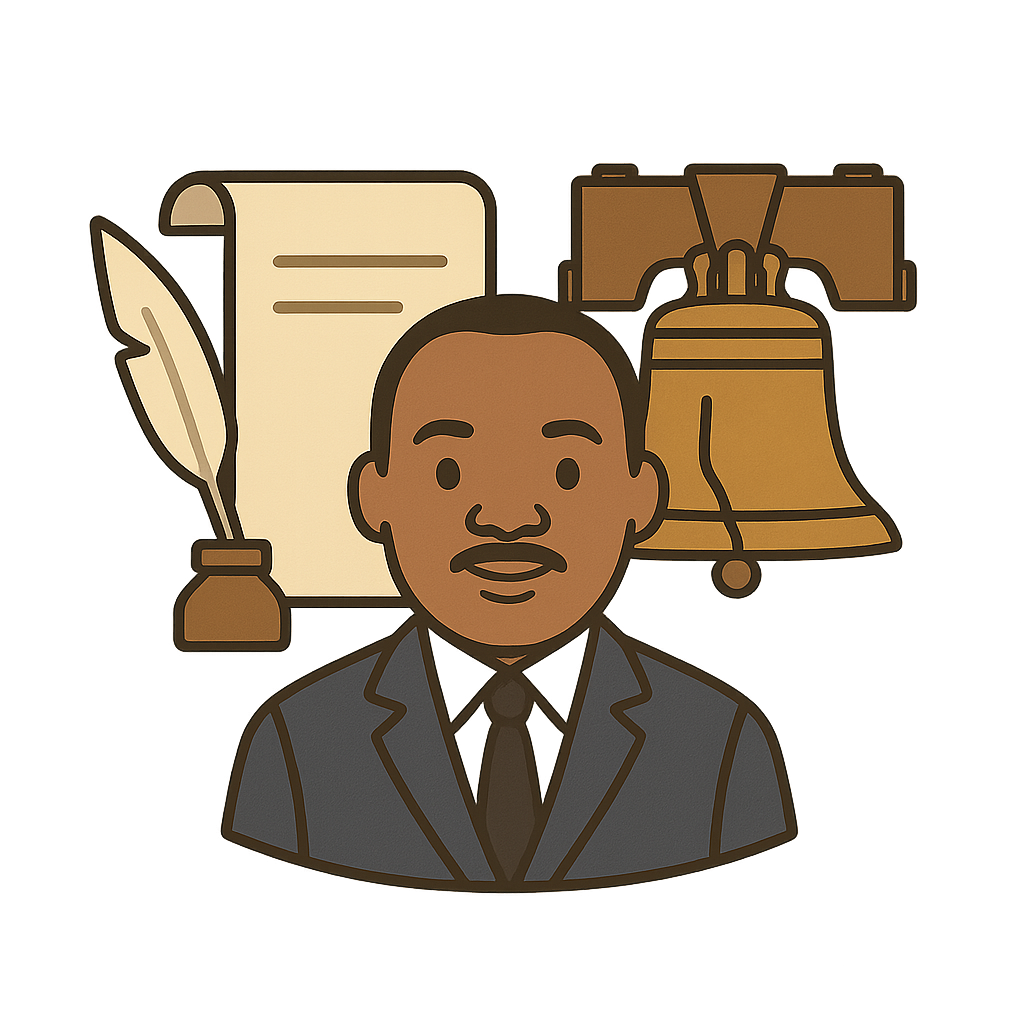
My name is Martin Luther King Jr., and my story begins not on a grand stage, but on the quiet streets of Atlanta, Georgia, where I was born on January 15th, 1929. Growing up, the world felt divided by invisible lines. I remember seeing signs that read 'Whites Only' on water fountains, in restaurants, and at the front of buses. It was a confusing and hurtful reality. I would ask my mother why we couldn't go to certain parks or sit in certain seats, and she would explain the injustice of segregation with a heavy heart. She always told me, 'You are as good as anyone.' Those words planted a seed in my mind. My father, a preacher, taught me the power of words to inspire and to heal. From him, I learned that the strongest weapon against hate wasn't a fist, but a well-spoken truth. I spent my youth reading books about history and philosophy, especially the teachings of Mahatma Gandhi, who changed a whole country without ever raising a hand in violence. These early experiences didn't fill me with hatred. Instead, they sparked a deep and powerful dream inside me: a dream of a world where people would not be judged by the color of their skin, but by the content of their character. I knew that fighting for this dream would be difficult, but I believed that love and peaceful protest could overcome any obstacle.
That belief was put to the test many times. One of the most important moments began on December 1st, 1955, in Montgomery, Alabama. A brave woman named Rosa Parks refused to give up her seat on a bus to a white passenger. Her quiet act of defiance was like a lightning bolt. We knew we had to support her and challenge the unfair bus laws. We decided to organize a boycott, asking all African Americans in the city to stop riding the buses. I was chosen to lead the effort, and I admit, I felt the weight of that responsibility. For 381 days, my community walked. They walked to work, to school, to the store, in the rain and in the hot sun. It was an incredible display of unity and determination. We held meetings in churches, singing freedom songs and encouraging one another to stay strong. It wasn't easy, but we persevered. Finally, the Supreme Court declared that segregation on public buses was illegal. We had won, not with anger, but with our tired feet and our unwavering spirits. This victory led to an even bigger moment. On August 28th, 1963, more than 250,000 people—black and white, young and old—gathered in Washington, D.C. for the March on Washington for Jobs and Freedom. Standing on the steps of the Lincoln Memorial, looking out at that sea of hopeful faces, I shared my dream with the world. I spoke of a day when my four little children could live in a nation where they would be judged for who they were, not what they looked like. The energy of that day was unforgettable. It felt like the conscience of America was finally awakening.
Our peaceful marches, sit-ins, and speeches began to make a real difference. The world was watching, and the leaders in our government could no longer ignore our calls for justice. Our persistence led to monumental changes. In 1964, President Lyndon B. Johnson signed the Civil Rights Act into law. This was a huge victory. It officially made it illegal to have those 'whites only' signs and to discriminate against people in public places because of their race. A year later, in 1965, the Voting Rights Act was passed, protecting the right of all citizens to vote, a right that had been denied to so many for so long. These laws were not just words on paper. they were the result of immense sacrifice, courage, and the unshakable belief in nonviolence. We faced many challenges and setbacks along the way, but we never gave up. My own journey was cut short on a sad day, April 4th, 1968, when my life was taken. But I had always known that this movement was never about one person. It was about an idea, a dream of freedom and equality for all. I believed that even if I couldn't be there to see it, the dream was strong enough to live on in the hearts of people who continued the work.
And the dream did live on. After I was gone, my dear wife, Coretta Scott King, worked tirelessly to make sure the work we started would continue. She knew that my legacy was about more than just speeches. it was about action. She and many others began a long campaign to have my birthday recognized as a national holiday, a day for the whole country to reflect on the principles of justice and peace. It took fifteen years of hard work. People signed petitions, wrote letters, and even created music to support the cause. The wonderful musician Stevie Wonder wrote a song called 'Happy Birthday' that became an anthem for the movement. Finally, on November 2nd, 1983, President Ronald Reagan signed the bill making the third Monday in January a federal holiday in my honor. But this day was never meant to be just a day off from school or work. My wife always said it should be 'a day on, not a day off.' It is a day for you to serve your community, to learn about others, and to think about your own dream for a better world. My story is proof that one person's dream, when shared with others, can change the world. Now, it's your turn to dream.
Activities
Get creative with colors!
Print a coloring book page of this topic.